

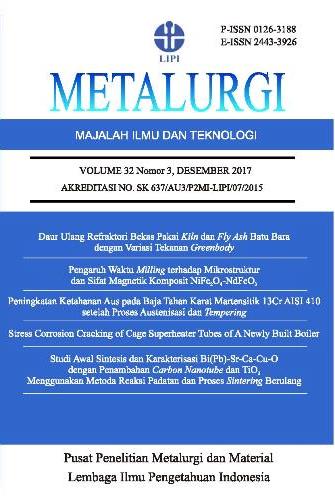
Daur Ulang Refraktori Bekas Kiln dan Fly Ash Batubara dengan Variasi Tekanan Greenbody [Recycling of Used Refractory of Kiln and Coal Fly Ash by Various of Greenbody Presure]
Article Sidebar
Main Article Content
Abstract
Refractory is one type of ceramic material which is thermostable (high temperature resistant) and has the ability to maintain a good physical and chemical condition at high temperature. Manufacture of refractory in this study using used kiln refractory from cement industry and 15% coal fly ash as additional. This research analyzed the effect of green body pressure produced by physical properties of refractory which made from mixture of used refractory and coal fly ash. Used refractory crushed into large aggregate size -40 +80 mesh and small aggregate size -80 mesh, while fly ash -100 mesh. Then, the two of material mixed. Raw material pressed by press hydrauliuc, with a cube-shaped mold in 5 x 5 x 5 cm size. The pressure of green body varied in 8, 9, 10, 12, and 13 tons. The product tested by archimedes methode to getting apparent porosity and bulk density, and guarded hot plate methode standard use ASTM (C 177-04) to getting the cold crushing strengh and thermal conductivity. Higher pressure molding green body product was obtained with higher compressive strength and bulk density, with lower value of the apparent thermal conductivity and porosity. The highest value for the compressive strength and bulk density was 4.48 MPa; 1.119 g / cm3; the lowest value of thermal conductivity and apparent porosity is 11.60 W / m.K; 22.034%. Those values obtained from green pressure body 13 tons.
Article Details

This work is licensed under a Creative Commons Attribution-ShareAlike 4.0 International License.
References
M. Schutte, “Refractory recycling earning your environmental brownie points,” The Southern African Institute of Mining and Metallurgy Refractories Conference, 2010, pp. 75-86.
M. B. Berger, “The importance and testing of density/porosity/permeability/pore size for refractories,” The Southern African Institute of Mining and Metallurgy Refractories Conference, 2010, pp. 101- 116.
L. Sylvia, ” Types of refractory materials and their applications,” linked in, 26, october, 2015 [online]. Available:https://www.linkedin.com/pulse/ types-refractory-materials-applications-lesylvia [Accessed: 10, Agust, 2017].
S. Rupnarayan, “Fly ash: characteristics, problems and possible utilization,” Advances in Applied Science Research, vol. 8, no. 3, pp. 32-50, 2017.
Harbinson & Walker, “Brick products,” Handbook of Refractory Practice, Moon Township: Harbinson-Walker Refractory Company, pp. 1-2, 2005.
ASTM C177-04,” Standard test method for steady-state heat flux measurements and thermal transmission properties by means of the guarded-hot-plate,” Annu. B. ASTM Stand., 552, pp.1-23, 2015.
E. Brochen, ”Cold crushing strength,” Review and Improvement of Testing Standard for Refractory Product, 1, october, 2013. [Online] Available:https://www.restar.eu/home/testi ng-standards-for-refractories/cold crushing-strength. [Accessed: 10, Agust, 2017].
N. Toniolo, K. Hurle, G. Taveri, dan A. R. Boccaccini, ”Fly-ash-based geopolymers: How the addition of recycled glass or red mud waste influences the structural and mechanical properties,” Journal of Ceramic Science and Technology, vol. 8, no. 3, pp. 411-419, 2017.DOI: 10.4416/JCST2017-00053.
P. K. Sarker, R. Haque, dan K. V.Ramgolam,” Fracture behaviour of heat cured fly ash based geopolymer concrete,” Mater. Des.,vol. 44, pp. 580-586, 2013. DOI : 10.1016/j.matdes.2012.08.005
P. C. Aitcin, “High-performance concrete demystified,” Concrete International, vol. 15, no. 1, pp. 21-26, 1993.
