
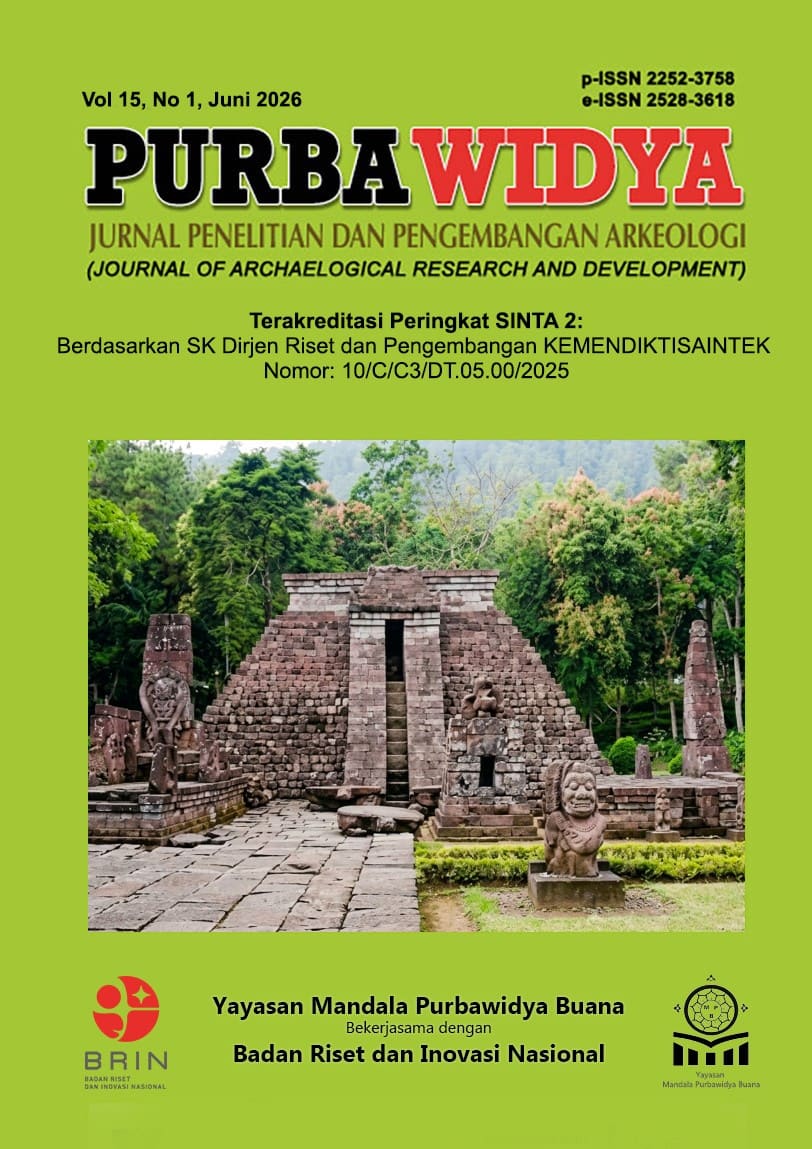
Semiotic Analysis of Sukuh Temple Relief: Fertility Symbols In Hindu-Javanese Cosmology
Article Sidebar
Main Article Content
Abstract
A study of the reliefs at Sukuh Temple is needed as visual archaeological evidence of Hindu-Javanese culture through semiotic interpretation. The purpose of this study is to explain how fertility, cosmological, and religious motifs convey ritual functions and regulate sacred movements at Sukuh Temple. The research uses a descriptive qualitative design through on-site observation, systematic visual recording (photos, measured sketches, and panel mapping), and in-depth analysis of primary reports and the latest scientific works. The data was interpreted to identify themes and narrative structure, then read semiotically to trace denotative forms and connotative cultural meanings. The results showed an integrated sign system dominated by images of fertility and body symbolism, including lingga-yoni. Anthropomorphic figures, turtles, garudas, and kala heads collectively articulate cosmic balance, purification, and spiritual renewal. The spatial distribution of these motifs on terraces and gates directs pilgrims along a sequential route, transforming movement into a symbolic process of transformation and rebirth. Tantric-oriented objects further position the body as a microcosm of the universe. This study concludes that the Sukuh relief program is inseparable from its ritual itinerary and spatial design, reinforcing the value of archaeological iconography for the interpretation and preservation of heritage.
Metrics
Article Details

This work is licensed under a Creative Commons Attribution-NonCommercial-ShareAlike 4.0 International License.
Authors who publish with this journal agree to the following terms:
- Authors retain copyright and grant the journal right of first publication with the work simultaneously licensed under Creative Commons Attribution-NonCommercial-ShareAlike 4.0 International License that allows others to share the work with an acknowledgement of the work's authorship and initial publication in this journal.
- Authors are able to enter into separate, additional contractual arrangements for the non-exclusive distribution of the journal's published version of the work (e.g., post it to an institutional repository or publish it in a book), with an acknowledgment of its initial publication in this journal.
- Authors are permitted and encouraged to post their work online (e.g., in institutional repositories or on their website) prior to and during the submission process, as it can lead to productive exchanges, as well as earlier and greater citation of published work (See The Effect of Open Access).
References
Andaka, Jhota Bangkit. 2023. “Kajian Terhadap Lingga-Yoni Berbentuk Unik Di Jawa (Yoni Bundar Temanggung, Yoni Liyangan, Yoni Gambar, Dan Lingga-Yoni Candi Sukuh) Sebagai Sumber Pembelajaran Sejarah.” Winaya 1 (1): 16–23.
Arumsari, Widya. 2023. “Mengenal Struktur Bangunan Candi Sukuh Sebagai Jejak Peninggalan Majapahit.” Tarikhuna 5 (2). https://doi.org/10.15548/thje.v5i2.7340.
Daito, Apollo. 2024. “Makna Semiotika Lingga Yoni Pada Candi Sukuh.” Jurnal Pendidikan Dan Kebudayaan Nusantara 2 (3): 147–56. https://doi.org/10.38035/jpkn.v2i3.693.
Doncheva, Stela. 2022. “The Mystery of the ‘Fiery’ Metallurgical Craft.” The Power of Fire in the Middle Ages (7th–14th Centuries), January 1, 2022, 135.
Fadil, Muhammad Ikhsan, Zulfa Jamalie, and Asikin Nor. 2024. “BETUMBANG APAM TRADITION AS A MEDIUM OF ISLAMIC EDUCATION: CLIFFORD GEERTZ’S INTERPRETATIVE ANALYSIS OF RELIGIOUS VALUES.” Tarbiyah Islamiyah: Jurnal Ilmiah Pendidikan Agama Islam 14 (2): 73–85. https://doi.org/10.18592/jtipai.v14i2.14400.
Kirnawati, Diyah, and Cucut Annaningtyas. 2020. “How Departement Of Tourism And Culture, Youth And Sport Services Manages Tourism Object In Karangnyar.” RADIANT: Journal of Applied, Social, and Education Studies 1 (1): 20–28.
Koh, Jing Hao, and Chee Men Lim. 2023. “Architectural Language of the Southern Fujianese Traditional Chinese Temple Timber Frame Structure in West Malaysia: A Cultural Semiotics Analysis.” Archnet-IJAR: International Journal of Architectural Research 17 (1): 24–42. https://doi.org/10.1108/ARCH-12-2021-0351.
Miranti, Karisma Putri, and Agus Setiawan. 2020. “PESAN GENDER PADA RELIEF-RELIEF CANDI SUKUH: FEMINISME MELALUI PENDEKATAN TUBUH DAN SEKS [GENDER MESSAGES IN THE RELIEFS OF CANDI SUKUH: FEMINISM BY APPROACHES OF BODY AND SEX].” Naditira Widya 14 (1): 19–34.
Mulyantari, Enny, and Yeni Rosilawati. 2021. “Cultural Heritage Development Model of Sukuh Temple as A Sustainable Cultural Tourism.” Technium Soc. Sci. J. 16 (2021): 438.
Munandar, Agus Aris. 2023. “Majapahit: Reflection of the Religious Life (14th–15th AD).” In Proceedings of the Fourth Asia-Pacific Research in Social Sciences and Humanities, Arts and Humanities Stream (AHS-APRISH 2019). Atlantis Press.
Nata, I. Gede Anjas Kharisma, Lalu Exel Ardi Alfiansyah, Mohamad Yudisa Putrajip, Qatrunnada Qatrunnada, and Ashar Banyu Lazuardi. 2025. “Analysing the Interconnectedness of Cultural Values in Fine Art Works with Roland Barthes’ Semiotic Approach.” Jurnal Multidisiplin Sahombu 5 (04): 606–18.
Pratiwi, Yulia, Ibrahim Numan, and Noor Cholis Idham. 2024. “The Synchronization of Hindu Buddhist Spatial and Architecture in Traditional Javanese Mosques.” Journal of Architectural Research and Design Studies 8 (2). https://doi.org/10.20885/jars.vol8.iss2.art4.
Purwanto, Heri, and Coleta Palupi Titasari. 2020. “MANDALA KADEWAGURUAN: THE PLACE FOR RELIGIOUS EDUCATION IN THE WEST SLOPE OF MOUNT LAWU IN 14th "“ 15th CENTURY.” Jurnal Pendidikan Dan Kebudayaan 5 (1): 13–42. https://doi.org/10.24832/jpnk.v5i1.1505.
Puspitasari, Evianna. 2021. “Makna Relief Candi Sukuh Relevansinya Dengan Erotisme Dalam Spiritualitas Orang Jawa.” Semarang: Skripsi Prodi Akhidah Filsafat Islam Fakultas Ushuluddin Dan Humaniora Universitas Islam Negeri Walisongo Semarang, 2021.
Putri, Ayu Famila, Arin Inayah, and Wageyono. 2023. “A SEMIOTIC ANALYSIS OF ALADDIN MOVIE BY USING ROLAND BARTHES THEORY.” LUNAR 6 (2): 376–86. https://doi.org/10.36526/ln.v6i2.2453.
Putri, Mutiara Indah. 2022. “EKSISTENSI DAN PEMAKNAAN SIMBOLIS RELIFE CANDI SUKUH PENINGGALAN KERAJAAN MAJAPAHIT DI JAWA TENGAH.” Prosiding Lokakarya Tadris Ilmu Pengetahuan Sosial IAIN Ponorogo 2 (2022): 97–109.
Riyanti, Menul Teguh. 2018. “Development of Learning Devices Commercial Graphic Based Planning Project.” International Journal of Education, Training and Learning 2 (1): 1–6. https://doi.org/10.33094/6.2017.2018.21.1.6.
———. 2020. “SUKUH TEMPLE IN KARANG ANYAR CENTRAL JAVA.” International Journal of Engineering Technologies and Management Research 5 (10): 75–93. https://doi.org/10.29121/ijetmr.v5.i10.2018.304.
Riyanti, Menul Teguh, Suhaila Binti Basar, Bambang Triwardoyo, Ekananda Haryadi, and Virginia Suryani. 2020. “Sukuh Temple as a Cultural and Arts Education Tourism in Central Java.” Understanding Global Digital Era Technologies and Transformations in Social, Environment, Peace & Business Development Perspectives in Society, January 1, 2020, 214.
Rodhiyah, A. K., and T. Hidayat. 2019. “Astronomical Aspects of Sukuh Temple, a Fifteenth Century Hindu Temple in Indonesia.” In The Growth and Development of Astronomy and Astrophysics in India and the Asia-Pacific Region, edited by Wayne Orchiston, Aniket Sule, and Mayank Vahia, 54:469–80. Astrophysics and Space Science Proceedings. Singapore: Springer Singapore. https://doi.org/10.1007/978-981-13-3645-4_29.
Saputro, Alfisyah Ajrin. 2023. “ANALISIS RELIEF LINGGA DAN YONI DI CANDI SUKUH MENURUT ROSEMARIE TONG : KAJIAN FEMINISME.” Sabdasastra : Jurnal Pendidikan Bahasa Jawa 7 (2): 238. https://doi.org/10.20961/sabpbj.v7i2.76784.
Soehadha, Moh Soehadha Moh. 2013. “Komodifikasi Asketisme Islam Jawa: Ekspansi Pasar Pariwisata Dan Prostitusi Di Balik Tradisi Ziarah Di Gunung Kemukus.” Harmoni 12 (1): 101–15.
Syafi’i, Achmad. 2022. “MAKNA SIMBOL RELIEF SENGKALAN CANDI SUKUH.” Acintya : Jurnal Penelitian Seni Budaya 13 (2): 178–90. https://doi.org/10.33153/acy.v13i2.4050.
Wicaksono, Andi, Dewi Nurnani, Pulung Wicaksana Nugraha, and Sri Harti. 2025. “INTERELASI PERBANDINGANANTARA VISUAL BIMA RELIEF CANDI SUKUHDENGAN FIGUR BIMA WAYANG KULIT GAYA YOGYAKARTATWEEN VISUAL BIMA AT SUKUH TEMPLE RELIEF WITH BIMA FIGURES IN WAYANG KULIT OF YOGYAKARTA STYLEENGAN FIGUR BIMA WAYANG KULIT GAYA YOGYAKARTA.” SANGIA JOURNAL OF ARCHAEOLOGY RESEARCH 9 (1): 30–44. https://doi.org/10.33772/sangia.v9i1.3145.
Widyastuti, Endang. 2017. “Architecture the Holy Building at the Indihiang Site of Tasikmalaya City.” PURBAWIDYA:Jurnal Penelitian Dan Pengembangan Arkeologi 6 (1): 19. https://doi.org/10.24164/pw.v6i1.186.
Winaya, Atina, and Agus Aris Munandar. 2021. “Ancient Javanese Women during the Majapahit Period (14th – 15th Centuries CE): An Iconographic Study Based on the Temple Reliefs | Perempuan Jawa Kuno Periode Majapahit (Abad Ke-14 – 15 Masehi): Suatu Tinjauan Ikonografi Terhadap Relief Candi.” SPAFA Journal 5 (2021). https://doi.org/10.26721/spafajournal.2021.v5.658.
Witama, Handy Nugraha, Rahadhian Prajudi Herwindo, and Yuswadi Saliya. 2025. “ARCHITECTONIC DEVELOPMENT STUDIES: FROM MAJAPAHIT TEMPLE TO DESIGN OF CONTEMPORARY HIGH-RISE BUILDING IN SURABAYA.” Architecture and Engineering 10 (1): 16–30.
Xiong, Wei, Dongxia Chen, Meijiao Huang, Bendegul Okumus, and Xiaomei Cai. 2025. “Children’s Tourism Memory: An Iconological Analysis of Drawings.” Children’s Geographies 23 (2): 237–56. https://doi.org/10.1080/14733285.2025.2481128.
Yasa, I. Kadek Abdhi. 2025. “Simbolisme Busana Sulinggih Dan Transformasi Nilai Dalam Pendidikan Seni Keagamaan Hindu: Sebuah Studi Etnopedagogis Di Bali.” Jurnal Penelitian Agama Hindu 9 (3): 233–50. https://doi.org/10.37329/jpah.v9i3.4389.
Yixuan, Li. 2018. “Study on the Application of Traditional Cultural Symbols in Visual Communication Design.” Paper presented at International Conference on Arts, Lingustics and Humanities. January 1, 2018. https://www.webofproceedings.org/proceedings_series/ART2L/ICALLH%202018/ICALLH055.pdf.