
Relief Astadikpalaka Candi Siwa Prambanan Materialisasi Astabrata Penguasa Mataram Kuno
Article Sidebar
Main Article Content
Abstract
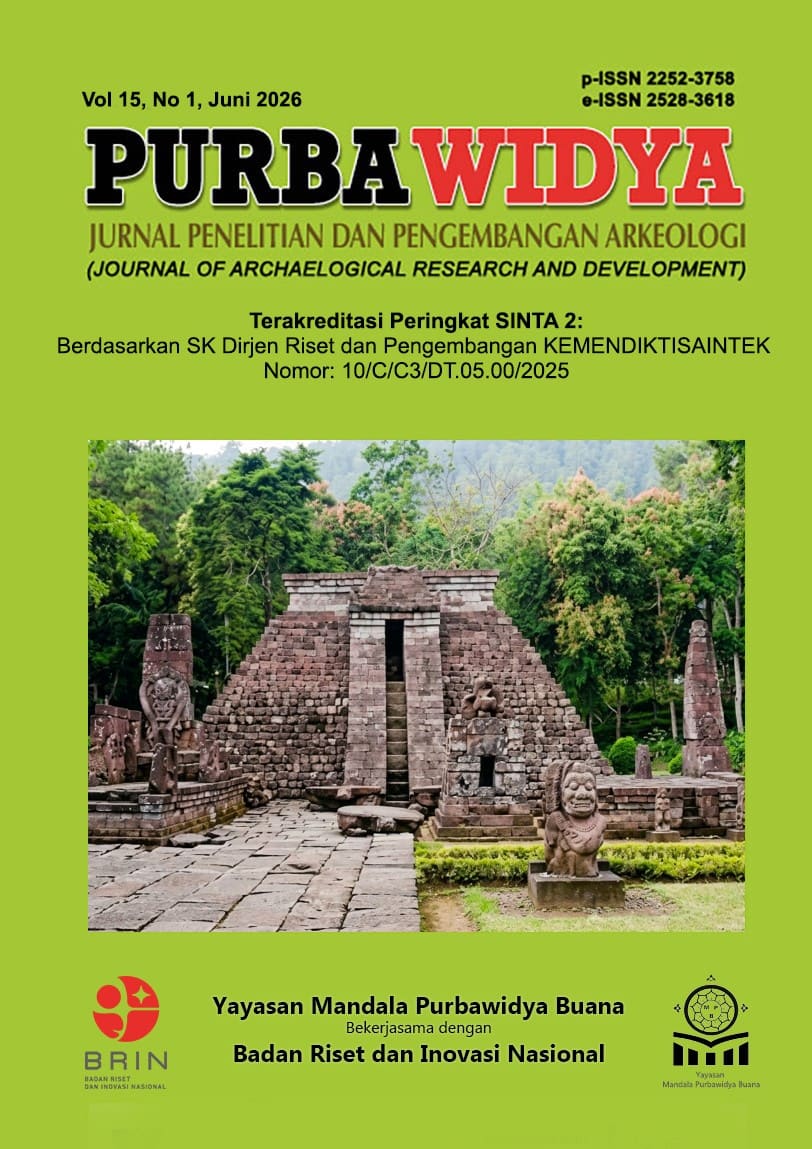
This study examines the Astadikpalaka reliefs (the eight guardian deities of the cardinal directions) at the Siwa Temple of Prambanan as the materialization of the Astabrata political ideology during the reign of Rakai Pikatan (9th century CE). By applying Anthony Giddens' structuration theory as adapted in archaeology by Andreas G. Orphanides, this research analyzes the reliefs not as passive objects but as active components in the reproduction of power structures. Using a qualitative-interpretative approach, data were collected from iconographic studies, the Siwagrha inscription (856 CE), and Astabrata texts. The findings indicate that the Astadikpalaka reliefs represent the eight ideal kingly virtues of Astabrata while also functioning as a legitimizing medium that naturalizes Rakai Pikatan's authority through cosmic symbolism. This study concludes that Prambanan Temple served not only as a sacred site but also as a political instrument that reinforced the hegemony of the Ancient Mataram rulers.
Metrics
Article Details

This work is licensed under a Creative Commons Attribution-NonCommercial-ShareAlike 4.0 International License.
Authors who publish with this journal agree to the following terms:
- Authors retain copyright and grant the journal right of first publication with the work simultaneously licensed under Creative Commons Attribution-NonCommercial-ShareAlike 4.0 International License that allows others to share the work with an acknowledgement of the work's authorship and initial publication in this journal.
- Authors are able to enter into separate, additional contractual arrangements for the non-exclusive distribution of the journal's published version of the work (e.g., post it to an institutional repository or publish it in a book), with an acknowledgment of its initial publication in this journal.
- Authors are permitted and encouraged to post their work online (e.g., in institutional repositories or on their website) prior to and during the submission process, as it can lead to productive exchanges, as well as earlier and greater citation of published work (See The Effect of Open Access).
References
Acri, A., & Jordaan, R. E. (2012). The Dikpalas of Ancient Java Revisited: A new identification for the 24 directional deities on the Siva temple of the Loro Jonggrang Complex. Bijdragen Tot de Taal-, Land- En Volkenkunde, 168(2–3), 274–313. https://hal.science/hal-03060462v1/file/Acri_Jordaan_2012.pdf
Bhikkhu, Ā. (2022). AVATĀRA: Two Incarnations of the Lord, Relief Stories at Prambanan Dua Titisan Dewata, Cerita Relief di Prambanan. Ehipassiko Foundation.
de Casparis, J. G. (1956). Prasasti Indonesia II: Selected Inscriptions from the 7th to the 9th Century A.D. Djawatan Purbakala Republik Indonesia.
Jordaan, R. (2009). Memuji Prambanan: Bunga Rampai Para Cendekiawan Belanda Tentang Kompleks Percandian Loro Jonggrang (Roy Jordaan, Ed.). Yayasan Obor Indonesia - KITLV Jakarta.
Kramrisch, S. (1946). The Hindu Temple, Volume 1. University of Calcutta.
Munandar, A. A. (2011). Catuspatha Arkeologi Majapahit. Wedatama Widya Sastra.
Munandar, A. A. (2017). Tradisi Pemerintahan dan Konsep Raja Ideal menurut Pandangan Masyarakat Sunda Kuna abad ke-13-16 M. In Siliwangi, Sejarah dan Kebudayaan Sunda Kuna (pp. 103–247). Wedatama Widya Sastra.
Munandar, A. A., Rahayu, A., & Wahyudi, D. Y. (2020). Candi Abang: Konflik dan Kuasa dalam Masyarakat Jawa Kuna antara abad ke-9-10. Wedatama Widya Sastra.
Orphanides, A. G. (1990). A Theoretical Approach For The Interpretation of Archaeological Material. Archaeologia Cypria 2, 11–19.
Rarianingsih, N. L. N., & Hardani, K. (2009). Catatan Perjalanan 1150 Tahun Lara Jonggrang. In I. Adrisijanti & A. Putranto (Eds.), Membangun Kembali Prambanan (pp. 11–36). Balai Pelestarian Peninggalan Purbakala Yogyakarta.
Soebadio, H., Sedyawati, E., Soesanti, N., & Astuti, R. (1997). Kajian Astabrata: Pendahuluan dan Teks Jilid I.
Soekmono, R. (1977). Candi: Fungsi dan Pengertiannya. Departemen Pendidikan dan Kebudayaan.
Soeroso, M. , Bambang Budi Utomo, P.E.J . Ferdinandus, Richadiana Kartakusuma, & Titi Surti Nastiti. (1985). Berita Penelitian Arkeologi No. 32: Laporan Penelitian Candi Sari, Prambanan Yogyakarta.
Van Lohuizen-de Leeuw, J. E. (1955). The Dikpalakas in Ancient Java. Bijdragen Tot De Taal-, Land- En Volkenkunde, 111, 356–384. https://brill.com/view/journals/bki/111/4/article-p356_3.xml?language=en&srsltid=AfmBOoq5c3iXwm5pvNIHzR2vEg3_ScAFBizxPlyoa0EWib9TpZYN8-6J