
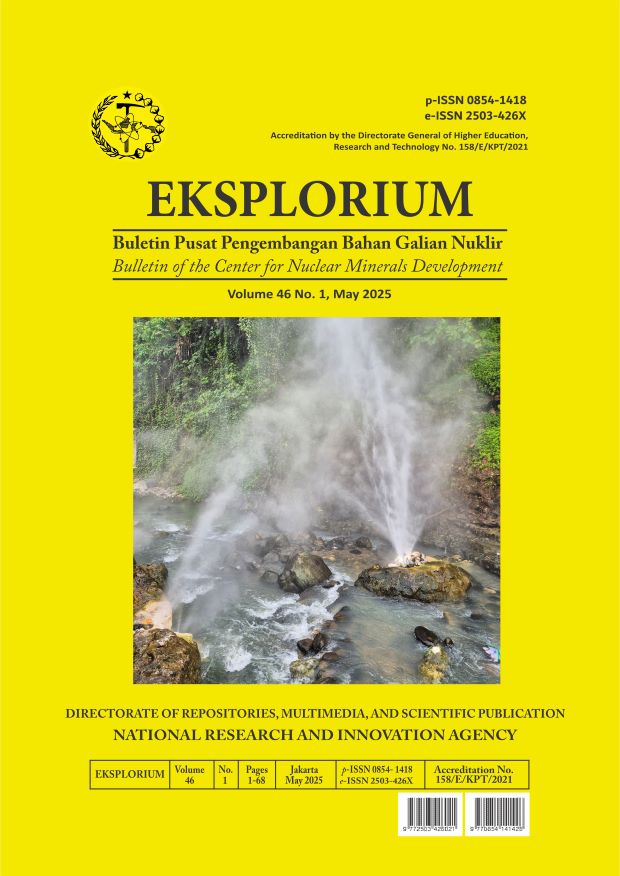
Rare Earth Elements (REEs) Potential in Active Geothermal Systems: A Global Review and Regional Study at Mount Slamet, Indonesia
Article Sidebar
Main Article Content
Abstract
As global demand for REEs continues to rise due to their strategic role in clean energy technologies, geothermal systems offer an emerging unconventional source. Although data on Indonesian geothermal REEs remain limited, geochemical signals from Mount Slamet provide valuable insights when interpreted alongside global analogs. This study investigates the occurrence, mobility, and potential of rare earth elements (REEs) in the active geothermal system of Mount Slamet, Central Java, Indonesia, with a focus on the hot spring manifestations in Baturraden and Guci using a systematic literature review method based on published research. Baturraden exhibits neutral fluids (pH 6–7) with elevated chloride levels, suggesting enhanced REEs mobilization and strong positive europium (Eu) anomalies under deeper reducing conditions. In contrast, Guci displays more alkaline fluids (pH ~8) with lower chloride content, indicating possible meteoric water dilution and lower REEs transport efficiency. These contrasting hydrochemical profiles highlight diverse water-rock interaction mechanisms and fluid pathways. The findings highlight Mount Slamet as a promising candidate for REEs exploration in a volcanic-related geothermal system. This study underscores the urgent need for systematic research on REEs geochemistry in Indonesian geothermal fields to support mineral diversification and sustainable energy transitions.
Article Details

This work is licensed under a Creative Commons Attribution-NonCommercial-ShareAlike 4.0 International License.
1. Introduction
By using or sharing content from EKSPLORIUM - Buletin Pusat Pengembangan Bahan Galian Nuklir ("the Journal"), you agree to follow these Terms and Conditions. The Journal's content is licensed under the Creative Commons Attribution-NonCommercial-ShareAlike (CC BY-NC-SA) license. If you do not agree to these terms, please do not use the content.
2. How You Can Use the Content
-
Share: You can copy, share, and distribute the work, but only for non-commercial purposes.
-
Adapt: You can change, remix, or build on the work, as long as it is for non-commercial purposes and you share it under the same license (CC BY-NC-SA).
3. Attribution (Giving Credit)
When you use or share the content, you must:
-
Give proper credit to the author(s).
-
Mention the title of the work and the journal name.
-
Provide a link to the license (https://creativecommons.org/licenses/by-nc-sa/4.0/).
-
Indicate if you made any changes to the work.
4. Non-Commercial Use
You cannot use the work to make money or for any commercial activities. For example, you cannot sell or use the content in advertisements.
If you want to use the content for commercial purposes, you need to get permission from the author(s) or the publisher.
5. ShareAlike
If you make changes to the content (like creating a new version or remixing it), you must share your new version under the same CC BY-NC-SA license.
6. Exclusions
Some materials in the Journal may have different licenses or restrictions, such as third-party content (like images or datasets). You must respect the rules for those materials.
7. No Warranty
The content is provided "as is." The authors and publisher do not guarantee that the content is error-free or suitable for any specific purpose. Use the content at your own risk.
8. Modifications and Withdrawal of Content
The publisher and authors can update or remove content at any time. If content is removed, the previous versions will still follow these terms.
9. Ethical Use
You must use the content ethically and follow all relevant laws. This includes properly citing the original authors and not misusing the content.
10. Legal Compliance
You are responsible for making sure your use of the content follows the laws of your country. If you believe content violates your rights, please contact us.
11. Changes to Terms
These Terms and Conditions may be updated from time to time. Any changes will be posted on the Journal's website.
12. Contact Information
For questions about these Terms or for permission to use content commercially, please contact us at:
-
Email: eksplorium@brin.go.id
-
Website: https://ejournal.brin.go.id/eksplorium
Conclusion
By using the content from EKSPLORIUM - Buletin Pusat Pengembangan Bahan Galian Nuklir, you agree to follow these Terms and Conditions and the CC BY-NC-SA 4.0 International License.
References
[1] D. Wang, F. Xue, L. Ren, X. Li, S. Wang, and X. Q. Er, "Critical Minerals in Tibetan Geothermal Systems: Their Distribution, Flux, Reserves, and Resource Effects," Minerals, vol. 15, no. 1, p. 93, Jan. 2025, doi: 10.3390/min15010093.
[2] A. Harijoko, S. Juhri, S. Taguchi, K. Yonezu, and K. Watanabe, "Geochemical indication of formation water influx to the volcanic hosted hot springs of Slamet Volcano, Indonesia," Indonesian Journal on Geoscience, vol. 7, no. 1, pp. 1–14, Apr. 2020, doi: 10.17014/IJOG.7.1.1-14.
[3] A. Harijoko, A. N. Milla, H. E. Wibowo, and N. I. Setiawan, "Magma evolution of Slamet Volcano, Central Java, Indonesia based on lava characteristic," IOP Conf Ser Earth Environ Sci, vol. 451, no. 1, p. 012092, Mar. 2020, doi: 10.1088/1755-1315/451/1/012092.
[4] I. Warren, "Techno-Economic Analysis of Lithium Extraction from Geothermal Brines," 2019. [Online]. Available: www.nrel.gov/publications.
[5] S. A. Wood and W. M. Shannon, "Rare-earth elements in geothermal waters from Oregon, Nevada, and California," J Solid State Chem, vol. 171, no. 1–2, pp. 246–253, Feb. 2003, doi: 10.1016/S0022-4596(02)00160-3.
[6] S. Toprak, Ç. Öncel, S. Yılmaz, A. Baba, G. A. Koç, and M. M. Demir, "Lithium extraction from geothermal brine using γ-MnO2: A case study for Tuzla geothermal power plant," Heliyon, vol. 10, no. 21, p. e39656, Nov. 2024, doi: 10.1016/j.heliyon.2024.e39656.
[7] P. Dobson and A. R. Pratama, "Technical Geothermal Roadmap for Indonesia."
[8] F. X. Bimantara, S. Syafrizal, and A. Hede, Characteristics of Rare Earth Elements Enrichment in Surface Area of Wayang Crater, West Java, Indonesia. 2022.
[9] S. A. Wood, "Behavior of Rare Earth Element In Geothermal Systems; A New Exploration/Exploitation Tool," Idaho Falls, ID, Jan. 2002. doi: 10.2172/792697.
[10] C.-H. Chung, C.-F. You, and Y.-L. Yeh, "Strontium Isotopes and Rare Earth Elements as Tracers of Water–Rock Interactions in Taiwan Hot Springs," Water (Basel), vol. 17, no. 1, p. 71, Dec. 2024, doi: 10.3390/w17010071.
[11] S. A. Wood and W. M. Shannon, "Rare-earth elements in geothermal waters from Oregon, Nevada, and California," J Solid State Chem, vol. 171, no. 1–2, pp. 246–253, Feb. 2003, doi: 10.1016/S0022-4596(02)00160-3.
[12] S. A. Wood, "The Geochemistry of Rare Earth Elements and Yttrium in Geothermal Waters," in Volcanic, Geothermal, and Ore-Forming Fluids, Society of Economic Geologists, 2005, pp. 133–158. doi: 10.5382/SP.10.08.
[13] J. Di and X. Ding, "Complexation of REE in Hydrothermal Fluids and Its Significance on REE Mineralization," Minerals, vol. 14, no. 6, p. 531, May 2024, doi: 10.3390/min14060531.
[14] F. Xue, H. Tan, X. Zhang, and J. Su, "Sources, enrichment mechanisms, and resource effects of rare metal elements-enriched geothermal springs in Xizang, China," Sci China Earth Sci, vol. 67, no. 11, pp. 3476–3499, Nov. 2024, doi: 10.1007/s11430-024-1413-0.
[15] S. Indarto, I. Setiawan, A. Kausar, and dan H. Permana, "Petrographic and major elements results as indicator of the geothermal potential in Java," IOP Conf Ser Earth Environ Sci, vol. 118, p. 012073, Feb. 2018, doi: 10.1088/1755-1315/118/1/012073.
[16] D. Vukadinovic and I. Sutawidjaja, "Geology, mineralogy and magma evolution of Gunung Slamet Volcano, Java, Indonesia," J Southeast Asian Earth Sci, vol. 11, no. 2, pp. 135–164, Feb. 1995, doi: 10.1016/0743-9547(94)00043-E.
[17] M. Djuri, H. Samodra, T. C. Amin, and S. Gafoer, “Peta Geologi Lembar Purwokerto dan Tegal Skala 1:100.000,” Bandung, 1996.
[18] A. Harijoko, S. Juhri, S. Taguchi, K. Yonezu, and K. Watanabe, "Geochemical indication of formation water influx to the volcanic hosted hot springs of Slamet Volcano, Indonesia," Indonesian Journal on Geoscience, vol. 7, no. 1, pp. 1–14, Apr. 2020, doi: 10.17014/IJOG.7.1.1-14.
[19] S. U. Pratomo, I. P. Haty, D. Ulhaq, and R. D. Martasari, "Comparison of geosite and geomorphosite quantitative analysis for geotourism purposes in Baturraden (Purwokerto) and Guci (Tegal) hot springs tourism area, Central Java," in IOP Conference Series: Earth and Environmental Science, Institute of Physics, 2024. doi: 10.1088/1755-1315/1339/1/012031.
[20] C.-H. Xiao, W. Qingfei, X. Z. Zhou, L. Yang, and J. Zhang, "Rare-earth elements in hot spring waters in the Tengchong geothermal area," Acta Petrologica Sinica, vol. 26, pp. 1938–1944, Jun. 2010.
[21] E. A. A. Mororó, M. Berkesi, Z. Zajacz, and T. Guzmics, "Rare earth element transport and mineralization linked to fluids from carbonatite systems," Geology, vol. 52, no. 4, pp. 240–244, Apr. 2024, doi: 10.1130/G51531.1.
[22] C. J. Gregory, C. R. M. McFarlane, J. Hermann, and D. Rubatto, "Tracing the evolution of calc-alkaline magmas: In-situ Sm-Nd isotope studies of accessory minerals in the Bergell Igneous Complex, Italy," Chem Geol, vol. 260, no. 1–2, pp. 73–86, Mar. 2009, doi: 10.1016/j.chemgeo.2008.12.003.
[23] A. Fowler and R. Zierenberg, Rare earth element concentrations in geothermal fluids and epidote from the Reykjanes geothermal system, Iceland. 2015.
[24] L. B. Klose, "Rare Earth Elements in alkaline geothermal fluids from Iceland and the East African Rift, Kenya: A data quality and anomaly assessment via the λ polynomial modelling approach," Goldschmidt Conference 2025, Prague, Czech Republic, July 10, 2025. .
[25] S. Quillinan et al., "Assessing rare earth element concentrations in geothermal and oil and gas produced waters: A potential domestic source of strategic mineral commodities (Final Report)," Golden, CO (United States), Jul. 2018. doi: 10.2172/1509037.
[26] Fiveable, "6.4 Rare earth elements – Geochemistry," Fiveable, 2024. Accessed May 24, 2025. https://library.fiveable.me/geochemistry/unit-6/rare-earth-elements/study-guide/mrdDf442sd2ZmyFm.
[27] I. A. Aditya, T. Wijayanto, and D. F. Hakam, "Advancing Renewable Energy in Indonesia: A Comprehensive Analysis of Challenges, Opportunities, and Strategic Solutions," Sustainability, vol. 17, no. 5, p. 2216, Mar. 2025, doi: 10.3390/su17052216.
[28] A. Agustin, D. Irawan, A. Susanto, and R. Herdianita, Application of Geochemical Methods in Geothermal Exploration in Indonesia: a Literature Review (Part 1). 2015.
