
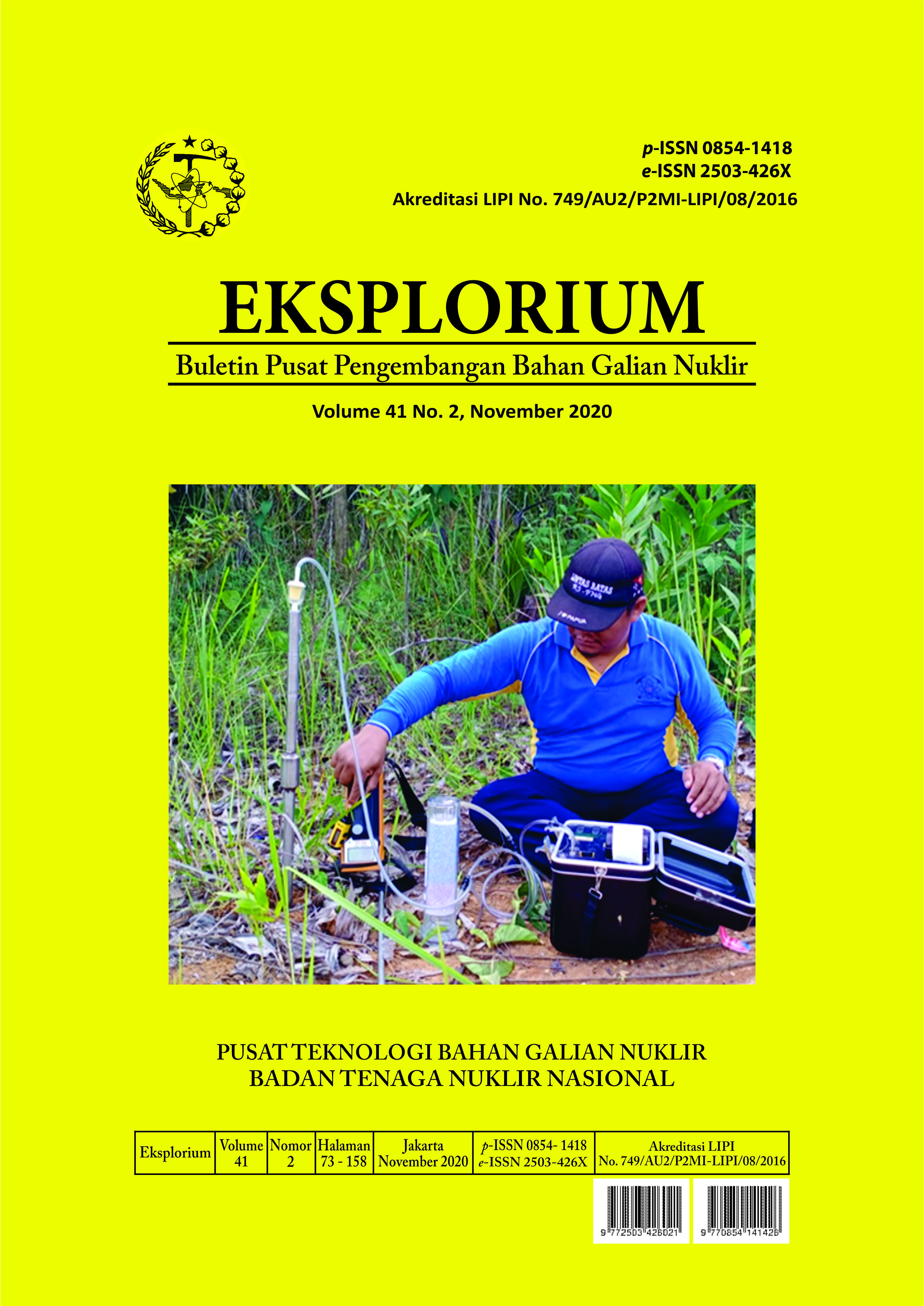
Peran Kontaminasi Kerak pada Diferensiasi Magma Pembentuk Batuan Vulkanik Sungai Ampalas, Mamuju, Sulawesi Barat
Article Sidebar
Main Article Content
Abstract
Anomalous radiometry has been found in Ampalas River Area on volcanic rock boulder. The values measured from gamma spectrometer are 787 ppm eU and 223 ppm eTh. This discovery is promising for exploration development. Further study need to figure the radioactive mineral bearing rock characteristic from in-situ samples. The research aim is to determine the petrology and geochemical characteristics of Ampalas volcanic rocks as preliminary study to find radioactive mineral accumulation process of Ampalas volcanic rocks. The methodologies are field observation, rock sampling, petrography, and X-Ray fluorescence (XRF) analyses. The Ampalas volcanic rocks consist of phonolite, phoidite, and phoid syenite. Their textures are porphyritic, flow, pyroxene rim, zoning, pseudo-leucite, corrosion, mafic inclusions, and sieve. The geochemical characteristics show high alkalinity and radioactive mineral enrichment disseminating on rock. The magmatic processes which play a significant role in radioactive mineral-bearing rocks formation are crystal fractionations (leucite and alkaline feldspar fractionations), continental crust assimilation, and magma mixing. Long interaction between magma and crust creates advanced magma differentiation causing higher uranium and thorium accumulation.
Article Details

This work is licensed under a Creative Commons Attribution-ShareAlike 4.0 International License.
1. Introduction
By using or sharing content from EKSPLORIUM - Buletin Pusat Pengembangan Bahan Galian Nuklir ("the Journal"), you agree to follow these Terms and Conditions. The Journal's content is licensed under the Creative Commons Attribution-NonCommercial-ShareAlike (CC BY-NC-SA) license. If you do not agree to these terms, please do not use the content.
2. How You Can Use the Content
-
Share: You can copy, share, and distribute the work, but only for non-commercial purposes.
-
Adapt: You can change, remix, or build on the work, as long as it is for non-commercial purposes and you share it under the same license (CC BY-NC-SA).
3. Attribution (Giving Credit)
When you use or share the content, you must:
-
Give proper credit to the author(s).
-
Mention the title of the work and the journal name.
-
Provide a link to the license (https://creativecommons.org/licenses/by-nc-sa/4.0/).
-
Indicate if you made any changes to the work.
4. Non-Commercial Use
You cannot use the work to make money or for any commercial activities. For example, you cannot sell or use the content in advertisements.
If you want to use the content for commercial purposes, you need to get permission from the author(s) or the publisher.
5. ShareAlike
If you make changes to the content (like creating a new version or remixing it), you must share your new version under the same CC BY-NC-SA license.
6. Exclusions
Some materials in the Journal may have different licenses or restrictions, such as third-party content (like images or datasets). You must respect the rules for those materials.
7. No Warranty
The content is provided "as is." The authors and publisher do not guarantee that the content is error-free or suitable for any specific purpose. Use the content at your own risk.
8. Modifications and Withdrawal of Content
The publisher and authors can update or remove content at any time. If content is removed, the previous versions will still follow these terms.
9. Ethical Use
You must use the content ethically and follow all relevant laws. This includes properly citing the original authors and not misusing the content.
10. Legal Compliance
You are responsible for making sure your use of the content follows the laws of your country. If you believe content violates your rights, please contact us.
11. Changes to Terms
These Terms and Conditions may be updated from time to time. Any changes will be posted on the Journal's website.
12. Contact Information
For questions about these Terms or for permission to use content commercially, please contact us at:
-
Email: eksplorium@brin.go.id
-
Website: https://ejournal.brin.go.id/eksplorium
Conclusion
By using the content from EKSPLORIUM - Buletin Pusat Pengembangan Bahan Galian Nuklir, you agree to follow these Terms and Conditions and the CC BY-NC-SA 4.0 International License.
References
[1] I. G. Sukadana, “Petrogenesis Batuan Vulkanik Adang dan Kaitannya dengan Keterdapatan Mineral Radioaktif di Kabupaten Mamuju, Sulawesi Barat,” Universitas Gadjah Mada, 2015.
[2] PTBGN BATAN, “Laporan Teknis PTBGN BATAN 2013,” Jakarta, 2013.
[3] J. D. Winter, Principles of Igneous and Metamorphic Petrology John D. Winter Second Edition, 2nd ed. London: Pearson Education Limited, 2013.
[4] S. E. Sichel, A. Motoki, S. E. Sichel, T. Vargas, J. R. Aires, S. Silva, A. Balmant, dan J. Gonçalves, “Geochemical evolution of the felsic alkaline rocks of tanguá and Rio bonito intrusive bodies , state of Rio de Janeiro , Brazil,” Geociencias, vol. 29, no. 3, pp. 291–310, 2010.
[5] A. Motoki, S. E. Sichel, T. Vargas, D. P. Melo, dan K. F. Motoki, “Geochemical behaviour of trace elements during fractional crystallization and crustal assimilation of the felsic alkaline magmas of the state of Rio de Janeiro, Brazil,” An. Acad. Bras. Cienc., vol. 87, no. 4, pp. 1959–1979, 2015.
[6] K. D. Putirka, M. A. Kuntz, D. M. Unruh, dan N. Vaid, “Magma evolution and ascent at the craters of the moon and neighboring volcanic fields, Southern Idaho, USA: Implications for the evolution of polygenetic and monogenetic volcanic fields,” J. Petrol., vol. 50, no. 9, pp. 1639–1665, 2009.
[7] M. L. Renjith, “Micro-textures in plagioclase from 1994-1995 eruption, Barren Island Volcano: Evidence of dynamic magma plumbing system in the Andaman subduction zone,” Geosci. Front., vol. 5, no. 1, pp. 113–126, 2014.
[8] M. Cuney dan K. Kyser, “Recent and Not-So-Recent Developments in Uranium Deposits and Implications for Exploration.,” Econ. Geol., vol. 104, no. 4, pp. 600–601, 2009.
[9] M. Cuney, A. Emetz, J. Mercadier, V. Mykchaylov, V. Shunko, dan A. Yuslenko, “Uranium deposits associated with Na-metasomatism from central Ukraine: A review of some of the major deposits and genetic constraints,” Ore Geol. Rev., vol. 44, pp. 82–106, 2012.
[10] H. D. Schorscher dan M. E. Shea, “The Regional Geology of the Pocos de Caldas Alkaline Complex: Mineralogy and Geochemistry of Selected Nepheline Syenites and Phonolites,” J. Geochemical Explor., vol. 45, pp. 25–51, 1992.
[11] L. Qiu, D. P. Yan, M. Ren, W. Cao, S. L. Tang, Q. Y. Guo, L. T. Fan, J. Qiu, Y. Zhang, dan Y. W. Wang, “The source of uranium within hydrothermal uranium deposits of the Motianling mining district, Guangxi, South China,” Ore Geol. Rev., vol. 96, pp. 201–217, 2018.
[12] P. Bruneton dan M. Cuney, “Geology of uranium deposits,” in Uranium for Nuclear Power: Resources, Mining and Transformation to Fuel, no. 1956, Elsevier Ltd, 2016, pp. 11–52.
[13] Y. S. Yuwono, R. C. Maury, R. Soeria-Atmadja, dan H. Bellon, “Tertiary and Quaternary geodynamic evolution of South Sulawesi constraints from the study of volcanic units,” Maj. Ikat. Ahli Geol. Indones., vol. 13, no. 1, pp. 32–48, 1988.
[14] B. Priadi, “Volkanisme Tersier-Kuarter di Lengan Barat Sulawesi,” Proceeding “Geologi Sulawesi dan Prospeknya” Makasar, 2009.
[15] N. Ratman dan S. Atmawinata, “Peta Geologi Lembar Mamuju dan Sekitarnya, Sulawesi, Skala 1:250.000,” Bandung, 1993.
[16] I. G. Sukadana, A. Harijoko, dan L. D. Setijadji, “Tectonic Setting of Adang Volcanic Complex in Mamuju Region, West Sulawesi Province,” Eksplorium, vol. 36, no. 1, pp. 31–44, 2015.
[17] J. Blundy dan K. Cashman, “Petrologic Reconstruction of Magmatic System Variables and Processes,” Rev. Mineral. Geochemistry, vol. 69, no. 1, pp. 179–239, 2008.
[18] M. J. Rutherford dan J. D. Devine, “Magmatic Conditions and Magma Ascent as Indicated by Hornblende Phase Equilibria Á re and Reactions in the 1995 ± 2002 Soufrie Hills Magma,” J. Petrol., vol. 44, no. 8, pp. 1433–1454, 2003.
[19] D. A. Jerram, K. J. Dobson, D. J. Morgan, dan M. J. Pankhurst, The Petrogenesis of Magmatic Systems: Using Igneous Textures to Understand Magmatic Processes. Elsevier Inc., 2018.
[20] K. Deniz dan Y. K. Kadioğlu, “Assimilation and fractional crystallization of foid-bearing alkaline rocks: Buzlukdağ intrusives, Central Anatolia, Turkey,” Turkish J. Earth Sci., vol. 25, no. 4, pp. 341–366, 2016.
[21] M. J. Streck, “Mineral Textures and Zoning as Evidence for Open System Processes,” Rev. Mineral. Geochemistry, vol. 69, no. 1, pp. 595–622, 2008.
[22] N. M. Asrial, M. F. Rosana, K. Arfiansyah, dan N. Nordin, “Petrogenesis of Andesite in Bukitcula, Baleendah District, Southern Bandung, West Java,” J. Geol. Sci. Appl. Geol., vol. 3, no. 3, pp. 1–6, 2019.
[23] A. Peccerillo dan S. R. Taylor, “Geochemistry of eocene calc-alkaline volcanic rocks from the Kastamonu area, Northern Turkey,” Contrib. to Mineral. Petrol., vol. 56, pp. 63–81, 1976.
[24] T. P. Mernagh dan Y. Miezitis, A Review of the Geochemical Processes Controlling the Distribution of Thorium in the Earth’s Crust and Australia’s Thorium Resources. Australia: Onshore Energy and Mineral Division, 2008.
[25] J. A. Pearce dan J. R. Cann, “Tectonic setting of basic volcanic rocks determined using trace element analyses,” Earth Planet. Sci. Lett., vol. 19, no. 2, pp. 290–300, 1973.
