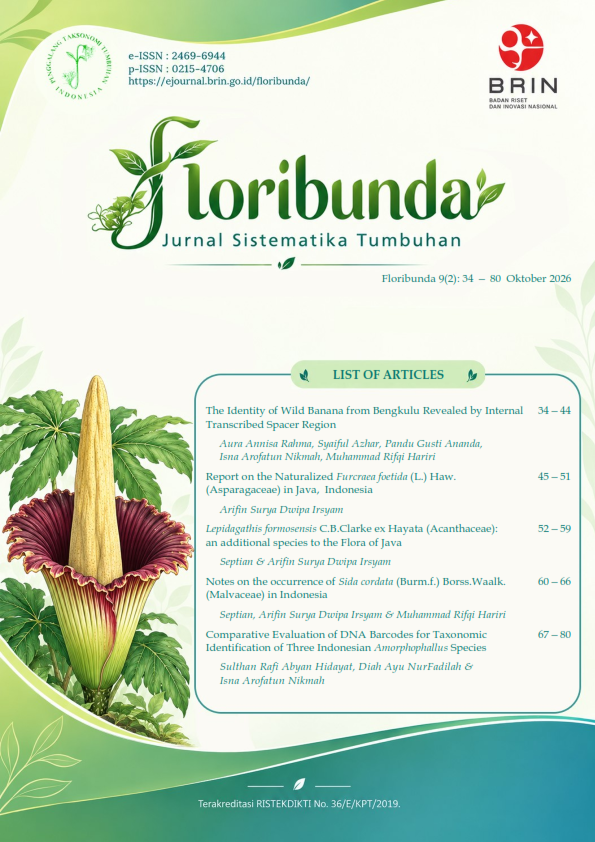
Comparative Evaluation of DNA Barcodes for Taxonomic Identification of Three Indonesian Amorphophallus Species
DOI:
https://doi.org/10.55981/floribunda.2026.16788Keywords:
Amorphophallus, barcoding gap, DNA barcoding, Kimura 2-parameter, Neighbor-JoiningAbstract
Amorphophallus Blume ex Decne. (Araceae) is native to Indonesia and holds significant ecological and economic value, making a reliable molecular method for taxonomic identification essential. GenBank sequences of three plastid markers (rbcL, matK, and trnL) from three Indonesian Amorphophallus species (A. muelleri Blume, A. paeoniifolius (Dennst.) Nicolson, and A. titanum (Becc.) Becc.) were analysed using barcoding gap analysis and Neighbor-Joining (NJ) distance-based clustering. All three markers showed a positive barcoding gap and grouped conspecific accessions into distinct clusters corresponding to each species. rbcL showed the largest barcoding gap (0.01163), followed by trnL (0.00873) and matK (0.00278), while bootstrap support for the species clusters was comparably high for rbcL and matK (≥95%) and lower for trnL (62–95%). These findings identify rbcL as the most informative marker among the three tested for the taxonomic identification of these three Amorphophallus species, with matK as a comparably reliable alternative and trnL as a complement, and provide a molecular reference for future taxonomic and conservation work on this genus in Indonesia.
Downloads
References
Braukmann TWA, Kuzmina ML, Sills J, Zakharov EV & Hebert PDN 2017. Testing the efficacy of DNA barcodes for identifying the vascular plants of Canada. PLoS ONE 12(1): e0169515.
CBOL Plant Working Group 2009. A DNA barcode for land plants. Proceedings of the National Academy of Sciences 106(31): 12794–12797.
Claudel C, Buerki S, Chatrou LW, Antonelli A, Alvarez N & Hetterscheid W 2017. Large-scale phylogenetic analysis of Amorphophallus (Araceae) derived from nuclear and plastid sequences reveals new subgeneric delineation. Botanical Journal of the Linnean Society 184(1): 32–45.
Cock PJA, Antao T, Chang JT, Chapman BA, Cox CJ, Dalke A, Friedberg I, Hamelryck T, Kauff F, Wilczynski B & de Hoon MJL 2009. Biopython: freely available Python tools for computational molecular biology and bioinformatics. Bioinformatics 25(11): 1422–1423.
Elansary HO, Ashfaq M, Ali HM & Yessoufou K 2017. The first initiative of DNA barcoding of ornamental plants from Egypt and potential applications in horticulture industry. PLoS ONE 12(2): e0172170.
Felsenstein J 1985. Confidence limits on phylogenies: an approach using the bootstrap. Evolution 39(4): 783–791.
Hebert PDN, Cywinska A, Ball SL & deWaard JR 2003. Biological identifications through DNA barcodes. Proceedings of the Royal Society B: Biological Sciences 270(1512): 313–321.
Kimura M 1980. A simple method for estimating evolutionary rates of base substitutions through comparative studies of nucleotide sequences. Journal of Molecular Evolution 16(2): 111–120.
Kress WJ & Erickson DL 2007. A two-locus global DNA barcode for land plants: the coding rbcL gene complements the non-coding trnH-psbA spacer region. PLoS ONE 2(6): e508.
Kumar S, Stecher G, Suleski M, Sanderford M, Sharma S & Tamura K 2024. MEGA12: molecular evolutionary genetics analysis version 12 for adaptive and green computing. Molecular Biology and Evolution 41(12): msae263.
Larkin MA, Blackshields G, Brown NP, Chenna R, McGettigan PA, McWilliam H, Valentin F, Wallace IM, Wilm A, Lopez R, Thompson JD, Gibson TJ & Higgins DG 2007. Clustal W and Clustal X version 2.0. Bioinformatics 23(21): 2947–2948.
Li LF, Yang M, Qi Y, Gao PH, Yang SW, Zhao YT, Guo JW, Wei HY, Liu JN, Zhao JR, Huang FY & Yu L 2024. Chloroplast genome of four Amorphophallus species: genomic features, comparative analysis, and phylogenetic relationships among Amorphophallus species. BMC Genomics 25(1): 1122.
Meyer CP & Paulay G 2005. DNA barcoding: error rates based on comprehensive sampling. PLOS Biology 3(12): e422.
Mutaqin AZ, Kurniadie D, Iskandar J, Nurzaman M & Husodo T 2021. Morphological characteristics and habitat conditions of suweg (Amorphophallus paeoniifolius) around Mount Ciremai National Park, West Java, Indonesia. Biodiversitas Journal of Biological Diversity 22(5): 2591–2600.
Nair VD, Aseema P & Saini KC 2024. DNA barcoding: an effective molecular tool for species identification, molecular authentication and phylogeny studies in plant science research. Plant Science Today 11(4).
Nikmah IA, Azrianingsih R & Wahyudi D 2016. Genetic diversity of porang populations (Amorphophallus muelleri Blume) in Central Java and West Java based on LEAFY second intron marker. The Journal of Tropical Life Science 6(1): 23–27.
Nurhidayati T, Febriawan Z, Saputro TB, Arifiyanto A & Purwani KI 2024. Morpho-physiological and glucomannan biosynthesis-related gene expression of porang (Amorphophallus muelleri Blume) under salinity stress. Acta Botanica Brasilica 38: e20230222.
Paradis E & Schliep K 2019. ape 5.0: an environment for modern phylogenetics and evolutionary analyses in R. Bioinformatics 35(3): 526–528.
Phillips JD, Gillis DJ & Hanner RH 2019. Incomplete estimates of genetic diversity within species: implications for DNA barcoding. Ecology and Evolution 9(5): 2996–3010.
R Core Team 2024. R: a language and environment for statistical computing. R Foundation for Statistical Computing, Vienna, Austria.
Rosidiani EP, Arumingtyas EL & Azrianingsih R 2013. Analisis variasi genetik Amorphophallus muelleri Blume dari berbagai populasi di Jawa Timur berdasarkan sekuen intron trnL. Floribunda 4(6): 129–137.
Saitou N & Nei M 1987. The neighbor-joining method: a new method for reconstructing phylogenetic trees. Molecular Biology and Evolution 4(4): 406–425.
Schliep KP 2011. phangorn: phylogenetic analysis in R. Bioinformatics 27(4): 592–593.
Sedayu A, Eurlings MCM, Gravendeel B & Hetterscheid WLA 2010. Morphological character evolution of Amorphophallus (Araceae) based on a combined phylogenetic analysis of trnL, rbcL and LEAFY second intron sequences. Botanical Studies 51(4): 473–490.
Taberlet P, Coissac E, Pompanon F, Gielly L, Miquel C, Valentini A, Vermat T, Corthier G, Brochmann C & Willerslev E 2007. Power and limitations of the chloroplast trnL (UAA) intron for plant DNA barcoding. Nucleic Acids Research 35(3): e14.
Tang R, Liu E, Zhang Y, Schinnerl J, Sun W & Chen G 2020. Genetic diversity and population structure of Amorphophallus albus, a plant species with extremely small populations (PSESP) endemic to dry-hot valley of Jinsha River. BMC Genetics 21(1): 102.
Trujillo-Argueta S, Del Castillo RF & Velasco-Murguía A 2022. Testing the effectiveness of rbcLa DNA-barcoding for species discrimination in tropical montane cloud forest vascular plants (Oaxaca, Mexico) using BLAST, genetic distance, and tree-based methods. PeerJ 10: e13771.
Wei L, Pacheco-Reyes F, Villarreal-Quintanilla JA, Robledo-Torres V, Encina-Domínguez J, Lara-Ramírez EE & Perez-Rodriguez M 2024. Effectiveness of DNA barcodes (rbcL, matK, ITS2) in identifying genera and species in Cactaceae. Pakistan Journal of Botany 56(5): 1911–1928.
Yu G, Smith DK, Zhu H, Guan Y & Lam TTY 2017. ggtree: an R package for visualization and annotation of phylogenetic trees with their covariates and other associated data. Methods in Ecology and Evolution 8(1): 28–36.
Yudaputra A, Fijridiyanto IA, Yuzammi, Witono JR, Astuti IP, Robiansyah I, Hendrian R, Hutabarat P, Yuswandi AY, Raharjo PD, Syartinilia & Cropper WP 2022. Habitat preferences, spatial distribution and current population status of endangered giant flower Amorphophallus titanum. Biodiversity and Conservation 31(3): 831–854.
Downloads
Published
How to Cite
Issue
Section
License
Copyright (c) 2026 Sulthan Rafi Abyan Hidayat, Diah Ayu NurFadilah, Isna Arofatun Nikmah

This work is licensed under a Creative Commons Attribution-NonCommercial-ShareAlike 4.0 International License.
Authors who publish with this journal agree to the following terms:
- Authors retain copyright and grant the journal right of first publication with the work simultaneously licensed under a Creative Commons Attribution License that allows others to share the work with an acknowledgement of the work's authorship and initial publication in this journal.
- Authors are able to enter into separate, additional contractual arrangements for the non-exclusive distribution of the journal's published version of the work (e.g., post it to an institutional repository or publish it in a book), with an acknowledgement of its initial publication in this journal.
- Authors are permitted and encouraged to post their work online (e.g., in institutional repositories or on their website) prior to and during the submission process, as it can lead to productive exchanges, as well as earlier and greater citation of published work (SeeThe Effect of Open Access).