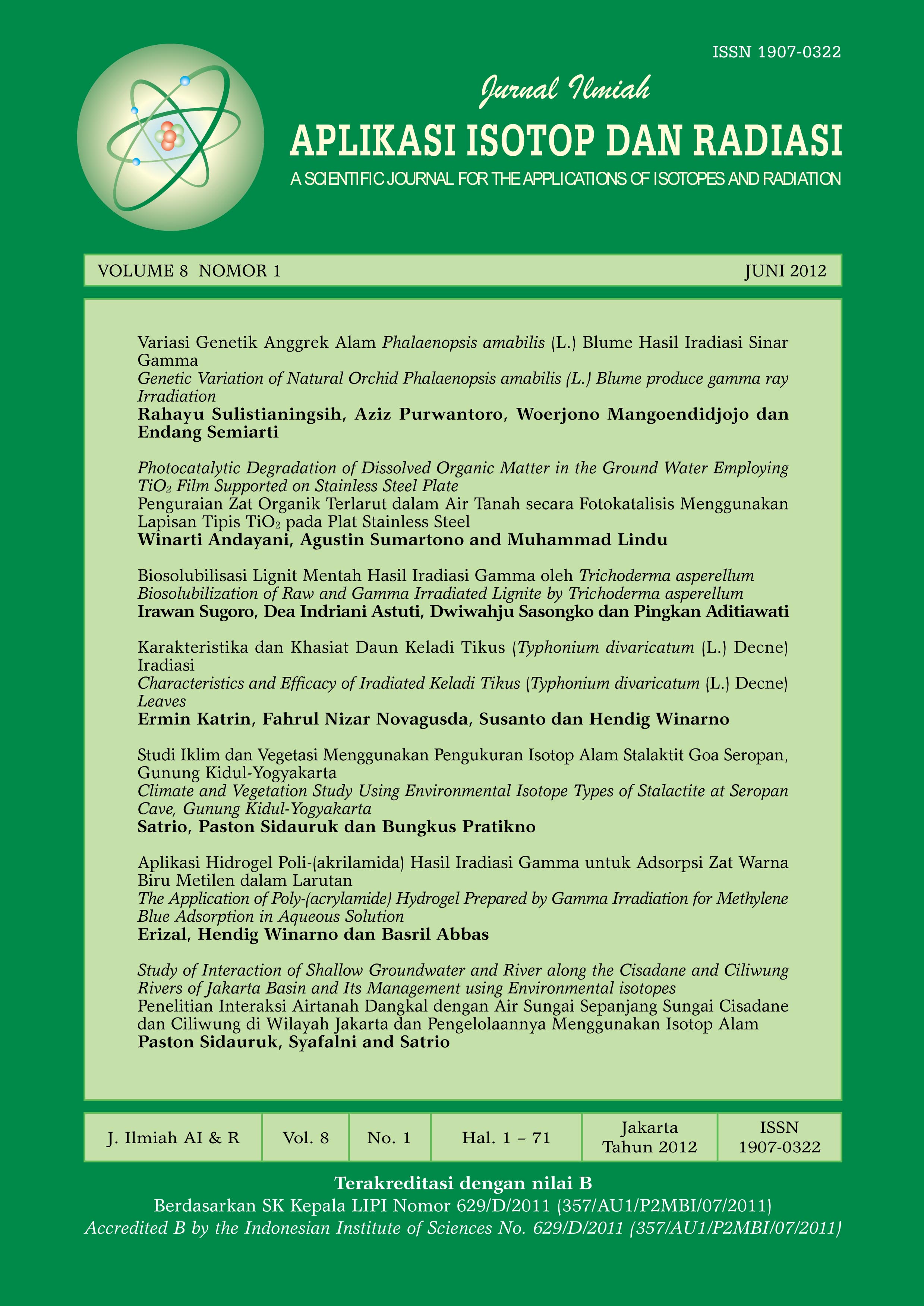
Studi Iklim dan Vegetasi Menggunakan Pengukuran Isotop Alam Stalaktit Goa Seropan, Gunung Kidul-Yogyakarta
DOI:
https://doi.org/10.17146/jair.2012.8.1.497Abstract
Climate and vegetation study usingenvironmental isotopes (i.e., 13C, 14C and 18O) variations of stalactite has been conducted atSeropan cave, Gunung Kidul Karst area. The stalactite samples were collected from SeropanCave at Semanu, Gunung Kidul, Yogyakarta. The objective of study is to understand theclimate change, and vegetation types, temperature of atmosphere, age and stalactite growthrate through the interpretation of environmental isotopes (i.e., 13C, 14C and 18O) of stalactitesamples. The environmental isotope content of stalactite samples were analysed throughCaCO3 compound that was found at the stalactite samples. The 13C content of samples isimportant to understand climate undulation and also vegetation variation. On the other hand,the variation of 18O and 14C contents is important to predict past temperature of atmosphere,and the age as well as stalactite growth rate, respectively. The result of environmental 13Cisotope analysis showed that Gunung Kidul area in general can be classified as dry climate. Itis also indicated that almost 87.5 % of local vegetation can be classified as dry vegetation C4as can be seen from the variation of 13C content that is -6 o/oo to +2 o/oo vs PDB. This can also mean that only 12.5 % of the time that the vegetation in the area is wet in which the variationof 13C content is in the range -14 o/oo to -6 o/oo vs PDB. The variations of 18O contents of thesamples (carbonate stalactite, or drip water) showed that the average temperature since 1621to 2011 was around 19.5 oC. On the other hand, the variations of 14C contents of the samplesshowed that stalactite growth rate was around 0.1 mm/year or one mm in ten years. Theresult shows that the stalactite growth is very slow as generally expected in tropical area suchas Gunung Kidul.
Downloads
Published
How to Cite
Issue
Section
License
Copyright (c) 2012 Author(s)

This work is licensed under a Creative Commons Attribution-ShareAlike 4.0 International License.