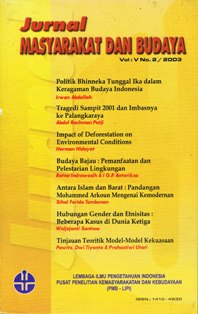
IMPACT OF DEFORESTATION ON ENVIRONMENTAL CONDITION
Article Sidebar
Main Article Content
Abstract
Rezim Orde Baru memulai kebijakan untuk mengeksploitasi hutan pada tahun 1967. Devisa negara yang diperoleh dari hasil hutan baik dari penjualan log kayu, industri plywood dan pulp menduduki nomer dua setelah pendapatan dari sektor minyak. Namun, penebangan log secara besar-besaran di areal konsesi log hutan (HPH) tidak disertai dengan penanaman massal kembali, penegakan hukum bagi mereka yang merusak hutan, dan komitmen yang konsisten mengenai ‘pengelolaan hutan’ yang telah diatur oleh Departemen Kehutanan. Fenomena di atas mendorong percepatan hancurnya hutan (Deforestation and Forest Degradation) di Indonesia. Tulisan ini memfokuskan kajian mengenai kerusakan hutan di Indonesia, dengan melihat komentar forum-forum kajian seperti FAO, WRI dan Myers serta penulis sendiri. Dikemukakan juga dampak hancurnya hutan atas lingkungan seperti kebakaran hutan tahun 1997-1998, rusaknya spesis sumber hayati hutan, polusi air, perubahan cuaca dan panas bumi.
Article Details

This work is licensed under a Creative Commons Attribution-ShareAlike 4.0 International License.
References
Books
Brown, K. and Pearce, D (eds.) (1994). The Causes of Tropical
Deforestation, UCL Press, London.
Brookfield and Byron (1993).South-East Asia’s Environmental Future:
The Search for Sustainability, Oxford Singapore Press.
Dauvergne, Peter (2001). Loggers and Degradation in the Asia-Pacific:
Corporations And Environmental management.United Kingdom:
Cambridge University Press.
Hurst, Philip (1990). Rainforest Politics: Ecological Destruction in
Southeast-Asia, United Kingdom: Zed Books Ltd.
Jepma, CJ (1995). Tropical Deforestation: A Socio-Economic Approach.
London: Earth scan Press.
Jacob, T (2001). Tahun-tahun yang sulit: Mari Mencintai Indonesia (The
most difficult Time to love Indonesia), Jakarta: Obor Press.
Kinnon, Mac and Philips, K (1993). A Field Guide to the Birds of Borneo,
Sumatra, Java and Bali, London: Oxford University Press.
Myers, Norman (1989). Deforestation Rates in Tropical Forests and their
Climatic Implications. London: Friends of the Earth.
Myers, Norman (1985). The Primary Source: Tropical Forests and Our
Future. New York: W.W. Norton.
Moll, H.A.J (1987).The Economics of Oil Palm, Netderlands: Pudoc
Wageningen Press.
Nusantara, G. Hakim (eds.) (1995). Atas nama Pembangunan: Bank Dunia
dan hak Asasi Manusia di Indonesia (On be half of Development:
World Bank and Human-Rights in Indonesia, Jakarta: Elsam Press.
Park, Chris C (1992). Tropical Rainforests. London: Routledge Press.
Palo, Matti and Vanhanen, Heidi . eds. (2000). World Forests From
Deforestation to Transition?. London: Kluwer Academic
Publishers.
Potter,
Lesley (1996). “Forest Degradation, Deforestation, and
Reforestation in Kalimantan: Toward a Sustainable Land Use?” in
Padoch Christine and Nancy Lee Peluso, eds. (1993). Borneo in
Transition: People, Forests, Conservation, and Development,
Kuala Lumpur: Oxford University Press.
Raup, David M (1988). Diversity crises in the geological past. In
Biodiversity,E. O. Wilson and Frances M. Peter, eds., pp. 51-57.
Washington, D.C.: National Academy Press.
Rietbergen, Simon (eds.) (1993).Tropical Forestry, London: Earthscan
Publication Ltd.
Sponsel, Leslie E. Headland, Thomas N. and Bailey, Robert C. eds.
(1996).Tropical Deforestation: The Human Dimension New York:
Columbia University Press.
Sharma, Narendra P., ed., (1992). Managing the World’s Forests:
Looking forBalance Between Conservation and Development
(Washington DC: World Bank).
Sharma, et al. (1992) “World Forests in Perspective,” in Sharma, ed.
Managing the World’s Forests.
The Third IGES International Workshop on Forest Conservation Strategies
for The Asia And Pacific Region, The University of Tokyo, Tokyo,
7-9 September 1999.
UNEP (UN Environment Program) (1996), UNEP’s forest Policy and a
Proposed Action Programme for the Period 1996-2000 (Nairobi:
UNEP).
Whitmore, T.C. and J.A. Sayer, eds. (1992). Tropical Deforestation and
Species Extinction. New York: Chpaman and Hall.
Journal/Newspaper/Report
Barber, Charles Victor & Schweithelm, James (eds.) (2000). Trial By Fire:
Forest Fires And Forest Policy in Indonesia’s Era of Crisis and
Reform, Washington: World Resource Institute (WRI) Report.
Bobsien and Hoffmann (1998),’Plantation Forest Fires in Indonesia,’
NGOs Forum Paper, 4-6 May 1990, Bon-Germany.
Common, M (1995). Economists don’t read Science. Ecological
Economics 15, 101-103.
The Ecologist Vol. 22, No. 4 (July/August 1992).
The Ecologist, Vol. 16, No.2/3, 1986.
FAO (Food and Agriculture Organization) (2000). Global Forest
Resources Assessment 2000: Main Report.
Far Eastern Economic Review (FEER), 1 April 1993.
Global Environmental Change, Vol. 1, Number 1, December 1990.
Goldschmidt, E., N. Hildyard, and P. Bunyard, eds. (1987). Save the
Forests: Save the Planet-A Plan for action. Ecologist 17 (4/5):
129-204.
Haba, Hidayat (eds.). Dampak Pembangunan Hutan Tanaman Industri
(HTI) Terhadap Masyarakat Pedesaan: Kasus Sanggau (Kal-Bar),
Kuala Dasal (Jambi) Dan Lubuk Kembang Bungo (Riau)
(Industrial Timber Plantation Influences Upon Village
Community), Jakarta:LIPI, Center for Social and Cultural
Studies,1998.
Jakarta Post, 12 August, 1995.
Jakarta Post, 27 October 1999.
Jakarta Post, 3 July 1995.
Japan Views Quarterly, Autumn/Winter 1992.
Jurnal Lingkungan Hidup (Journal of Environment), Jakarta: Walhi,
Volume 1, 1996.
Kompas, 5 June 1984.
Leahy, Joe, (1999)”Wood-Processing Industry under Scrutiny,” Financial
Times, 17 December.
Laporan kebakaran Hutan dan Lahan di Indonesia (Forest Fire and Land
in Indonesia) Volume, published by Ministry of Environment
Office and United Nations Development Programme (UNDP),
Jakarta, 1998.
Myers, Norman, ‘Tropical Forests: Present Status and Future Outlook,’ in
Climatic Change, Vol. 19, September 1991.
Pacific Affairs, 1993-1994, Vol. 66, No. 4, pp. 516.
Peluso,
(1995),’Whose Woods Are These? Counter Mapping Forest
Territories in Kalimantan, Indonesia, in Antipode 27, No. 4, pp.
403.
Peluso, Nancy Lee (1993), ‘The Political Ecology of Extraction and
Extractive Reserves in East Kalimantan, Indonesia,’ in
Development and Change, Vol. 23, No. 4, October, pp. 50.
Repetto, R (1990). Deforestation in the tropics. Scientific American 262 (4):
36-42.
Repetto, R (1986) “Soil Loss and Population Pressure on Java,” Ambio
(Sweden), Vol. 15, No. 1.
SKEPHI: A Call for International Solidarity on Indonesian Tropical Forest
Issue, No. 10 (January-June 1993, No. 11 (July-September) 1993.
Schindler, Ludwig (1998),’ Fire Management in Indonesia-Qua Vadis?,’ in
Tropical Forest Fire: Prevention, Control, Rehabilitation and
Trans-Boundary issues,Proceeding Paper, published by Bappenas,
Jica and ITTO, 7-8 December, 1998.
Secrett, Charles (1986). “The Environmental Impact of Transmigration,”
The Ecologist, Vol. 16. No. 2/3.
Statistic of Reformation Program, Report Paper in Directorate General of
Reforestation And Rehabilitation Land, in Department of Forestry.
Turner, B.L (et al.) ‘Two types of Global Environmental Change,’ in
Global Environmental Change, Vol. 1, Number 1, December,
1990.
Tanah Air Jurnal (Journal of Mother Land), Walhi, No. 5/1998, No. 1,
1996.
Thompson, Herb (1999). “Social Forestry: An Analysis of Indonesian
Forestry Policy,” Journal of Contemporary Asia 29 (May): 187
201.
Walhi (1995).’Kembalikan Dana Pelestarian Hutan’ (Sustainable Forest
Fund Have to returned). Report paper.
Walton, Thomas and Derek Holmes (2000). “Indonesia’s Forests Are
Vanishing Faster Than Ever,” International Herald Tribune, 25
January.
World Bank report (1999) on ‘Oil Palm’ Plantation in many Provinces in
Indonesia’.
Yamane, Masanobu (eds.), Report of the First Phase Strategic Research
Forest Conservation, IGES, March, 2001.