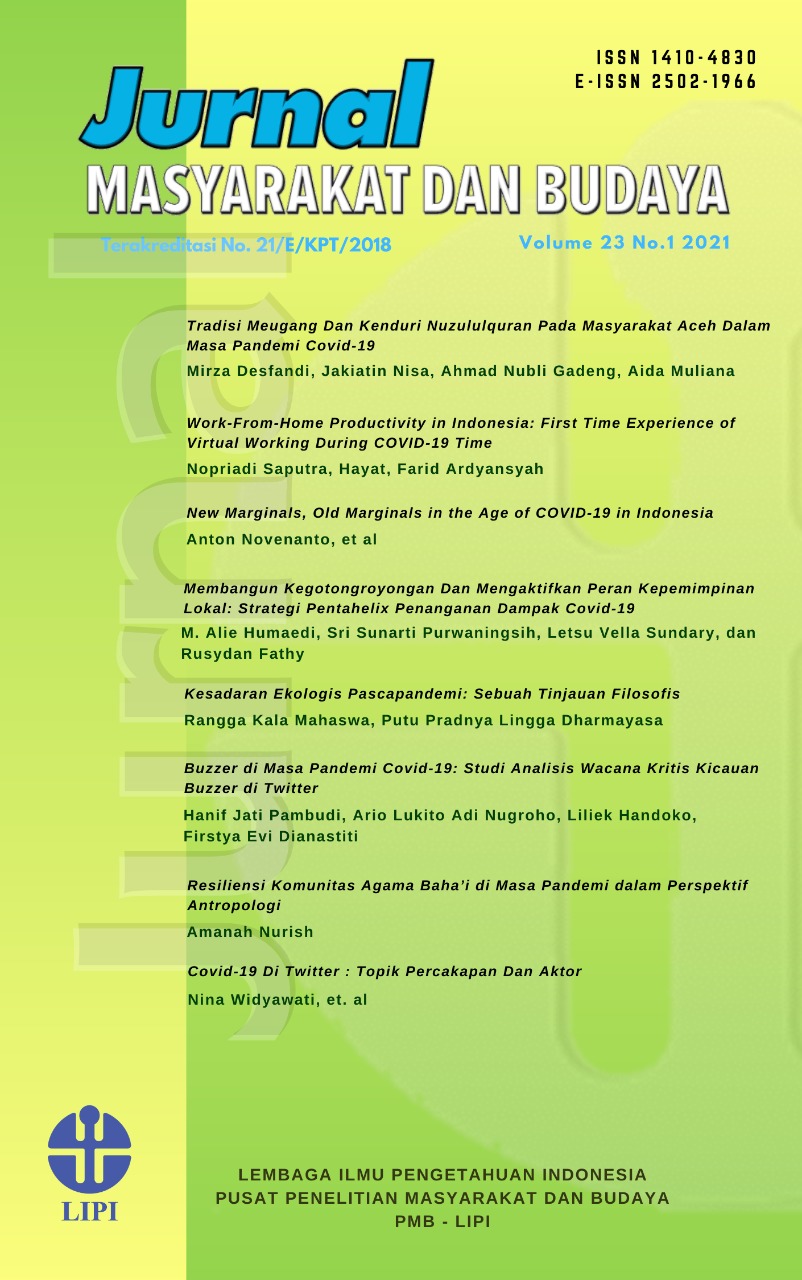
WORK-FROM-HOME PRODUCTIVITY IN INDONESIA FIRST TIME EXPERIENCE OF VIRTUAL WORKING DURING COVID-19 TIME
Article Sidebar
Main Article Content
Abstract
During COVID-19, working from home (WFH) becomes most possible working arrangement alternative in order to practice social distancing. The productivity of WFH is still questioned by many organizations, especially companies which conduct WFH extensively for the first time. Do digital skills, work motivation, digital leadership, digital collaboration, perceived organizational support, and performance management impact positively and significantly on work productivity? This paper is based on cross-sectional study which involved 855 office workers from 32 provinces in Indonesia. PLS SEM and SmartPLS version 3.0 were used to structure and test the research model. The analysis result reveals that individual factor influences WFH productivity directly, while group and organizational antecedents influenced indirectly. To leverage WFH productivity, organizations should focus to develop digital skills and work motivation as individual factor. The organizational and group antecedents should be aligned and directed to impact on WFH productivity.
Article Details

This work is licensed under a Creative Commons Attribution-ShareAlike 4.0 International License.
References
Attaran, M., Attaran, S., & Kirkland, D. (2019). The need for digital workplace:
Increasing workforce productivity in the information age. International Journal of
Enterprise Information Systems, 15(1), 1–23.
Aydın, A., & Tiryaki, S. (2018). Impact of performance appraisal on employee
motivation and productivity in Turkish forest products industry: A structural
equation modeling analysis. Drvna industrija: Znanstveni časopis za pitanja
drvne tehnologije, 69(2), 101–111.
Bakker, A. B., Du, D., & Derks, D. (2019). Major life events in life, work
engagement, and performance: A test of the work-home resources model.
Internal Journal of Stress Management, 26(2), 238.
Bao, L., Li, T., Xia, X., Zhu, K., Li, H., & Yang, X. (2020). How does Working from
Home Affect Developer Productivity?--A Case Study of Baidu During COVID-19
Pandemic. arXiv preprint arXiv:2005.13167.
Baker, C. L., Flores, N. M., Zou, K. H., Bruno, M., & Harrison, V. J. (2017).
Benefits of quitting smoking on work productivity and activity impairment in the
United States, the European Union and China. International Journal of Clinical
Practice, 71(1), e12900.
Belsito, C. A., & Reutzel, C. R. (2019). SME employee performance appraisal
formalization and trust in leadership change. International Journal of
Organizational Analysis, 28(2).
Bick, A., Blandin, A., & Mertens, K. (2020). Work from home after the COVID-19
outbreak (No. 15000). CEPR Discussion Papers.
Bloom, N. (2014). To raise productivity, let more employees work from home.
Harvard Business Review.
Bosua, R., Kurnia, S., & Moza, A. (2017). Telework impact on productivity and
well-being. In Social Inclusion and Usability of ICT Services (p. 201).
Dingel, J. I., & Neilman, B. (2020). How many jobs can be done at home?
National Bureau of Economic Research.
Dong, Y., Bartol, K. M., Zhang, Z. X., & Li, C. (2017). Enhancing employee
creativity via individual skill development and team knowledge sharing:
Influences of dual‐focused transformational leadership. Journal of Organizational
Behavior, 38(3), 439–458.
Duke, É., & Montag, C. (2017). Smartphone addiction, daily interruptions and
self-reported productivity. Addictive Behaviors Reports, 6, 90–95.
Easley, R. F., Devaraj, S., & Crant, J. M. (2003). Relating collaborative
technology use to teamwork qyality and performance: An empirical analysis.
Journal of Management Information Systems, 247–265.
Eder, P., & Eisenberger, R. (2008). Perceived organizational support: Reducing
the negative influence of coworker withdrawal behavior. Journal of Management,
34(1), 55–68.
Eisenberger, R., Huntington, R., Hutchison, S., & Sowa, D. (1986). Perceived
organizational support. Journal of Applied Psychology, 71(3), 500.
Felstead, A., Jewson, N., Phizacklea, A., & Walter, S. (2002). Opportunities to
work at home in teh context of work life balance. Human Resource Management
Journal, 12, 54–76.
Feng, Z., & Savani, K. (2020). COVID-19 created a gender gap in perceived
work productivity and job satisfaction: Implications for dual-career parents
working from home. Gender in Management: An International Journal.
Funes, J. M., Aguirre, F., Deeg, F., & Hoefnagels, J. (2018). Skill for tomorrow:
How to address the digital skill gap. Policy, p. 3.
Green, B. N., & Johnson, C. D. (2015). Inter-profesional collaboration research,
education, and clinical practice: Working together for a better future. Journal of
Chiropractic Education, 29(1), 1–10.
Guterresa, L. F. D. C., Armanu, A., & Rofiaty, R. (2020). The role of work
motivation as a mediator on the influence of education-training and leadership
style on employee performance. Management Science Letters, 10(7), 1497–
1504.
Gubler, T., Larkin, I., & Pierce, L. (2018). Doing well making well: The impact of
corporate wellness program on employee productivity. Management Science,
64(11), 4967–4987.
Hair, J. F., Hult, G. T. M., Ringle, C., & Sarstedt, M. (2014). A primer on partial
least squares structural equations modeling (PLS-SEM). Sage.
Hevia, C., & Neumeyer, A. (2020). A conceptual framework for analyzing the
economic impact of COVID-19 and its policy implications. UNDP LAC COVID-19
Policy Documents Series, 1, 29.
Iyswarya, P., & Rajaram, S. (2017). Impact of performance management
process on print organizational performance: In India context. In C. C.
Satapathy, V. Bhateja, & A. Joshi, Proceedings of the International Conference
on Data Engineering and Computing Technology and Communication
Technology (pp. 661–671). Springer.
Kazekami, S. (2018). Does teleworking improve labor productivity? Presented at
27th Eurasia Business and Economics Society Conference on January 11th,
2018.
Kim, H. J., Hur, W. M., Moon, T. W., & Jun, J. K. (2017). Is all support equal? The
moderating effect of supervisor, coworker, and organizational support on tje link
between emotional labor and job performance. Business Research Quarterly,
20(2), 124–136.
Kramer, A.,– & Kramer, K. Z. (2020). The potential impact of the COVID-19
pandemic on occupational status, work from home, and occupational mobility.
Journal of Vocational Behavior, 119.
Kurtessis, J. N., Eisenberger, R., Ford, M. T., Buffardi, L. C., Steward, K. A., &
Adis, C. S. (2017). Perceived organizational support: A meta analytics evaluation
of organizational support theory. Journal of Management, 1853–1884.
Lavy, S., & Littman-Ovadia, H. (2017). My better self: Using strengths at work
and work productivity, organizational citizenship behavior, and satisfaction.
Journal of Career Development, 44(2), 95–109.
Lyubovnikova, J., Dawson, J. F., & West, M. A. (2018). Examining the indirect
effects of perceived organizational support for teamwork training on acute healt
care tem productuivity and innovation. The role of shared objectives. Group &
Organization Management, 43(3), 382–413.
Maruyama, T., Hopkinson, P. G., & James, P. W. (2009). A multivariate analysis
of work-life balance outcomes from a large-scale telework program. New
Technology, Work and Employment, 24(1), 76–88.
McClelland, D. C. (1961). The achieving society. University of Illinois at Urbana-
Champaign's Academy for Entrepreneurial Leadership Historical Research
Reference in Entrepreneurship.
Murphy K. R., & Cleveland J. N. (1995). Understanding performance appraisal:
Social, organizational and goal-oriented perspectives. Sage.
Nakrošienė, A., Bučiūnienė, & Goštautaitė, B. (2019). Working from home:
Characteristics and outcomes of telework. International Journal of Manpower,
40(1).
Pulakos, E. D., Mueller-Hanson, R., & Arad, S. (2019). The evolution of
performance management: Searching for value. Annual Review of
Organizational Psychology and Organizational Behavior.
Purwanto, A., Asbari, M., Fahlevi, M., Mufid, A., Agistiawati, E., Cahyono, Y., &
Suryani, P. (2020). Impact of Work from Home (WFH) on Indonesian Teachers
Performance During the Covid-19 Pandemic: An Exploratory Study. International
Journal of Advanced Science and Technology, 29(5), 6235-6244.
Rehman, S., Zahid, M., Rahman, H. U., & Habib, M. N. (2019). A Partial Least
Squares Approach to the Leadership Styles, Organizational Culture, and
Employees' Productivity: A Case of Pakistan Banking Industry. International
Journal of Asian Business and Information Management (IJABIM), 10(1), 55–64.
Rudito, P., & Sinaga, M. (2017). Digital mastery: Membangun kepemimpinan
digital untuk memenangkan era disrupsi. Gramedia Pustaka Utama.
Saunila, M., Ukko, J., Rantala, T., Nasiri, M., & Rantanen, H. (2019). Preceding
operational capabilities as antecedents for productivity and innovation
performance. Journal of Business Economics, 1–25.
Sink, D. (1985). Productivity management: Planning, measurement and
evaluation, control and improvement. Wiley, p. 518.
Scandura, T. A. (2017). Essentials of organizational behavior: An evidence-
based approach. Sage publications.
Shaban, O. S., Al-Zubi, Z., Ali, N., & Alqotaish, A. (2017). The effect of low
morale and motivation on employees’ productivity & competitiveness in
Jordanian industrial companies. International Business Research, 10(7), 1–7.
Sitthiwarongchai, C., Wichayanuparp, W., Chantaki, P., & Charoenboon, P.
(2020). Impact of organization's leadership style on motivation of its employees.
Systematic Reviews in Pharmacy, 11(3), 48–56.
Shonfeld, M., & Magen-Nagar, N. (2020). The impact of an online collaborative
program on intrinsic motivation, satisfaction and attitudes towards technology.
Technology, Knowledge and Learning, 25(2), 297–313.
Tseng, S. T., & Levy, P. E. (2019). A multilevel leadership process framework of
performance management. Human Resource Management Review, 29(4).
Uhl-Bien, M., Picolo, R. F., & Schermerhorn Jr., J. R. (2020). Organizational
behavior. John Wiley & Sons.
Westerman, Bonnet, & McAfee. (2014). Leading digital: Turning technology into
business transformation. HBR Press.
Yunus, E. N., & Ernawati, E. (2018). Productivity paradox? The impact of office
redesign on employee productivity. International Journal of Productivity and
Performance Management, 67(9).
Zeike, S., Bradbury, K., Lindert, L., & Pfaff, H. (2019). Digital leadership skills
and associations with psychological well-being. International Journal of
Environment Research and Public Health.
http://dx.doi.org/10.3390/ijerph16142628
Zira, E. (2016). The impact of skill mismatch on aggregate productivity: Cross-
country analysis in OECD economies (Unpublished master thesis). KTH
Industrial Engineering and Management, Stockholm, Sweden.