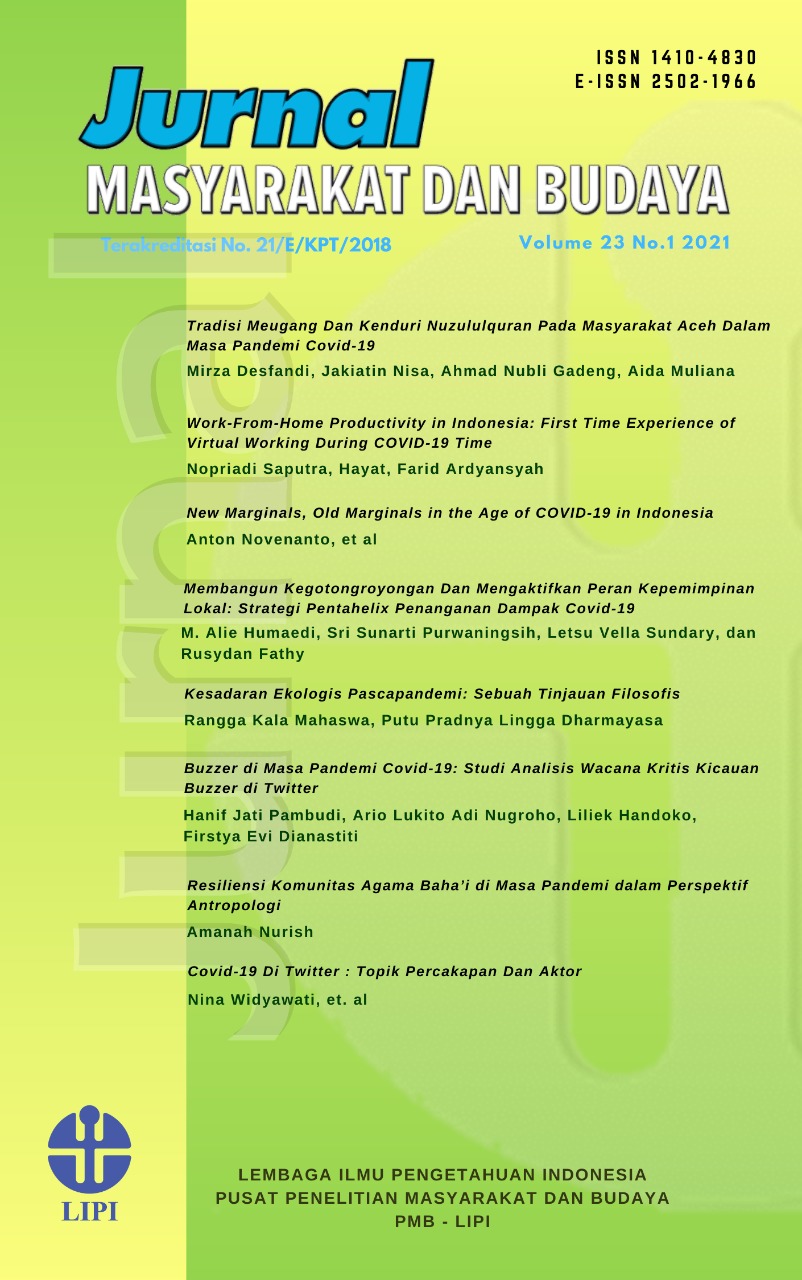
NEW MARGINALS, OLD MARGINALS IN THE AGE OF COVID-19 IN INDONESIA
Article Sidebar
Main Article Content
Abstract
This study is a patchwork ethnography of how certain social groups in Indonesia are marginalized while coping with the ongoing global pandemic of COVID-19. A consortium consisting of social researchers living in different locations in Indonesia conducted observation to identify marginal/marginalized groups in their surroundings. We focus on the marginalization or marginalizing process by considering the vulnerability concept developed within the disaster studies field. Our observations guided by questions: How vulnerable were pre-existing marginal/marginalized groups in Indonesia before and during the outbreak? To what extent does the Indonesian government approach for the outbreak become a new vulnerability structure by creating new marginal groups within the society? Our observation identified that the ongoing pandemic has further marginalized pre-existing marginal groups and emerged some new marginal groups within society.
Article Details

This work is licensed under a Creative Commons Attribution-ShareAlike 4.0 International License.
References
Ahimsa-Putra, H. S. (2012). Etnosains untuk Kajian Bencana, Kajian Integratif
Ilmu, Agama, dan Budaya. In A. I. Kuswanjono (Ed.), Respons Masyarakat Lokal
atas Bencana (pp. 7–23). Mizan & CRCS-UGM.
Amir, S. (2018). Introduction: Resilience as Sociotechnical Construct. In S. Amir
(Ed.), The Sociotechnical Constitution of Resilience: A New Perspective on
Governing Risk and Disaster (pp. 1–16). Palgrave Macmillan.
Andersen, K. G., Rambaut, A., Lipkin, W. I., Holmes, E. C., & Garry, R. F. (2020).
The proximal origin of SARS-CoV-2. Nature Medicine.
Anderson, J. W. (1968). Cultural Adaptation to Threatened Disaster. Human
Organization, 27(4), 298–307.
Bankoff, G. (2003). Cultures of Disaster: Society and Natural Hazard in the
Philippines. RoutledgeCurzon.
Cernea, M. M. (1997). The risks and reconstruction model for resettling
displaced populations. World Development, 25(10), 1569–1587.
Cernea, M. M. (2003). For a new economics of resettlement: a sociological
critique of the compensation principle. International Social Science Journal,
55(175), 37–45.
Collins, T. W. (2008). The Political Ecology of Hazard Vulnerability:
Marginalization, Facilitation and the Production of Differential Risk to Urban
Wildfires in Arizona’s White Mountains. Journal of Political Ecology, 15, 21–43.
Cui, J., Li, F., & Shin, Z. L. (2019). Origin and evolution of pathogenic
coronaviruses. Nature Reviews Microbiology, 17, 181–192.
Elias, N. (2001). The Loneliness of the Dying. Continuum.
Febryan, A. (2020, May 3). Nadiem Kaget Masih Ada Wilayah Indonesia tanpa
Listrik. Republika. https://republika.co.id/berita/q9q5zx328/nadiem-kaget-masih-
ada-wilayah-indonesia-tanpa-listrik
Günel, G., Varma, S., & Watanabe, C. (2020, June 9). A Manifesto for Patchwork
Ethnography. Fieldsights. https://culanth.org/fieldsights/a-manifesto-for-
patchwork-ethnography?fbclid=IwAR3ZCRd18--FXAEss18xpz4uCps-
aMnySJeKKWVJkYziLWwRVsY_qg69qdc
Hasani, A., & Endi, S. (2020, 3 24). Some Indonesians try to ward off COVID-19
with talismans, rituals. The Jakarta Post.
https://www.thejakartapost.com/news/2020/03/24/some-indonesians-try-to-ward-
off-covid-19-with-talismans-rituals.html
Henrickson, M., & Fouché, C. (2018). Vulnerability and marginality in human
services. In Aotearoa New Zealand Social Work (Vol. 30, Issue 2).
https://doi.org/10.11157/anzswj-vol30iss2id525
Hilhorst, D., & Bankoff, G. (2004). Introduction: Mapping Vulnerability. In G.
Bankoff, G. Frerks, & D. Hilhorst (Eds.), Mapping Vulnerability: Disasters,
Development & People (pp. 1–9). Earthscan.
Huet, M. H. (2012). The Culture of Disaster. The University of Chicago Press.
International Monetary Fund. (2020). World Economic Outlook, April 2020: The
Great Lockdown. IMF.
https://www.imf.org/en/Publications/WEO/Issues/2020/04/14/World-Economic-
Outlook-April-2020-The-Great-Lockdown-49306
The Jakarta Post. (2020, October 26). 253 health workers lost to COVID-19
since pandemic began: IDI This article was published in thejakartapost.com with
the title "253 health workers lost to COVID-19 since pandemic began: IDI. The
Jakarta Post. https://www.thejakartapost.com/news/2020/10/26/25
Jannah, S. M. (2020, May 19). PKL Pasar Tanah Abang Tetap Ramai Pembeli:
Bukti PSBB Jakarta Gagal? Tirto. https://tirto.id/pkl-pasar-tanah-abang-tetap-
ramai-pembeli-bukti-psbb-jakarta-gagal-fx8L
Janti, N. (2019, June 30). Impor Beras Burma Sebabkan Wabah Pes di Jawa.
Historia. https://historia.id/sains/articles/impor-beras-burma-sebabkan-wabah-
pes-di-jawa-vgX1V
Kupferschmidt, K., & Cohen, J. (2020). Race to find COVID-19 treatments
accelerates. Science, 367(6485), 1412-1413.
Maffioli, E. M. (2020). How is the world responding to the 2019 coronavirus
disease compared with the 2014 West African epidemic? The importance of
China as a player in the global economy. American Journal of Tropical Medicine
and Hygiene, 1–2. 10.4269/ejtmh.20-0135
Marshall, W. F. (2020, August 19). How do COVID-19 antibody tests differ from
diagnostic tests? Mayo Foundation for Medical Education and Research.
https://www.mayoclinic.org/diseases-conditions/coronavirus/expert-
answers/covid-antibody-tests/faq-20484429
Massola, J. (2020, July 14). More than a month’s salary for a COVID test?
Welcome to Indonesia. The Sydney Morning Herald.
https://www.smh.com.au/world/asia/more-than-a-months-salary-for-a-covid-test-
welcome-to-indonesia-20200714-p55bvq.html
McCabe, J. T. (2002). Impact of and response to drought among Turkana
pastoralists: implications for anthropological theory and hazards research. In S.
M. Hoffman (Ed.), Catastrophe and Culture: The Anthropology of Disaster (pp.
213–236). School of American Research.
Mills, C. W. (1959). The Sociological Imagination. Oxford University Press.
Moore, H. E. (1956). Towards a Theory of Disaster. American Sociological
Review, 21(6), 73–737.
Nature. (2020). The pandemic question. Nature, 579, 7.
Nature. (2020). Rapid outbreak response requires trust. Nature Microbiology, 5,
227–228.
Oliver-Smith, A. (1999). What is a Disaster?: Anthropological Perspectives on a
Persistent Question. In A. Oliver-Smith & S. M. Hoffman (Eds.), The Angry Earth:
Disaster in Anthropological Perspective (pp. 18–34). Routledge.
Oliver-Smith, A. (2002). Theorizing Disasters: Nature, Power and Culture. In S.
M. Hoffman & A. Oliver-Smith (Eds.), Catastrophe and Culture: The
Anthropology of Disaster (pp. 23–47). School of American Research.
Oliver-Smith, A. (2010). Defying Displacement: Grassroot Resistance and the
Critique of Development. University of Texas Press.
Oliver-Smith, A., & Hoffman, S. M. (2002). Introduction: Why Anthropologists
Should Study Disasters. In S. M. Hoffman & A. Oliver-Smith (Eds.), Catastrophe
and Culture: The Anthropology of Disaster (pp. 3–22). School of American
Research.
Prabowo, H. (2020, July 7). Mentan SYL soal Kalung Anti Corona: ‘Saya Enggak
Boleh Ngomong. Tirto. https://tirto.id/mentan-syl-soal-kalung-anti-corona-saya-
enggak-boleh-ngomong-fPdr
Putri, C. A. (2020, March 5). Ini Fakta Kenapa BPJS Kesehatan Tak Tanggung
Pasien Corona. CNBC Indonesia.
https://www.cnbcindonesia.com/news/20200305084921-4-142608/ini-fakta-
kenapa-bpjs-kesehatan-tak-tanggung-pasien-corona
Putri, C. A. (2020, May 14). Tagihan Pasien Corona Belum Dibayar, Cashflow
RS “Sekarat”. CNBC Indonesia.
https://www.cnbcindonesia.com/news/20200514094829-4-158373/tagihan-
pasien-corona-belum-dibayar-cashflow-rs-sekarat
Riyanto, G. (2020). COVID-19 Secrecy in Indonesia: Between Economy and the
Government’s Empty Pride. Medizinethnologie.
https://www.medizinethnologie.net/covid-19-secrecy-in-indonesia-witnessing-
corona/
Rogers, E. M. (1999). Georg Simmel’s Concept of the Stranger and Intercultural
Communication Research. Communication Theory, 9(1), 58-74.
Rozario, K. (2007). The Culture of Calamity: Disaster and the Making of Modern
America. The University of Chicago Press.
Shang, W., Yang, Y., Rao, Y., & Rao, X. (2020). The outbreak of SARS-Cov-2
pneumonia calls for viral vaccines. npj Vaccines, 5(18).
https://doi.org/10.1038/s41541-020-0170-0
Stallings, R. A. (2002). Weberian Political Sociology and Sociological Disaster
Studies. Sociological Forum, 17(2), 281–305.
SUR, & AR-3. (2020, June 3). Tren Konsumsi Pangan Selama Pandemi
Berubah, Masyarakat Pilih yang Higienis. Koran Jakarta. http://www.koran-
jakarta.com/tren-konsumsi-pangan-selama-pandemi-berubah–masyarakat-pilih-
yang-higienis/
Sutarsa, I. N., Prabandari, A., & Itriyati, F. (2020, March 20). No work, no money:
how self-isolation due to COVID-19 pandemic punishes the poor in Indonesia.
The Conversation. https://thecoversation.com/no-work-no-money-how-self-
isolation-due-to-covid-19-pandemic-punishes-the-poor-in-indonesia-134141
Syambudi, I. (2020, July 9). Kasus Kematian COVID-19 Jatim Tertinggi: Puluhan
Nakes Jadi Korban. Tirto.id. https://tirto.id/kasus-kematian-covid-19-jatim-
tertinggi-puluhan-nakes-jadi-korban-fPpJ
Wardoyo, S. (2020, May 7). PHK Meroket Akibat Corona, BPJS Cairkan Klaim
Rp 7,6 T! CNBC Indonesia.
https://www.cnbcindonesia.com/news/20200507131701-4-156920/phk-meroket-
akibat-corona-bpjs-cairkan-klaim-rp-76-t
Watts, M. J. (2000). Political Ecology. In E. Sheppard & T. J. Barnes (Eds.), A
Companion to Economic Geography (pp. 257–274). Blackwell Publishing.
Widyaningrum, N. (2009, May). Kota dan Pedagang Kaki Lima. Jurnal Analisis
Sosial, 14(1), 1-18.
Wisner, B. (1998). Marginality and vulnerability: why the homeless of Tokyo don’t
“count” in disaster preparations. Applied Geography, 18(1), 25–33.
https://doi.org/10.1016/S0143-6228(97)00043-XWorld Health Organization.
(2020, February 2). Novel Coronavirus (2019-nCoV): Situation Report – 13.
https://www.who.int/docs/default-source/coronaviruse/situation-
reports/20200202-sitrep-13-ncov-v3.pdf?sfvrsn=195f4010_2.
Wu, F., Zhao, S., Yu, B., Chen, Y., Wang, W., Song, Z., Hu, Y., Tao, Z., Tian, J.,
Pei, Y., Yuan, M., Zhang, Y., Dai, F., Liu, Y., Wang, Q., Zheng, J., Xu, L., Holmes,
E. C., & Zhang, Y. (2020). A new coronavirus associated with human respiratory
disease in China. Nature, 579(7798), 265-269. https://doi.org/10.1038/s41586-
020-2008-3