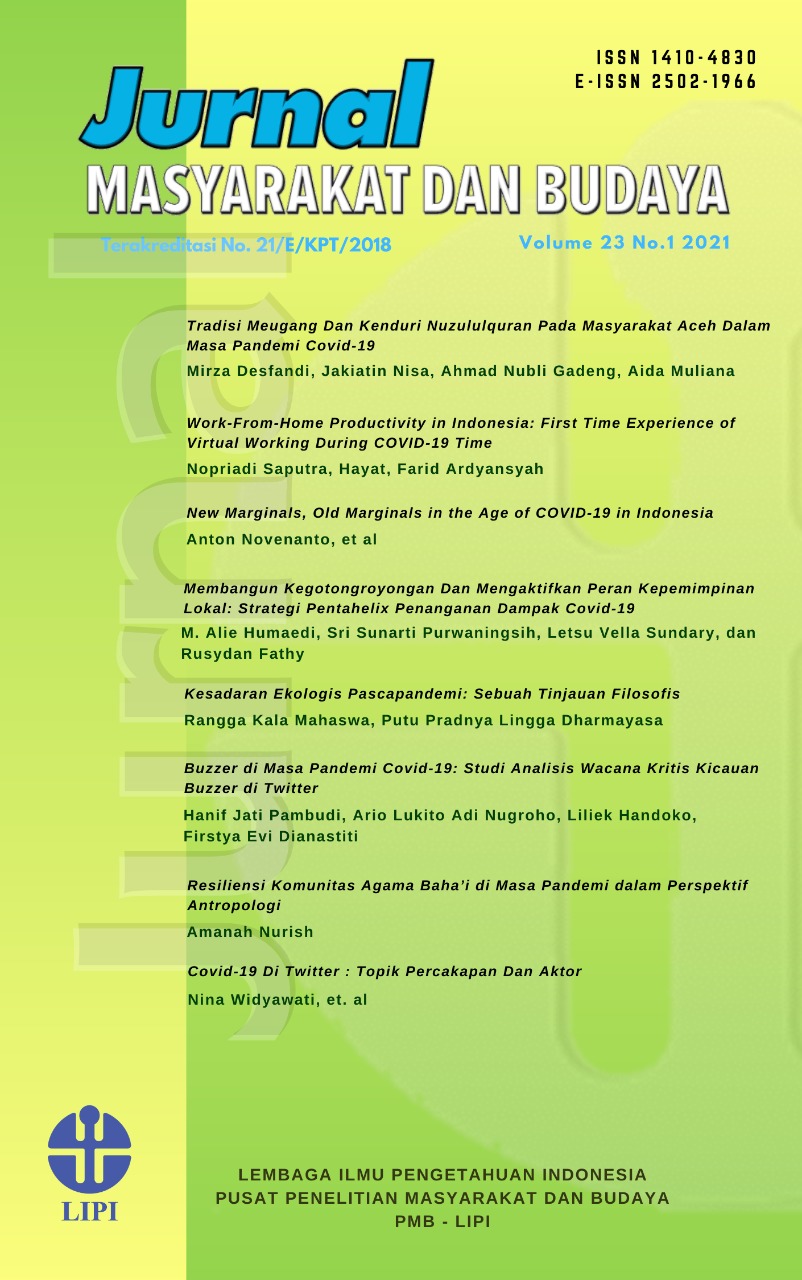
REFLECTING ECOLOGICAL AWARENESS IN POST-PANDEMIC WORLD A PHILOSOPHICAL REVIEW
Article Sidebar
Main Article Content
Abstract
This article explains neglected the ecological awareness during Covid-19 pandemic. The global community focused more on increasing public health awareness than reflecting and reviewing the forgotten space—the affected environment. The affected environment consists of the social and the natural environment. However, ecological awareness recognizes both. Added to that, the Anthropocene is a marker of ecological crisis and environment has become less habitable due to mass-anthropogenic activities in indirectly determining the notion of ecological awareness. Ecological awareness is essential for realizing a new normal society based on transformative movement and adaptive change. This research uses a literature review and a philosophical approach to reformulate ecological awareness in the post-pandemic world. its idealization must recognize the diversity of ecological awareness in terms of social transformation. There are several cultural strategies to build ecological awareness. First, idealization level concerning concept or world-view toward ‘what is ecological awareness?’. Second, the formulation level for post-pandemic ecological awareness formulation. Third, the real political movement oriented towards implementation. Therefore, the value of ecological awareness as a cultural strategy expects to recognize non-human existence, to avoid class discrimination and impartiality towards nature and society in the post-pandemic world.
Article Details

This work is licensed under a Creative Commons Attribution-ShareAlike 4.0 International License.
References
Ahmada, S. F., Marsetyo, F. D., & Putri, R. A. (2020). Solidaritas pangan Jogja
sebagai aktor alternatif penyedia kesejahteraan di masa krisis pandemi Covid-
19. Journal of Social Development Studies, 1(2), 1–13.
Alexander, J. C., & Smith, P. (2020). Covid-19 and symbolic action: Global
pandemic as code, narrative, and cultural performance. Springer. 263–269.
Amalia, V., Hadisantoso, E. P., Wahyuni, I. R., & Supriatna, A. M. (2020).
Penanganan limbah infeksius rumah tangga pada masa wabah Covid-19. LP2M,
UIN Sunan Gunung Djati. http://digilib.uinsgd.ac.id/30736/.
Bhaskar, R. (2014). The possibility of naturalism: A philosophical critique of the
contemporary human sciences. Routledge.
Bobrowski, T., Melo-Filho, C. C., Korn, D., Alves, V. M., Popov, K. I., Auerbach,
S., … Tropsha, A. (2020). Learning from history: Do not flatten the curve of
antiviral research! Drug Discovery Today. https://doi.org/
10.1016/j.drudis.2020.07.008.
Bonnett, M. (2017). Environmental consciousness, sustainability, and the
character of philosophy of education. Studies in Philosophy and Education,
36(3), 333–347. https://doi.org/10.1007/s11217-016-9556-x.
Bonneuil, C., & Fressoz, J.-B. (2016). The shock of the anthropocene: The earth,
history, and us. New York: Verso Books.
Cahapay, M. B. (2020). Rethinking education in the new normal post-Covid-19
era: a curriculum studies perspective. Aquademia, 4(2), ep20018.
Cappelen, H., Gendler, T., & Hawthorne, J. P. (2016). The Oxford handbook of
philosophical methodology. Oxford: Oxford University Press.
D’Souza, C., Singaraju, S., Halimi, T., & Mort, G. S. (2016). Examination of
cultural shock, inter-cultural sensitivity and willingness to adapt. Education+
Training. 906–925.
David, P.-M., Le Dévédec, N., & Alary, A. (2021). Pandemics in the age of the
Anthropocene: is ‘planetary health’ the answer? Global Public Health, 1–14.
https://doi.org/10.1080/17441692.2021.1893372.
Davies, J. (2016). The birth of the Anthropocene. California: University of
California Press.
Dodonova, V., & Dodonov, R. (2020). Transformation of social values during aCalifornia Press.
pandemic and problems of global solidarity. Skhid, 3(167), 21–26.
Dwi, A. (2021). Di Teluk Jakarta dipergoki limbah medis, Dinas Lingkungan
Hidup: itu isu lama. Diakses pada 5 Februari 2021 dari
https://metro.tempo.co/read/1430056/di-teluk-jakarta-dipergoki-limbah-medis-
dinas-lingkungan-hidup-itu-isu-lama.
El Zowalaty, M. E., & Järhult, J. D. (2020). From SARS to Covid-19: a previously
unknown SARS-related coronavirus (SARS-CoV-2) of pandemic potential
infecting humans–call for a one health approach. One Health, 9, 100124.
Erkoreka, A. (2009). Origins of the Spanish Influenza pandemic (1918–1920)
and its relation to the First World War. Journal of Molecular and Genetic
Medicine: An International Journal of Biomedical Research, 3(2), 190.
Flinders, M. (2020). Democracy and the politics of coronavirus: Trust, blame,
and understanding. Parliamentary Affairs. https://doi.org/10.1093/pa/gsaa013.
Funay, Y. E. N. (2020). Indonesia dalam pusaran masa pandemi: Strategi
solidaritas sosial berbasis nilai budaya lokal. Jurnal Sosiologi Agama Indonesia
(JSAI), 1(2), 107–120.
Hall, M. C., Prayag, G., Fieger, P., & Dyason, D. (2020). Beyond panic buying:
consumption displacement and Covid-19. Journal of Service Management,
32(1).
Hemida, M. G., & Abduallah, M. M. B. (2020). The SARS-CoV-2 outbreak from a
one health perspective. One Health, 10, 100127.
https://doi.org/10.1016/j.onehlt.2020.100127.
Heyd, T. (2020). Covid-19 and climate change in the times of the Anthropocene.
The Anthropocene Review, 2053019620961799.
https://doi.org/10.1177/2053019620961799.
Inge, K. (2021). Mengimbangi laju peningkatan limbah medis. Diakses pada 5
Februari 2021 dari https://koran.tempo.co/amp/metro/462117/upaya-mengelola-
peningkatan-sampah-medis-di-masa-pandemi.
Islam, T., Pitafi, A. H., Arya, V., Wang, Y., Akhtar, N., Mubarik, S., & Xiaobei, L.
(2021). Panic buying in the Covid-19 pandemic: A multi-country examination.
Journal of Retailing and Consumer Services, 59, 102357. https://doi.org/
10.1016/j.jretconser.2020.102357.
Joharudin, A., Septiadi, M. A., Maharani, S., Aisi, T. D., & Nurwahyuningsih, N.
(2020). Panic syndrom Covid-19: Penekanan terhadap kebijakan yang
diberikan. Jurnal Perspektif, 4(1), 44–53.
Keppres. (2020). Keputusan Presiden Republik Indonesia Nomor 12 Tahun 2020
tentang Penetapan sebagai Bencana Nasional. Jakarta, Indonesia.
Landrigan, P. J., Fuller, R., Acosta, N. J. R., Adeyi, O., Arnold, R., Baldé, A. B.,
… Breysse, P. N. (2018). The Lancet Commission on pollution and health. The
Lancet, 391(10119), 462–512.
Leach, M., MacGregor, H., Scoones, I., & Wilkinson, A. (2021). Post-pandemic
transformations: How and why Covid-19 requires us to rethink development.
World Development, 138, 105233.
https://doi.org/10.1016/j.worlddev.2020.105233.
Mahaswa, R. K., & Widhianto, A. (2020). Questioning the ‘Anthropos’ in the
Anthropocene: Is the Anthropocene Anthropocentric? SHS Web of Conferences,
76, 1040. EDP Sciences.
Mahaswa, R. K., Widhianto, A., & Hasanah, N. (2021). Eco-agriculture and
farming in the Anthropocene epoch: A philosophical review. E3S Web of
Conferences, 226, 35. EDP Sciences.
Maizan, S. H., Bashori, K., & Hayati, E. N. (2020). Analytical theory: Gegar
budaya (culture shock). Psycho Idea, 18(2), 147–154.
Martini, M., Gazzaniga, V., Bragazzi, N. L., & Barberis, I. (2019). The Spanish
Influenza pandemic: A lesson from history 100 years after 1918. Journal of
Preventive Medicine and Hygiene, 60(1), E64.
Nababan, F. H. (2021). Limbah medis B3 masker sekali pakai di DKI tembus
12,785 ton. Diakses pada 5 Februari 2021 dari
https://www.kompas.id/baca/metro/2021/01/28/limbah-medis-b3-masker-sekali-
pakai-di-dki-tembus-12785-ton.
Panov, V. I. (2013). Ecological thinking, consciousness, responsibility. Procedia-
Social and Behavioral Sciences, 86, 379–383.
https://doi.org/10.1016/j.sbspro.2013.08.583.
Peters, D. J. (2020). Community susceptibility and resiliency to Covid-19 across
the rural-urban continuum in the United States. Journal of Rural Health, 36(3),
446–456. https://doi.org/10.1111/jrh.12477.
Pinner, D., Rogers, M., & Samandari, H. (2020). Addressing climate change in
post-pandemic world. McKinsey Quarterly April.
Pratiwi, I., & Utama, B. (2020). Kesenjangan kualitas layanan pendidikan di
Indonesia pada masa darurat Covid-19: Telaah demografi atas implementasi
kebijakan belajar dari rumah. Jurnal Kependudukan Indonesia, 81–86.
Purba, R. (2020). Kepanikan sosial skibat munculnya Covid-19. Jurnal
Penelitian Kesejahteraan Sosial, 19(2), 124–136.
Rachmawati, E. (2021). Kasus Covid-19 global turun, Indonesia justru naik.
Diakses pada Februari 5 2021 dari https://www.kompas.id/baca/bebas-
akses/2021/02/04/kasus-covid-19-global-turun-indonesia-justru-naik/.
Rahardi, K. (2020). Building critical awareness of corona virus-related news:
cyber-pragmatic study of Covid-19 hoaxes on social media. International Journal
of Advanced Science and Technology, 29(6), 5398–5409.
Reicher, S., & Drury, J. (2021). Pandemic fatigue? How adherence to Covid-19
regulations has been misrepresented and why it matters. Bmj, 372.
Reperant, L. A., & Osterhaus, A. D. M. E. (2017). AIDS, Avian flu, SARS, MERS,
Ebola, Zika… what next? Vaccine, 35(35), 4470–4474.
Rosita, R. (2020). Panic buying in the Covid–19 pandemic era in Indonesia.
International Journal of Multi-Science, 1(07), 60–70.
Ruhyani, Y. (2020). Sampah medis di muara sungai menuju Teluk Jakarta
semasa pandemi Covid-19 meningkat. Diakses pada 5 Februari 2021 dari
http://lipi.go.id/siaranpress/Sampah-Medis-di-Muara-Sungai-Menuju-Teluk-
Jakarta-Semasa-Pandemi-COVID-19-Meningkat/22308.
Sarkodie, S. A., & Owusu, P. A. (2020). Global assessment of environment,
health and economic impact of the novel coronavirus (Covid-19). Environment,
Development, and Sustainability, 1–11.
Satgas Covid-19. (2021). Peta sebaran. Diakses pada 5 Februari 2021 dari
https://covid19.go.id/peta-sebaran.
Schneider, S. H., Eger, J., Bruder, M., Faust, J., & Wieler, L. H. (2021). Does the
Covid-19 pandemic threaten global solidarity? evidence from Germany. World
Development, 140, 105356.
Shadiqi, M. A., Hariati, R., Hasan, K. F. A., I’anah, N., & Al Istiqomah, W. (2020).
Panic buying pada pandemi Covid-19: Telaah literatur dari perspektif psikologi.
Jurnal Psikologi Sosial.
Shahsavari, S., Holur, P., Tangherlini, T. R., & Roychowdhury, V. (2020).
Conspiracy in the time of corona: Automatic detection of Covid-19 conspiracy
theories in social media and the news. ArXiv Preprint ArXiv. 2004.13783.
Sharfuddin, S. (2020). The world after Covid-19. The Round Table, 109(3), 247–
257.
Stanley, M. L., Barr, N., Peters, K., & Seli, P. (2020). Analytic-thinking predicts
hoax beliefs and helping behaviors in response to the Covid-19 pandemic.
Thinking & Reasoning, 1–14.
Steffen, W., Broadgate, W., Deutsch, L., Gaffney, O., & Ludwig, C. (2015). The
trajectory of the Anthropocene: The great acceleration. The Anthropocene
Review, 2(1), 81–98.
Steffen, W., Grinevald, J., Crutzen, P., & McNeill, J. (2011). The Anthropocene:
Conceptual and historical perspectives. Philosophical Transactions of the Royal
Society: A Mathematical, Physical, and Engineering Sciences, 369(1938), 842–
867.
Taskinsoy, J. (2020). A move towards a cashless society accelerates with the
novel coronavirus induced global lockdown. Available at SSRN 3747750.
Tempo. (2020,). Covid-19 telah memicu gegar budaya. 2020. Diakses pada 5
Februari 2020 dari
https://majalah.tempo.co/read/wawancara/161308/wawancara-emil-salim-
pandemi-covid-19-telah-memicu-gegar-budaya.
Tempo, E. (2021). Gonta ganti kebijakan Covid. Diakses pada 5 Februari 2020
dari https://koran.tempo.co/read/editorial/462174/gonta-ganti-kebijakan-covid.
Van Bavel, J. J., Boggio, P., Capraro, V., Cichocka, A., Cikara, M., & Crockett, M.
(2020). & Ellemers, N.(2020). Using social and behavioural science to support
Covid-19 pandemic response. Nature Human Behavior.
Verma, A., & Prakash, S. (2020). Impact of Covid-19 on environment and
society. Journal of Global Biosciences, 9(5), 7352–7363.
Wallace, R. (2016). Big farms make big flu: Dispatches on influenza,
agribusiness, and the nature of science. New York: NYU Press.
Whitmee, S., Haines, A., Beyrer, C., Boltz, F., Capon, A. G., de Souza Dias, B.
F., … Head, P. (2015). Safeguarding human health in the Anthropocene epoch:
Report of the Rockefeller Foundation–Lancet Commission on planetary health.
The Lancet, 386(10007), 1973–2028.
WHO. (2020). Pandemic fatigue: Reinvigorating the public to prevent COVID-19:
Policy considerations for member states in the WHO European Region. Diakses
pada 5 Februari 2020 dari https://apps.who.int/iris/handle/10665/335820.
WHO. (2021). WHO Coronavirus Disease (Covid-19) dashboard. Diakses pada
5 Februari 2020 dari https://covid19.who.int/.
Wilson-Scott, J. (2021). Accommodating the Anthropocene: The home as a site
of ecological significance in climate fiction. Green Letters, 1–10.
https://doi.org/10.1080/14688417.2021.1886968.
Winanti, P. S., & Mas’udi, W. (2020). New normal: Perubahan sosial ekonomi
dan politik akibat Covid-19. Yogyakarta: UGM Press.
Windfeld, E. S., & Brooks, M. S.-L. (2015). Medical waste management–a
review. Journal of Environmental Management, 163, 98–108.
Zakaria, F. (2020). Ten lessons for a post-pandemic world. New York: WW
Norton et Company.
Zalasiewicz, J., Waters, C. N., Williams, M., & Summerhayes, C. P. (2019). The
Anthropocene as a geological time unit: A guide to the scientific evidence and
current debate. Cambridge: Cambridge University Press.
Zambrano-Monserrate, M. A., Ruano, M. A., & Sanchez-Alcalde, L. (2020).
Indirect effects of Covid-19 on the environment. Science of the Total
Environment, 728, 138813.
Zhong, H., Tan, Z., He, Y., Xie, L., & Kang, C. (2020). Implications of Covid-19
for the electricity industry: a comprehensive review. CSEE Journal of Power and
Energy Systems, 6(3), 489–495.