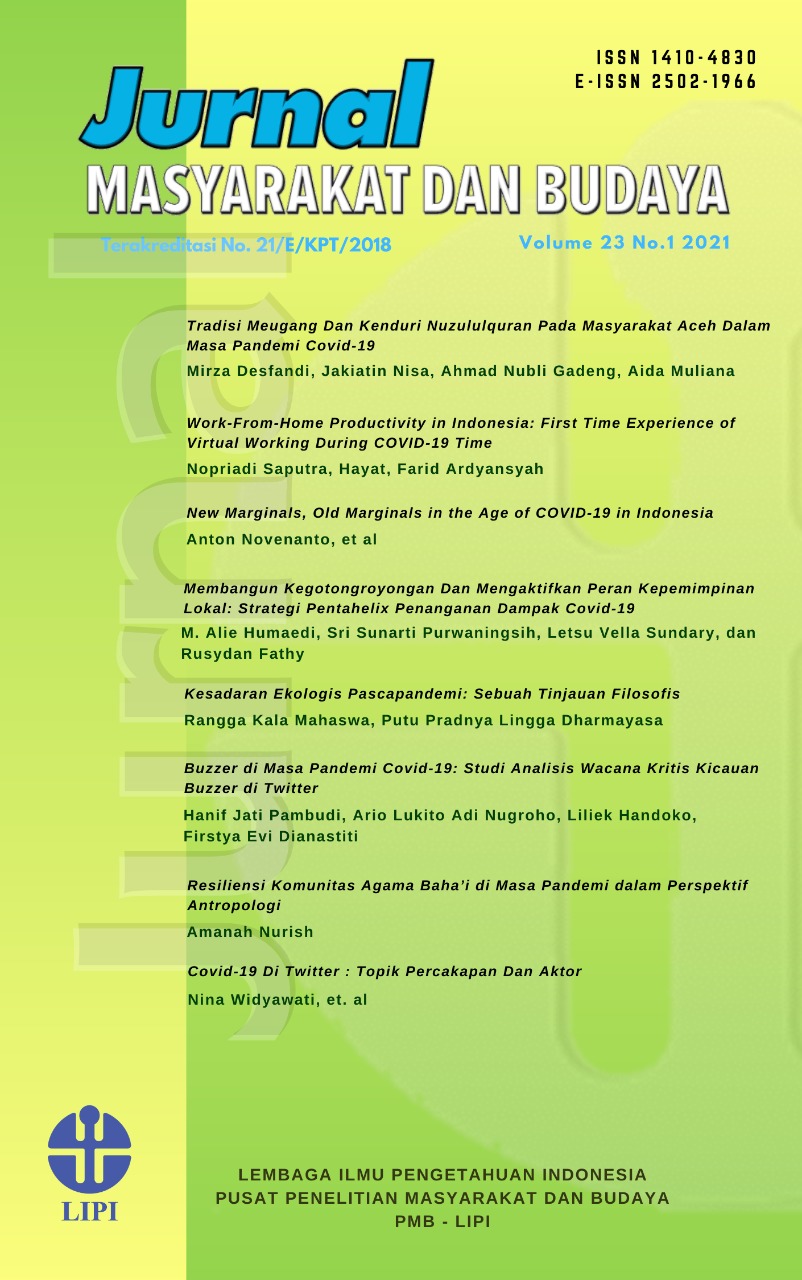
BUZZERS DURING THE COVID-19 PANDEMIC STUDY OF CRITICAL DISCOURSE ANALYSYIS OF BUZZER'S TWEET IN TWITTER
Article Sidebar
Main Article Content
Abstract
The Covid-19 pandemic in Indonesia was widely discussed on social media, such as the Twitter. The widespread use of social media was followed by the emergence of buzzers with their goals and interests as well as the ideology they promote. One of the buzzers is @ permadiaktivis1, in this case, who has confirmed himself a buzzer. This qualitative research refers to Norman Fairclough's critical discourse analysis by repeating the discussion on the textual dimension, the discourse practice, and the sociocultural dimension. Data obtained from tweets on the Twitter account @ permadiaktivis1 during the Covid-19 pandemic. The Buzzer in this study is positioned as a key opinion leader who is assumed able to polarize information related to the Covid-19 pandemic. the representation of the pandemic imaged as something negative is to negate the government's mismanagement in making policies related to pandemics. The tweets never blame the government for the policies issued, and insinuations and invitations became a pattern for tweets. The vaccination’s policy is packaged that teases those who doubt vaccinations or those who refuse it. The Buzzer phenomenon will impact the polarization of the information about COVID-19. Besides, several tweets from Buzzer show that they play significant role to support government policies.
Article Details

This work is licensed under a Creative Commons Attribution-ShareAlike 4.0 International License.
References
Alkatiri, Awad Bin Muhammad, Zhafira Nadiah, Adinda Nada S. Nasution. 2020.
“Opini Publik Terhadap Penerapan New Normal di Media Sosial Twitter”.
CoverAge: Journal of Strategic Communication Vol. 11, No. 1, Hal. 19-26.
September 2020
Anugerah, Boy. (2020). “Urgensi Pengelolaan Pendengung (Buzzer) Melalui
Kebijakan Publik Guna Mendukung Stabilitas Politik di Indonesia”. Jurnal Kajian
Lembaga Ketahanan Republik Indonesia, vol. 8 nomor 3, 2020, pg. 391-407.
BBC Indonesia. (2020). Covid-19: 'Stres, mudah marah, hingga dugaan bunuh
diri', persoalan mental murid selama sekolah dari rumah. Diakses melalui
https://www.bbc.com/indonesia/indonesia-55992502 pada 7 Maret 2021 Pukul
11.32 WIB
Blumler, J. G., & Kavanagh, D. (1999). The third age of political communication:
Influences and features. Political communication, 16(3), 209-230.
CNN Indonesia. (2020). 8 Bulan Pandemi, 56 Persen Ibu Rumah Tangga Alami
Stres diakses melalui https://www.cnnindonesia.com/gaya-
hidup/20201111113804-255-568443/8-bulan-pandemi-56-persen-ibu-rumah-
tangga-alami-stres pada 7 Maret 2021 Pukul 11.48 WIB
Darma, Yoce Aliah. (2013). Analisis Wacana Kritis. Bandung: Yrama Widya
Dianastiti, Firstya Evi, Hari Bakti Mardikantoro. (2016). “Analisis Wacana Kritis
Pemberitaan Harian Suara Merdeka, Harian Republika, Harian Kompas, dan
Tabloid Derap Guru dalam Pembentukan Citra Guru”. Seloka: Jurnal Pendidikan
Bahasa dan Sastra Indonesia, Volume 5, nomor 2, tahun 2016.
Eriyanto, (2002). Analisis Framing: Konstruksi, Ideologi, dan Politik Media”.
Yogyakarta: LKis
Felicia, F., & Loisa, R. (2019. “Peran buzzer politik dalam aktivitas kampanye di
media sosial twitter”. Koneksi, 2(2), 352-359.
Fortner, R. S. & Fackler, P. M. (2014). The Handbook of Media and Mass
Communication Theory. Volume 1. West Sussex: John Wiley & Sons, Inc
Gunawan, S. H., & Salamah, U. (2018).. Social Media Buzzer Utilization as a
Form of Digital Campaign Practice. 507–519.
Gustomy, Rachmad. (2020). “Pandemi ke Infodemi: Polarisasi Politik dalam
Wacana Covid-19 Pengguna Twitter”. JIIP: Jurnal Ilmiah Ilmu Pemerintahan,
Volume 5, Nomor 2, Tahun 2020, DOI: 10.14710/jiip.v5i2.8781
Haryanto, A. (2021, Februari 10). Apa Itu Buzzer Politik? Arti, Strategi, Sejarah
dan Pola Rekrutmen. tirto.id. https://tirto.id/apa-itu-buzzer-politik-arti-strategi-
sejarah-dan-pola-rekrutmen-gaaE
Haryanto, H. (2014). Kebangkitan Party ID: Analisis Perilaku Memilih dalam
Politik Lokal di Indonesia. Jurnal Ilmu Sosial dan Ilmu Politik, 17(3), 291-308.
Heryanto, G. G. (2018). Media Komunikasi Politik. IRCiSoD.
KADIN. (2020). Selama Pandemi, Pengusaha Lakukan Efisiensi. Diakses
melalui https://www.kadin.id/news-event/news-detail/1290/selama-pandemi-
pengusaha-lakukan-efisiensi pada 7 Maret 2021 Pukul 12.38 WIB
Kusno, Ali. (2017). “Analisis Wacana Percakapan Warga dalam Grup Facebook
Bubuhan Samarinda: Identifikasi Potensi Konflik Sosial.” Jurnal Masyarakat
Budaya Volume 19 No.1 Tahun 2017.
MacBean, N., Ward, E., Murdoch, B., Cahill, L., Solley, M., Geraghty, T., &
Hukins, C. (2009). Optimizing speech production in the ventilator‐assisted
individual following cervical spinal cord injury: a preliminary investigation.
International journal of language & communication disorders, 44(3), 382-393.
Maharani, Prima Suci, Nisma Laela Nurafifah. (2020). “Political Communication:
Social Media Strengths and Threats in the 2019 General Election”. Politik
Indonesia: Indonesian Political Science Review, 5 (2), August 2020, pp. 292-
306, ISSN 2477-8060 (print), ISSN 2503-4456 (online), DOI:
https://doi.org/10.15294/ipsr.v5i2.21522
Neyasyah, Muhammad Syirazi. (2019). “Legal Resilience in the Phenomenon of
Social Media Political Buzzer in Indonesia”. Advances in Economics, Business
and Management Research, volume 130, 3rd International Conference on Law
and Governance (ICLAVE 2019), 338-344.
Putra, Ariandi, Irwansyah. (2020). “Orkestrasi Buzzer melalui Media Sosial
Microblogging dalam Kampanye Penanganan Virus Covid-19”. Jurnal Riset
Komunikasi Volume 3 nomor 2 (2020), ph. 267-288. P-ISSN: 2615-0875 E-
ISSN: 2615-0948
Syahputra, I. (2017). Demokrasi virtual dan perang siber di media sosial:
Perspektif Netizen Indonesia. Jurnal Aspikom, 3(3), 457-475.
Setianto, Y. P. (2019). Trusting Twittersphere as a Genuine Political Debate? The
Case of Indonesian Election Hashtags. AoIR Selected Papers of Internet
Research.
Sudibyo, Agus. (2006). Politik Media dan Pertarungan Wacana. Yogyakarta:
LKIS.
Sudrajat. (2021, Februari 01). Permadi Arya Bicara Islam Arogan, Evolusi hingga
Buzzer Jokowi. detik.com. https://news.detik.com/berita/d-5356106/permadi-
arya-bicara-islam-arogan-evolusi-hingga-buzzer-jokowi
Sugiono, Shiddiq. (2020). “Fenomena Industri Buzzer di Indonesia: Sebuah
Kajian Ekonomi Politik Media”. Communicatus: Jurnal Ilmu Komunikasi, Volume
4 Nomor 1 (2020) 47-66 , DOI: 10.15575/cjik.v4i1.7250
Soderborg, S., & Muhtadi, B. (2020, Desember 9). Riset: keberpihakan politik
mempengaruhi perilaku warga terkait pandemi di wilayah dengan konflik politik
tinggi (misal Jakarta). The Conversation. https://theconversation.com/riset-
keberpihakan-politik-mempengaruhi-perilaku-warga-terkait-pandemi-di-wilayah-
dengan-konflik-politik-tinggi-misal-jakarta-150877