COVID-19 IN TWITTER: ISSUES AND ACTORS
Article Sidebar
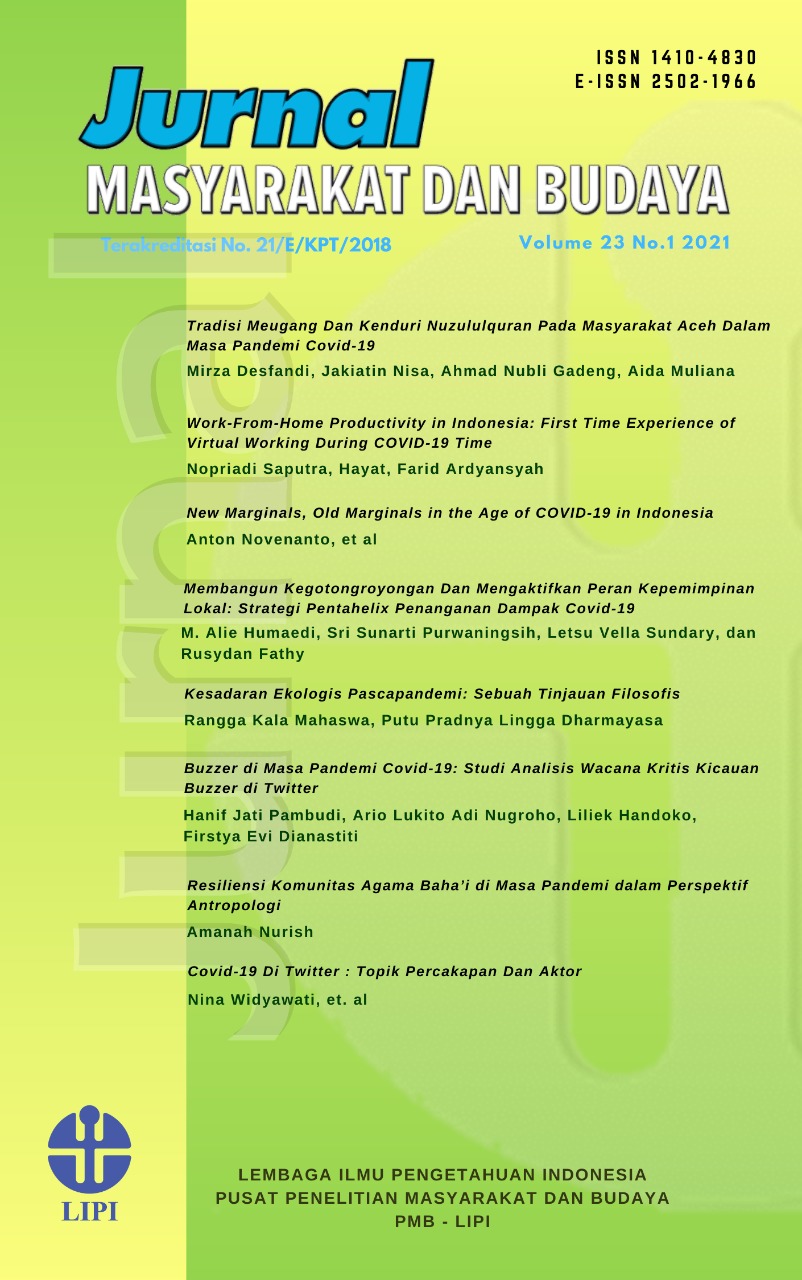
Main Article Content
Abstract
The social media is assumed as canal to get information during the pandemic of COVID-19, however it also indicate the landscape of the media. During the pandemic, social media produces information, however several are inaccurate, therefore it coins new terms such as infodemic. On the other hand, government afraid that it might cause confusion and questioning the legitimate information for the economic and health reasons. The other important assumption is due to its popularity, the social media function as means of education and socialization. Therefore the goals of the study are, first is showing information as education and socialization or as infodemic; second is show actors dominate the social media discussion; third is to map the changing of the media’s landscape. Object of study is twitter during the three stages of PSBB (Pembatasan Sosial Berskala Besar) or large scale social restriction; the first, the transition and the full scale. The result shows that civil society as well as government educate and socialize to prevent the spread of pandemic. However, there are several unpopular infodemic and seldom re-Tweet. Individual plays important role rather that the media indusry, and it indicate the transition period of the media, where the media industry plays important role in the social media’s information due to its dominant Tweet.
Article Details

This work is licensed under a Creative Commons Attribution-ShareAlike 4.0 International License.
References
Alice Marwick dan Rebecca Lewis. Media Manipulation and Disinforation Online.
Data and Society Research Institute, page 106, 2017.
Baran, Stanley J., and Dennis K. Davis. 2015. Mass Communication Theory:
Foundation, Ferment, and Future. Seventh Edition. Stamford: Cengage Learning
Benkler, Yochai, Robert Faris, and Hal Robert. 2018. Network Propaganda:
Manipulation, Disinformation, and Radicalization In American Politics. New York:
Oxford University Press
Blei, David M.; Ng, Andrew Y.; Jordan, Michael I (January 2003). Lafferty, John
(ed.). "Latent Dirichlet Allocation". Journal of Machine Learning Research. 3 (4–
5): pp. 993–1022.
Brennen, A. J. S., Simon, F. M., Howard, P. N., & Nielsen, R. K. (2020). Types
Sources , and Claims of COVID-19 Misinformation. April, 1–13.
Dubuis, Marc dan Andrew William. 2019. The Spread of Disinformation on The
Web: An Examination of Memes on Social Networking. Conference paper. 2019.
http://researchgate.net/publication/335277618, DOI:10.1109/SmartWorld-UIC-
ACT-SCALCOM-IOP-SCI.2019.00256
Edgley, Alison. 2015. Noam Chomsky. UK: Palgrave
Europian Commission. (2018). A multi-dimensional approach to disinformation:
Report of the independent High level Group on fake new sand online
disinformation. Diunduh dari https://ec.europa.eu/digital-single-
market/en/news/final-report-high-level-expert-group-fake-news-and-online-
disinformation
Herman, Edwards S. and Noam Chomsky. 1988. Manufacturing Concent The
Political Economy of the Mass Media. New York: Pantheon Book
Koch-Baumgarten, Sigrid and Katrin Voltmer. Editors. 2010. Public Policy and
Mass Media The Interplay of mass communication and political decision making.
London and New York: Routledge/ECPR Studies in European Political Science
MacLeod, Alan. Editor. Propaganda In the Information Age Still Manufacturing
Consent. London and New York: Routledge Taylor & Francis Group
Matthewman, S., & Huppatz, K. (2020). A sociology of Covid-19. Journal of
Sociology. https://doi.org/10.1177/1440783320939416
https://indonesia.go.id/narasi/indonesia-dalam-angka/ekonomi/kasus-covid-19-
pertama-masyarakat-jangan-panik, diakses 29 Desember 2020
Pulido, C. M., Villarejo-Carballido, B., Redondo-Sama, G., & Gómez, A. (2020).
COVID-19 infodemic: More retweets for science-based information on
coronavirus than for false information. International Sociology, 35(4), 377–392.
https://doi.org/10.1177/0268580920914755
Urry, J. (2000). Sociology Beyond Societies. In Sociology Beyond Societies.
Routledge. https://doi.org/10.4324/9780203021613
Wodak, Ruth dan Paul Chilton. Editor. 2005. New Agenda in (Critical) Discourse
Analysis Theory, methodology, and interdiciplinarity. Amsterdam/Philadelpia:
John Benjamins Publishing Company.
Woolley, Samuel C., and Philip N. Howard. Editors. 2019. Computational
Propaganda Political Parties, Politicians and Political Manipulation on Social
Media. New York: Oxford University Press