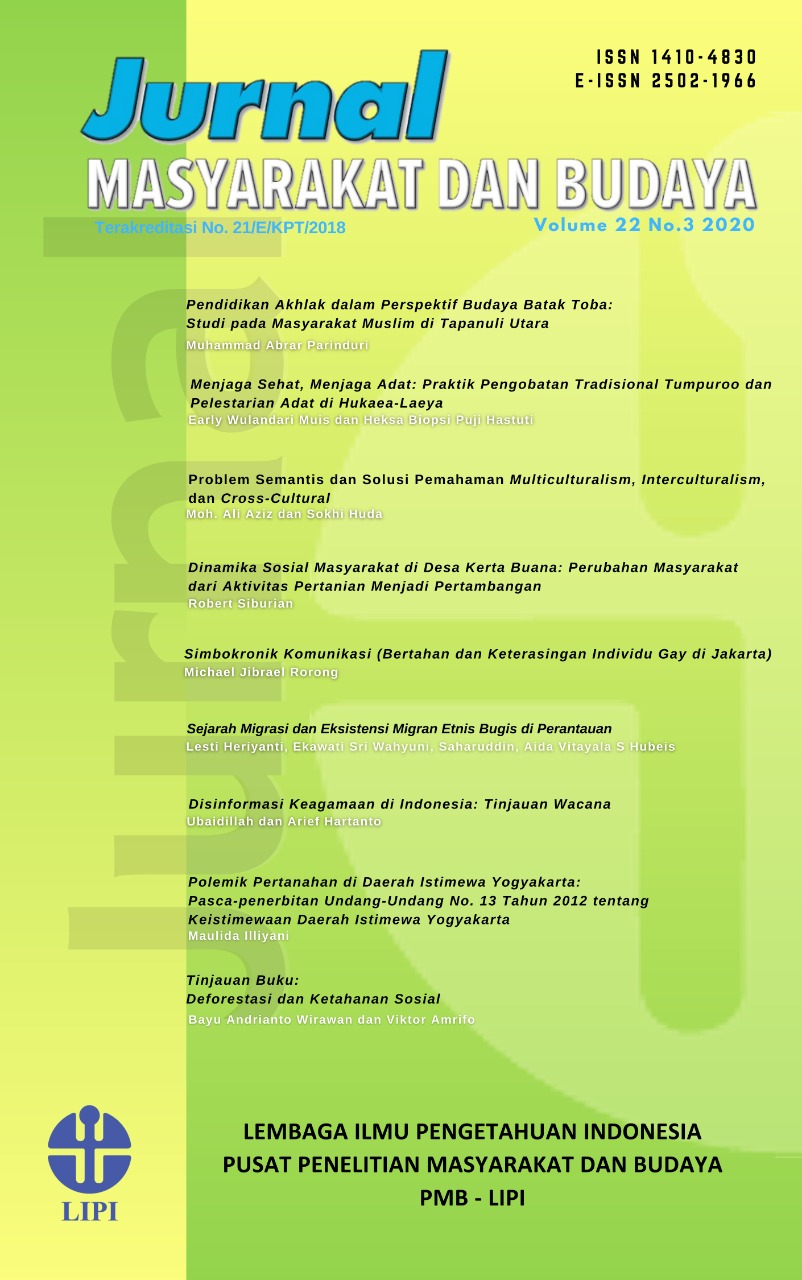
SEJARAH MIGRASI DAN EKSISTENSI MIGRAN ETNIS BUGIS DI PERANTAUAN
Article Sidebar
Main Article Content
Abstract
This study aims to analyze the history of migration and the livelihood system of ethnic Bugis in Jambi
Province. The research used qualitative approach with descriptive analysis method. Data collected used interview
with interview guide, observation non-participant and questionnaire 25 informan from ethnic Bugis, Javanese,
Sundanese, Minangkabaunese and Bataknese. The results showed that: the history of Bugis ethnic migration to the
Jambi region was a long history since the period after Indonesia became independent. The political and security
turmoil after Indonesian independence encouraged Buginese to migrate to areas they considered safe and there
were networks of Bugis communities in the region. The livelihood systems developed by Buginese are related to
intra-social fabric links and between Buginese communities that are overseas. Social capital in the lives of ethnic
Bugis overseas makes it easier for them to develop a livelihood system, supports the process of adaptation to
new environments overseas and is even able to encourage a number of individuals to own assets and control the
overseas economy
Article Details

This work is licensed under a Creative Commons Attribution-ShareAlike 4.0 International License.
References
Acciaioli, G. L. (1989). Searching or good fortune: The
making of a bugis shore community at Lake Lin
du, Central Sulawesi. Australian National Uni
versity: Thesis. DOI:10.25911/5d7633f0dcc2c.
http://hdl.handle.net/1885/111372.
Abdullah, A. (2017). Ethical politic and emergence of
intellectual class. Paramita: Historical Studies
J. 27(1): 34–49.
Abdoellah, O. S. (2017). Ekologi manusia dan pem
bangunan berkelanjutan. Jakarta: PT Gramedia
Pustaka Utama.
Ahimsa-Putra, H. S. (2003). Ekonomi moral, rasional,
dan politik dalam industri kecil di Jawa. Yog
yakarta: KEPEL Press.
Ammarell, G. (2002). Bugis migration and modes of
adaptation to local situations. Ethnology, 41(1),
51-6741.
Arisandi, H. (2015). Buku pintar pemikiran tokoh sosi
ologi dari klasik sampai modern. Yogyakarta
(ID): IRCiSoD.
Black, R., Kniveton, D., & Schmidt-Verkerk, K.
(2011). Migration and climate change: Towards
an integrated assessment of sensitivity. Envi
ronment and Planning A: Economy and
Space, 43(2), 431–450. https://doi.org/10.1068/
a43154.
Budhi, S. (2015). Bugis Pagatan: Migration, adapta
tion and identity. IOSR J of Humanities and
Social Science, 20(1),71-78.
Chambers, R. & Conway, G. (1992). Sustainable
rural livelihoods: Practical concepts for the
21st Century. IDS Discussion Paper 296, IDS,
Brighton.
Dharmawan, A. H. (2007). Sistem penghidupan dan
nafkah pedesaan: Pandangan sosiologi nafkah
(livelihood sociology) Mazhab Barat dan
Mazhab Bogor. Sodality: J Transdisiplin Sosi
ologi, Komunikasi dan Ekologi,1(2), 169–191.
Ellis, F. (1999). Rural livelihood and diversity in devel
oping countries. Natural Resource Perspective.
Diakses dari: https://dlc.dlib.indiana.edu/dlc/
bitstream/handle/10535/4486/40-rural-liveli
hood-diversity.pdf?sequence=1&isAllowed=y.
Field, J. (2003). Social Capital. London: Routledge.
Field, J. (2010). Modal Sosial. Yogyakarta: Kreasi
Wacana.
Fridayanti, N. & Dharmawan, AH. (2013). Analisis
struktur dan strategi nafkah rumah tangga
petani sekitar kawasan hutan konservasi di
Desa Cipeuteuy Kabupaten Sukabumi. Sodal
ity: J Transdisiplin Sosiologi, Komunikasi dan
Ekologi. 1(1), 26–36.
Harun, M. H., Sibe, M. Y., & Katutu, B. (2015).
Prinsip “siri” dalam perkahwinan masyarakat
Bugis di Jambi Indonesia. DOI: 10.13140/
RG.2.1.4080.4560.
Hein, J. & Faust, H. (2010). Frontier migration as
response to environmental change: a case study
from Central Sulawesi, Indonesia. STORMA
Discussion Paper Series No. 31 10.13140/
RG.2.2.13271.88484.
Jumadi. (2016). Social capital of Madura barbers in
Makassar, South Sulawesi. Komunitas Inter
national J of Indonesian Society and Culture,
8(2), 267–274 DOI:10.15294/komunitas.
v8i2.6219.
Kristiawan, N. (2017). Pola adaptasi ekologi budaya
tiga komunitas di Jambi. J Bhumi. 3(2):
189–200.
Lampe, M. (2012). Bugis-Makassar Seamanship and
reproduction of maritime cultural values in
Indonesia. Humaniora, 24(2), 121–132.
Lee, E. S. (2007). A theory of migration. Demography,
3(1), 47–57.
Lineton, J. (1975). Pasompe Ugi: Bugis migrant and
wanderers. Archipel., 10, 173–201.
Mansyur. (2016). Migrasi dan jaringan ekonomi suku
Bugis di wilayah Tanah Bumbu Keresidenan
Borneo bagian selatan dan timur 1930–1942.
J Sejarah Citra Lekha, 1(1), 24–39.
Moniaga, Vicky R. B. (2011). Analisis daya dukung
lahan pertanian. Agri-sosioekonomi J Ilmiah
Sosial Ekonomi Pertanian UNSRAT, 7(2),
61–68.
Mulyoutami, Elok, P., Ekawati, S. W., & Lala,
M. K. (2016). Agroforestry and forestry in
Sulawesi series: Unravelling rural migration
networks: land-tenure arrangements among
Bugis migrant communities in Southeast
Sulawesi. Working Paper 225. Bogor (ID):
World Agroforestry Centre (ICRAF) Southeast
Asia Regional Program. DOI: http://dx.doi.
org/10.5716/WP16035.PDF.
Naim. M. (1979). Merantau pola migrasi Suku
Minangkabau. Yogyakarta (ID): Gadjah Mada
University Press.
Poston, D. L., & Frisbie, P. W. (2005). Ecological
demography. Poston D. L. dan Micklin M.
(editors). Handbook of Population. New York
(US): Kluwer Academic/Plenum Publisher. Pp
601–623.
Rahman, K. M. A. (2015). Ethno-political conflict:
The Rohingya vulnerability in Myanmar.
International J of Humanities & Social Science
Studies, 6959(288), 2349–6959.
Rusli, S. (2014). Pengantar ilmu kependudukan. (edisi
revisi). Jakarta (ID): LP3ES.
Saleh, M. H. (2015). Dinamika masyarakat perbatasan:
Eksistensi perantau Bugis di Pulau Sebatik,
Kalimantan Utara. J Borneo Administrator,
11(1), 31–48.
Sani, A. (2020). Diaspora Bugis dan perkembangan
perdagangan kopra di Sumatera pada awal abad
XX. Tamadun: Jurnal Kebudayaan dan Sastra
Islam, 20(1).
Santo, R. S. (1978). Concept of applied ecology. New
York (US): Springer-Verlag.
Sasongko, Y. A. T. & Ekawati, S. W. (2013). Diaspora
Madura: Analisis modal sosial usaha sektor
informal oleh migran Madura di Kecamatan
Tanah Sareal, Kota Bogor, Jawa Barat. Sodal
ity: J Sosiologi Pedesaan, 1(1), 52–63.
Scoones, I. (1998). Sustainable rural livelihoods:
A framework for analysis. Institute of Devel
opment Studies. Working Paper 72. 1–22.
https://doi.org/10.1057/palgrave.develop
ment.1110037.
Scoones, I. (2009). Livelihoods perspectives and rural
development. The J of Peasant Studies, 36(1), pp
171-196. DOI: 10.1080/03066150902820503.
Sofyan, F. (2013). Pengaruh transmigrasi terhadap
kehidupan sosial ekonomi masyarakat di Desa
Tepian Makmur, Kecamatan Rantau Pulung,
Kabupaten Kutai Timur. eJournal Ilmu Pemer
intahan. 1(3), pp 1167-1180.
Sjaf, S, & Zid, M. (2009). Sejarah perkembangan
Desa Bugis–Makassar Sulawesi Selatan. Jurnal
Sejarah Lontar, 6(2), Juli-Desember 2009.
Tamtiari. (1999). Dampak sosial migrasi tenaga kerja
ke Malaysia. Jurnal Populasi, 10(2), pp 39-56.
Tachimoto, N. M. (1994). Coping with the currents of
change: A frontier Bugis settlement in Johor,
Malaysia. Southeast Asian Studies, 32(2), pp
1197-230.
Tridakusumah, A. C, Supyandi, D., & Sukayat, Y.
(2016). Social identity, ethnicity and internal
mobility in Indonesia. Dalam Abdullah, A.
G., Arifin, A., Adriany V., Aryanti, T., Nandi
yanto, A. B. D., Nuria, H., & Nugraha, F. (Ed).
Prosiding 1st UPI International Conference
on Sociology Education (UPI ICSE 2015).
Bandung: Atlantis Press. 247–250.
Vayda, A. P., & Ahmad, S., (1985). Forest clearing
and pepper farming by Bugis migrants in East
Kalimantan: antecedents and impact. Indone
sia, 39, Pp 93-110.
Yani, A. (2018). Dampak perang Makassar terhadap
umat Islam Sulawesi Selatan abad XVII–VIII
M. Jurnal Rihlah, 06(01), pp 113-131.
Wartiharjono, S., (2017). Potensi konflik dan pem
bentukan modal sosial: Belajar dari sebuah
desa transmigran di Kalimantan Timur. J
Masyarakat, Kebudayaan dan Politik, 30(2),
84–93.
Wiharyanto, A. K. (2008). Kebijakan ekonomi kolo
nial tahun 1830-1901. Journal Historia Vitae,
22(1), pp 11-14.
Widodo, B., Lupyanto, B., Sulistiono, D. A., Harjito,
Hamidin, J., Hapsari, E, &Ellinda, C. (2015).
Analysis of environmental carrying capacity
for the development of sustainable settlement
in Yogyakarta urban area. Procedia Environ
mental Science, 28, pp 519-527.