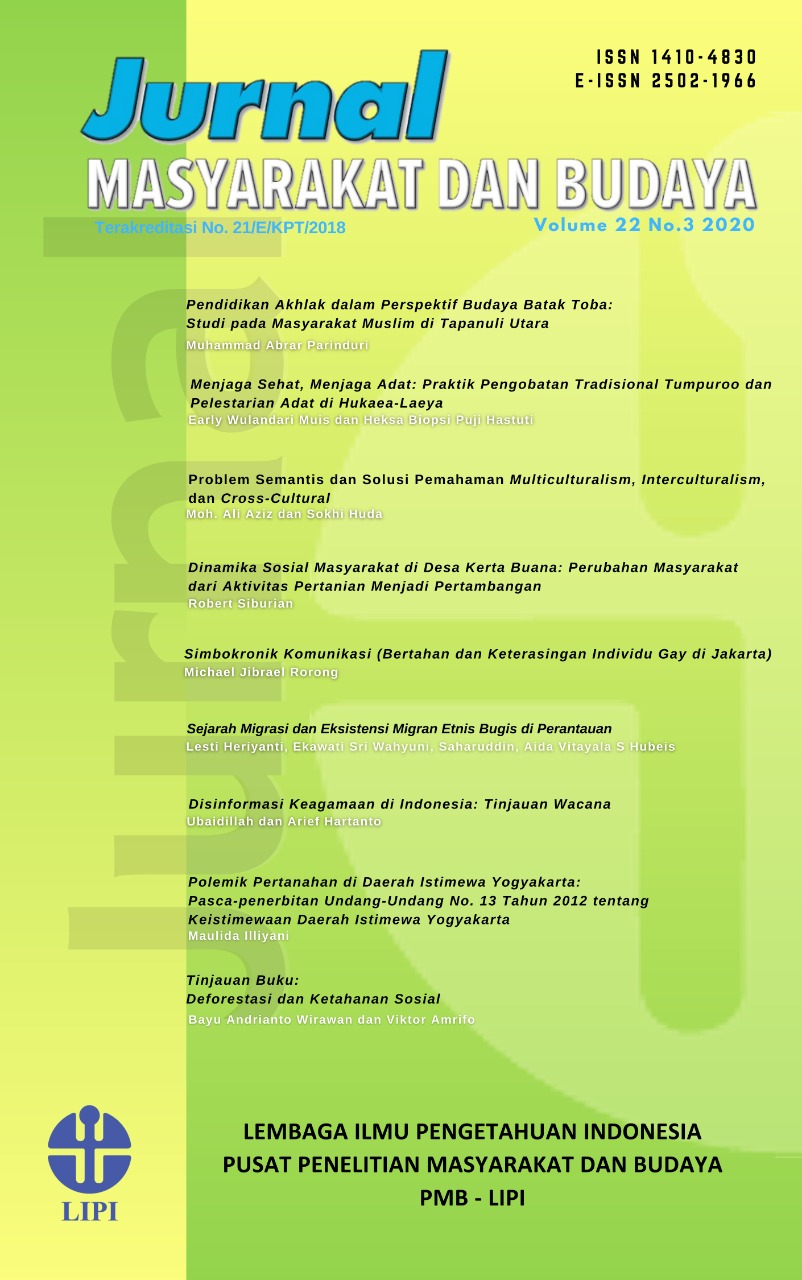
DISINFORMASI KEAGAMAAN DI INDONESIA: TINJAUAN WACANA
Article Sidebar
Main Article Content
Abstract
This paper attempts to describe the disinformation on communism, the Republic of China, and Chinese Indonesians that show the correlation between ethnicity and religious sentiments, especially Islam intertwined with historical narratives from the early days of the establishment of the Republic of Indonesia. The interwoven narratives were used to describe a projection of disinformation impact desired by the disinformation actors. Data on religious disinformation discourse was obtained from the cekfakta.com managed by the Indonesian Anti-Defamation Society (Mafindo). The site confirmed whether or not the information is classified as disinformation. The data were analyzed using the theoretical foundation of critical discourse analysis proposed by Fairclough (1989; 1992; 1995) and speech acts developed by Austin (1968) and Searle (1969). Islamic religious disinformation in Indonesia may have a high degree of persuasion since it has a historical foundation, the underlying narrative is maintained by authoritative actors, and is supported by economic inequality conditions among groups of people associated with aspects of religion and ethnicity. This persuasion power can ignite the mental state of the recipient of disinformation dominated by anger, hatred, or revenge in interpreting a discourse. This disinformation can also change the demographic resource potentials into political resources because it is able to reach the majority of Indonesia population. The incident of Chinese worship houses burning in Tanjung Balai shows that the religious disinformation also brings about a potency to escalate into riots or conflicts among groups of people.
Article Details

This work is licensed under a Creative Commons Attribution-ShareAlike 4.0 International License.
References
Austin, J.L. (1968). How To Do Things With Words. New York: Oxford University
Press.
Europian Commission. (2018). A multi-dimensional approachto disinformation:
Report of the independent High level Group on fake newsand online
disinformation. Diunduh dari https://ec.europa.eu/digital-single-
market/en/news/final-report-high-level-expert-group-fake-news-and-online-
disinformation
Fairclough, Norman. (1989). Language and Power. New York: Longman.inc
Fairclough, Norman. (1992). Discourse and Social Changes. Cambrigde: Polity
Press
Fairclough, Norman. (1995). Critical Discourse Analysis: The Critical Study of
Language. London and New York: Longman.inc
Farkas, J., & Schou, J. (2018). Fake News as a Floating Signifier: Hegemony,
Antagonism and the Politics of Falsehood. Javnost, 25(3), 298–314.
https://doi.org/10.1080/13183222.2018.1463047
Fukuyama, Francis. (2018). Identity: The Demand for Dignity and The Politic of
Resentment. New York: Farrar, Straus and Giroux
George, Cherian. (2017). Pelintiran Kebencian: Rekayasa Ketersinggungan
Agama dan Ancamannya bagi Demokrasi. Jakarta: Pusat Studi Agama dan
Demokrasi (PUSAD) Yayasan Paramadina.
Halliday, M.A.K. (1978). Language as Social Semiotic: Social Interpretation of
language and meaning. London: Edward Arnold
Harsin, J. (2018). Post-Truth and Critical Communication Studies. Oxford
Research Encyclopedia of Communication.
https://doi.org/10.1093/acrefore/9780190228613.013.757
Information Office of State Council. (2002, Januari 21). "East Turkistan" Terrorist
Forces Cannot Get Away With Impunity. Retrieved Maret 2020, from
china.org.cn: http://www.china.org.cn/english/2002/Jan/25582.htm
Komisi Nasional HAM. (2016). Keterangan Pers tentang Peristiwa Penyerangan
dan Pembakaran Rumah Ibadah di Kota Tanjung Balai Provinsi Sumatera Utara.
Diunduh dari https://www.komnasham.go.id/index.php/siaran-
pers/2016/08/11/9/keterangan-pers-peristiwa-penyerangan-dan-pembakaran-
rumah-ibadah-di-kota-tanjung-balai-provinsi-sumatera-utara.html
Mahmut, D. (2019). Controlling Religious Knowledge and Education for
Countering Religious Extremism: Case Study of The Uyghur Muslim in China.
FIRE: Forum for International Research in Education, 5(1), 22 - 43.
Martin, J.R. (2009). Discourse Studies. Continum Companion to Systemic
Functional Linguistic (M.A.K. Halliday dan Jonathan J. Webster edited). London
dan New York: Continum.
Mcgregor, K. (2009). a Reassessment of the Significance of the 1948 Madiun
Uprising To the Cold War in Indonesia. Kajian Malaysia, 27(1–2), 85–119.
Moon, Richard. 2018. Putting Faith in Hate: When Religion is The Source or
Target of Hate. New York: Cambrigde University Press.
Nadzir, I., Seftiani, S., & Permana, Y. S. (2019).. Hoax and Misinformation in
Indonesia: Insights from a Nationwide Survey. ISEAS PERSPECTIVE, 2
PEW Research Center. (2019). How people around the world view religion’s
role in their countries. Diunduh dari
https://www.pewresearch.org/global/2019/04/22/how-people-around-the-world-
view-religions-role-in-their-countries/
Redaksi Islam. (2019). Ketika Allah Runtuhkan Penguasa Sombong.
https://www.youtube.com/watch?v=W1Ahj21OClA
Seri Dokumen Kunci: Temuan Tim Gabungan Pencari Fakta Peristiwa
Kerusuhan Mei 1998. Publikasi Komisi Nasional Perempuan
Searle, John R. (1969). Speech Acts: A Essays The Phillosophy of Language.
Cambrigde: Cambrigde University Press.
Searle, John. R. (1979). Expression and Meaning. New York: Cambridge
University Press.
Sobur, A. (2001). Analisis Teks Media. Bandung: PT Remaja Rosdakarya.
Soliev, N. (2019). Uygur Violece and Jihadism in China and Beyond. Counter
Terrorist Trends and Analyses, 11(1), 71 - 75.
Tahfidz Media. (2019). Sebab Tak Terkena Virus Corona. Diunduh dari
https://www.youtube.com/watch?v=qWtKYAQYbRY
Temby, Q. (2019). Disinformation, Violence, and Anti-Chinese Sentiment in
Indonesia’s 2019 Elections. ISEAS PERSPECTIVE.
Tim PBNU. 2013. Benturan NU-PKI 1948-1965. Jakarta: Pengurus Besar
Nahdlatul Ulama.
Tionghoa.info. (2015). Korban Mei 1998: Mengapa harus Perempuan Tiong Hoa.
Diunduh dari https://www.tionghoa.info/korban-mei-1998-mengapa-harus-
perempuan-tionghoa/
Unesco. (2019). Berita Palsu dan Disinformasi (Penerjemah Engelbertus
Wendratama). Prancis: Unesco.
Wahid Institute. (2018). Ringkasan Eksekutif Laporan Tahunan Kemerdekaan
Beragama/Berkeyakinan (KBB) di Indonesia 2017: Mengikis Politik Kebencian.
Jakarta: Wahid Institute.