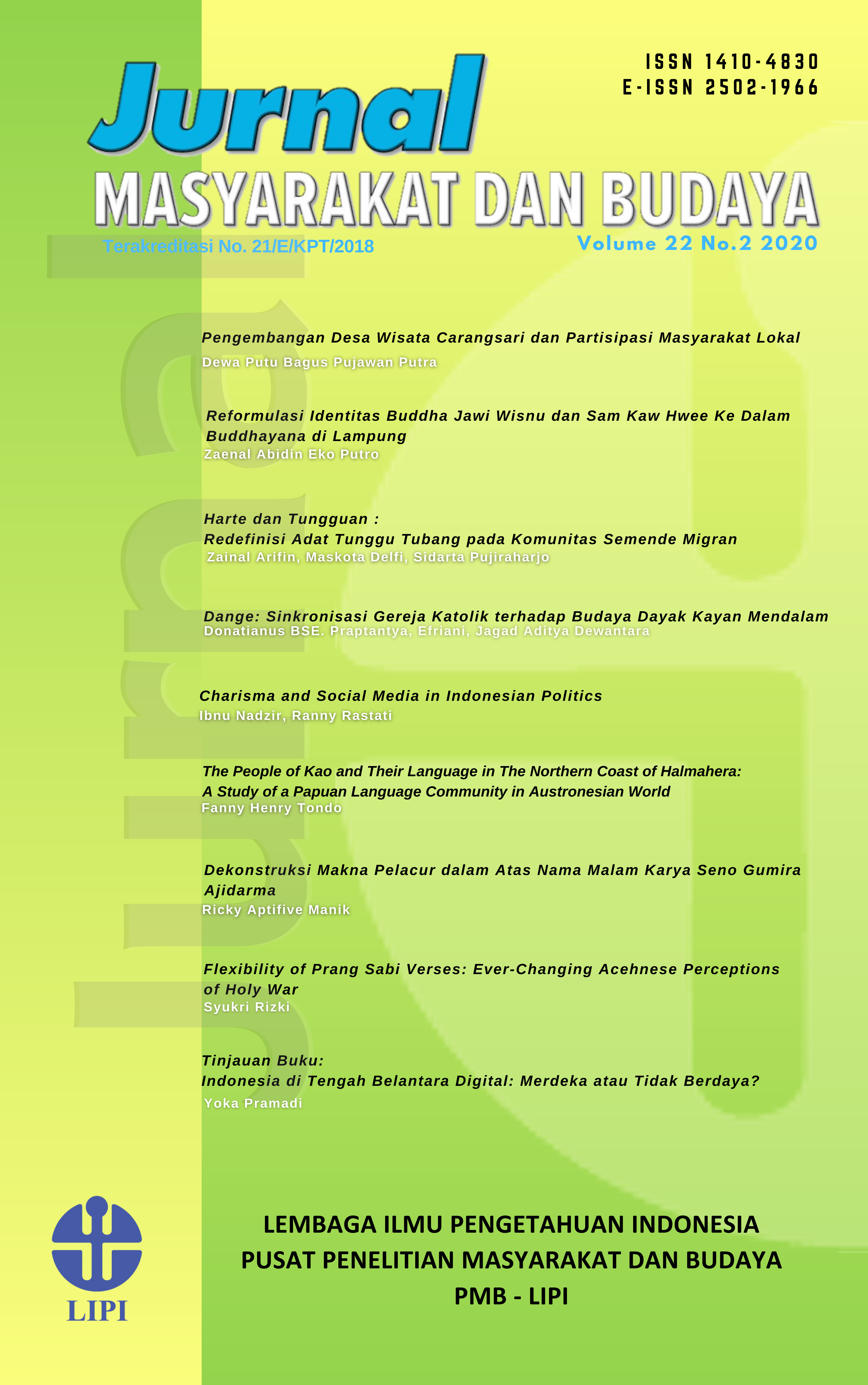
Reformulasi Identitas Buddha Jawi Wisnu dan Sam Kaw Hwee Ke Dalam Buddhayana di Lampung Reformulating Identity of Buddha Jawi Wisnu and Sam Kaw Hwee Into Buddhayana in Lampung
Article Sidebar
Main Article Content
Abstract
The formulation of a social group identity is strongly influenced by the historical context and institutional site in which reformulation of social identity occurred. As a result, the group has a common understanding and categories that unite them into sameness identity. It is what we have seen on the Sam Kaw Hwee Buddhist sect group as well as Buddha Jawi Wisnu sect group who in early New Order regime changed their identity into becoming Buddhayana Buddhist sect in Lampung. At a glance, the Majelis Buddhayana Indonesia (MBI, or Indonesian Buddhayana Council) was a meeting point of which Javanese and Chinese are encountered. Furthermore, MBI is regarded as a shared identity for most Buddhists in Lampung. This paper wants to explain the background and the process of reformulating new social identity, as well as the impacts around it.
The paper is based on a qualitative research that tries to understand the early formation of Buddhayana sect as the largest Buddhist sect in Lampung. MBI was as a new social identity resulting from interaction and negotiation its followers with external group who threatened the Buddhist group in Lampung in the past.
Article Details

This work is licensed under a Creative Commons Attribution-ShareAlike 4.0 International License.
References
Bryman, A. (1989). Research methods and organization studies. London & New
York: Routledge.
Burke, P. J. & Stet, J. E. (2009). Identity theory. Oxford: Oxford University Press.
Dharmawimala dkk. (2012). Buddhayana values. Jakarta: Keluarga Buddhayana
Indonesia.
Elbedour, S., Bastien, D. T., & Center, B. A. (1997). Identity formation in the
shadow of conflict: Projective drawings by Palestinian and Israeli Arab children
from the West Bank and Gaza. Journal of Peace Research, 34(2), 217–231.
Gunasilo (2009). Manfaat membaca Paritta. Diakses dari
http://www.dhammacakka.org/?channel =ceramah&mode=detailbd&id=272 pada
31 Maret 2020
Hall, S. (2003). Who needs ‘identity’? Dalam Hall, S., & Gay, P. D., (Eds.),
Questions of cultural identity. London, Thousand Oaks & New Delhi: SAGE
Publications
Jayamedho, B. (2012). Menapak pasti. Kisah spiritual anak Madura. Jakarta:
Centre of Asian Studies (Cenas).
Kaharuddin, P. (2015). Catatan hidup pejuang dhamma. Otobiografi singkat
Pandit Kaharuddin. Jakarta: Persatuan Pariyati Abhidhamma.
Kantor Wilayah Kementerian Agama Provinsi Lampung. (2014). Propinsi
Lampung dalam angka. Data Statistik Keagamaan Tahun 2013. Lampung:
Kanwil Kemenag Provinsi Lampung.
Liong, T. J. (2011). Edisi khusus kenangan purna pugar Ban Tek Yan (D/H
Wihara Banten). Bandar Lampung: Yayasan Boddhisttva.
Pengurus Pusat Majelis Agama Buddha Theravada Indonesia (2018). Sejarah
singkat agama Buddha Theravada di Indonesia sejak abad kedua puluh.
Jakarta: Magabudhi.
Qodim, H. (2017). Strategi bertahan agama Djawa Sunda (ADS) Cigugur. Jurnal
Kalam, 11(2), 329–364. DOI: http://dx.doi.org/10.24042/klm. v11i2.1912
Sam, A. (2017, 25 April). Mengenal agama Budho- jawi/Wisnu. Buddhazine.
Diakses dari http:// buddhazine.com/mengenal-agama-budhojawi- wisnu/ pada
31 Maret 2020.
Sekarbatu A, D. (2013). Struktur, makna, dan fungsi mantra Hindu-Jawa. Jurnal
Ilmiah Kebudayaan Sintesis, 7(2), 154–163.
Sudhamek. (2012). Eksplorasi nilai-nilai Buddhayana (Sebuah telaah dari
perspektif transformatif- liberatif). Dalam Dharmawimala dkk., Bud- dhayana
values. Jakarta: Keluarga Buddhayana Indonesia.
Somantri, G. R. (2005). Memahami metode kualitatif. Jurnal Makara, 9(2), 57–
65.
Subbag Informasi Dan Humas Kanwil Kementerian Agama Provinsi Lampung
(2017). Kementerian Agama Provinsi Lampung Dalam Angka Tahun 2017.
The Dharma: The teachings of the Buddha. Diakses dari
https://rlp.hds.harvard.edu/religions/ buddhism/dharma-teachings-buddha, pada
30 Maret 2020)
The Sangha: The Buddhist community. (tt). Diakses dari
https://rlp.hds.harvard.edu/religions/bud- dhism/sangha-buddhist-community,
pada 30 Maret 2020).
Keputusan Samaya No. III/1978 (1978). Susunan Pimpinan Sangha Agung
Indonesia. 27 Sep- tember 1978.
Putro, ZAE (ed.). (2011). Berpeluh Berselaras. Buddhis-Muslim Meniti Harmoni.
Jakarta: Centre of Asian Studies (Cenas), Kepik Ungu & Hivos.
Saktiyanto, A. (2015, 23 November) Inilah 5 Vihara di Bandar Lampung.
saibumi. Diakses dari https:// www.saibumi.com/artikel-70382-inilah-5-vihara-di-
bandar-lampung.html#ixzz6IAs8SWkR pada 30 Maret 2020.
Sunarto, K. (2004). Pengantar sosiologi. Jakarta: Lembaga Penerbit FEUI.
Suryadinata, L. (1997). The culture of the Chinese minority in Indonesia.
Singapore: Times Books International.
Turner, J. H. (1998). The structure of sociological theory. Sixth Edition. Belmont,
CA: Wad- sworth Publishing Company.
Yoo, D. (1996). Enlightened identities: Buddhism and Japanese Americans of
California, 1924–1941. Western Historical Quarterly, 27(3), 281–301.
Zaini, M. R. (2014). Perjalanan menjadi Cina Benteng: Studi identitas etnis di
Desa Situgadung. Jurnal Sosiologi Masyarakat, 19(1), 93–117.