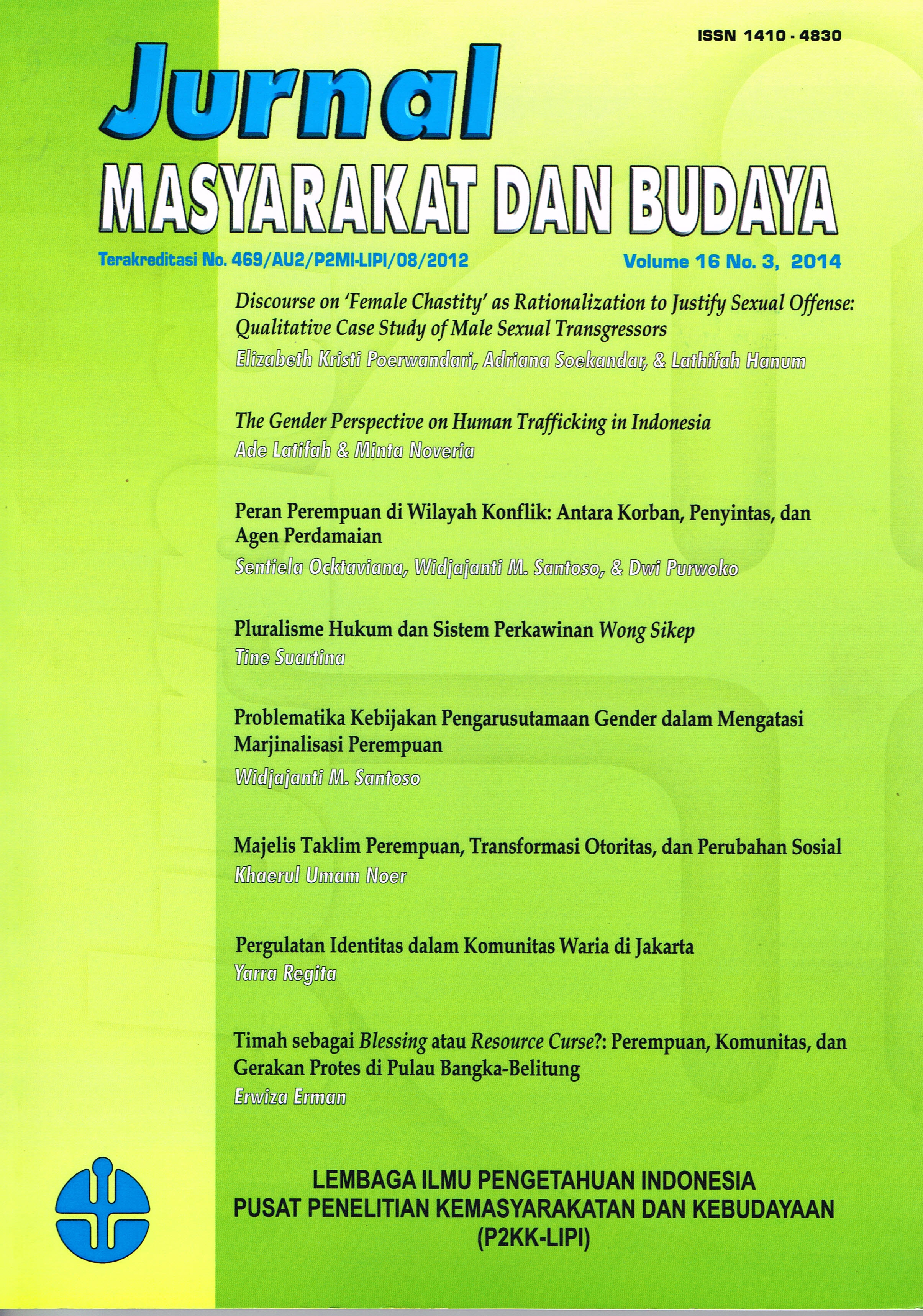
DISCOURSE ON ‘FEMALE CHASTITY’ AS RATIONALIZATION TO JUSTIFY SEXUAL OFFENSE: Qualitative Case Study of Male Sexual Transgressors
Article Sidebar
Main Article Content
Abstract
The present qualitative study explores the rationalization of 24(twenty-four) men reported to the police of conducting sexual offense, to justify their sexual offense or transgression. Denials vary from absolute denial, minimization, such as claiming of having mutual consent sex, denial of victim harm, and a rarer phenomenon but apparent in two subjects, a kind of depersonalization. More specific denials relate to gender-based rationalization is prevalent, such as having unharmonious relationship with wife therefore they need other women for sexual outlet, or the girls are not ‘good girl’. Very strong rationalization is related to the discourse on ‘female chastity’ in which offenders justify their behavior as OK since their target subjects are not ‘good girls’, be evidenced by they are not virgin anymore, hang out at night, or have relation with other men. Offenders who are in relationships with their victims need to prove the chastity of their female partner, or felt suspicious and angry about the past relationships of the girls therefore forcing sex or conducting sexual assault. Offender might adopt a ‘professional’, a ‘hero’, a ‘revenger’ as well as a ‘victim’ role. All cannot be separated from the cultural context of Indonesia and are explaining the beliefs of male offenders about men as superior and having authority over women.
Article Details

This work is licensed under a Creative Commons Attribution-ShareAlike 4.0 International License.
References
Antara. (2013, January 18). Ayah Kandung RI jadi Tersangka Kekerasan Seksual. Retrieved from http://www.republika.co.id/berita/ nasional/jabodetabek-nasional/13/01/18/ mgtd2s-ayah-kandung-ri-jadi-tersangkakekerasan-seksual.
Berita Satu. (2012, March 6). Marzuki Alie: Aturan Berbusana Cegah Perkosaan. Retrieved from http://www.beritasatu.com/ politik/35344-marzuki-alie-aturanberbusana-cegah-perkosaan.html
Blanchard, G., & Tabachnick, J. (2002). The prevention of sexual abuse: Psychological and public health perspectives. Sexual Addiction & Compulsivity, 9, 1-13. crossref
Burt, M.R. (1980). Cultural Myths and Supports For Rape. Journal of Personality and Social Psychology, 38 (2), 217-230. crossref
Burton, D.L. (2008). An Exploratory Evaluation of the Contribution of Personality and Childhood Sexual Victimization to the Development of Sexually Abusive Behavior. Sexual Abuse: A Journal of Research and Treatment, 20, 102-115 crossref
Collins Dictionaries. (2002). Collins thesaurus of the english language: Complete and Unabridged 2nd edition. NewYork, NY: Harper Collins Publishers.
Estrich, S. (1987). Real Rape. Cambridge, Massachusetts: Harvard University Press.
Franiuk, R., & Shain, E.A. (2011). Beyond christianity: The status of women and rape myths. Sex Roles, 65, 783-791. crossref
Frazier, P.A., & Haney, B. (1996). Sexual assaults cases in the legal system: Police, prosecutor, and victim perspectives. Law and Human Behavior, 20(6), 607-628. crossref
Komnas Perempuan. (2013). Korban Berjuang, Publik Bertindak: Mendobrak Stagnansi Sistem Hukum. Catatan Kekerasan Terhadap Perempuan Tahun 2012. Jakarta: Komisi Nasional Anti Kekerasan Terhadap Perempuan.
LBH Apik Jakarta. (2007). Notulensi Diskusi Panel D: Perkembangan Konsep Delik Kesusilaan dalam Pembaharuan KUHP. Jakarta: LBH Apik Jakarta.
Lonsway, K.A., & Fitzgerald, L.F. (2006). Rape Myths in Review. Psychology of Women Quarterly, 18(2), 133-164.
Mallie, A.L., Viljoen, J.L., Mordell, S., Spice, A., &Roesch, R. (2011). Childhood Abuse and Adolescent Sexual Re-Offending: A MetaAnalysis. Child Youth Care Forum, 40, 401-417. crossref
Prasetyo, W. A. (2011, September 16). Kata Foke, ‘Jangan Pakai Rok Mini di Angkot’. Retrieved from http://www.tempo.co/ read/news/2011/09/16/064356605/KataFoke-Jangan-Pakai-Rok-Mini-di-Angkot
Quinsey, V.L., Chaplin, T.C., & Upfold, D. (1984). Sexual Arousal to Nonsexual Violence and Sadomasochistic Themes Among Rapists and Non-Sex-Offenders. Journal of Consulting and Clinical Psychology, 52, 651-657. crossref
Ramadani, B. (2012, November 5). Menyoal Hak Pendidikan Bagi Siswi Korban Tindak Kekerasan Seksual. Retrieved from http:// rifkaanisa.blogdetik.com/2012/11/05/ menyoal-hak-pendidikan-bagi-siswikorban-tindak-kekerasan-seksual/
Rice, M. E., Chaplin, T.C., Harris, G.T., & Coutts, J. (1994). Empathy For The Victim and Sexual Arousal Among Rapists and NonRapists. Journal of Interpersonal Violence, 9, 435-449. crossref
Schewe, P.A., Adam, N.M., & Ryan, K.M. (2009). A Qualitative Analysis of the Temptation to Use Force in Sexual Relationships. Violence and Victims, 24(2), 219-231. crossref
Jurnal Masyarakat & Budaya, Volume 16 No. 3 Tahun 2014 371
Schneider, S.L., & Wright, R.C. (2004). Understanding Denials in Sexual Offenders: A Review of Cognitive and Motivational Processes to Avoid Responsibility. Trauma, Violence, and Abuse, 5(1), 3-20. crossref
Suharman, T. (2013, August 20). Tes Keperawanan Siswa SMA di Prabumulih Diprotes. Retrieved from http://www.tempo.co/read/ news/2013/08/20/079505650/TesKeperawanan-Siswa-SMA-di-PrabumulihDiprotes The American Heritage Publishing Company. (2000).
The American Heritage Dictionary of English Language, fourth edition. Boston, Massachusetts: Houghton Mifflin Company. Thomas, K.D., & Levant, R.F. (2012). Does the Endorsement of Traditional Masculinity Ideology Moderate the Relationship Between Exposure to Violent Video Games and Aggression? The Journal of Men’s Studies, 20(1), 47-56. crossref
Warrick, C. (2005). The vanishing victim: Criminal law and gender in Jordan. Law & Society Review, 39(2), 315-348. crossref
Wielstein, L. H. (2010). The sex offender and his Experience of Sexual Assault: A Phenomenological study (Doctoral dissertation, Capella University). Available from Pro Quest Dissertation and Theses database. (UMI No. 3426528).
Woodhams, J., Hollin, C. R., Bull, R., & Cooke, C. (2012). Behavior displayed by female victims during rapes committed by lone and multiple perpetrators. Psychology, Public, Policy, and Law, 18(3), 415-452. crossref
Youngs, D., & Canter, D.V. (2013). Offenders’ crime narratives as reveales by the narrative roles questionnaire. Int J Offender Ther Comp Criminol, 57, 289-311. crossref