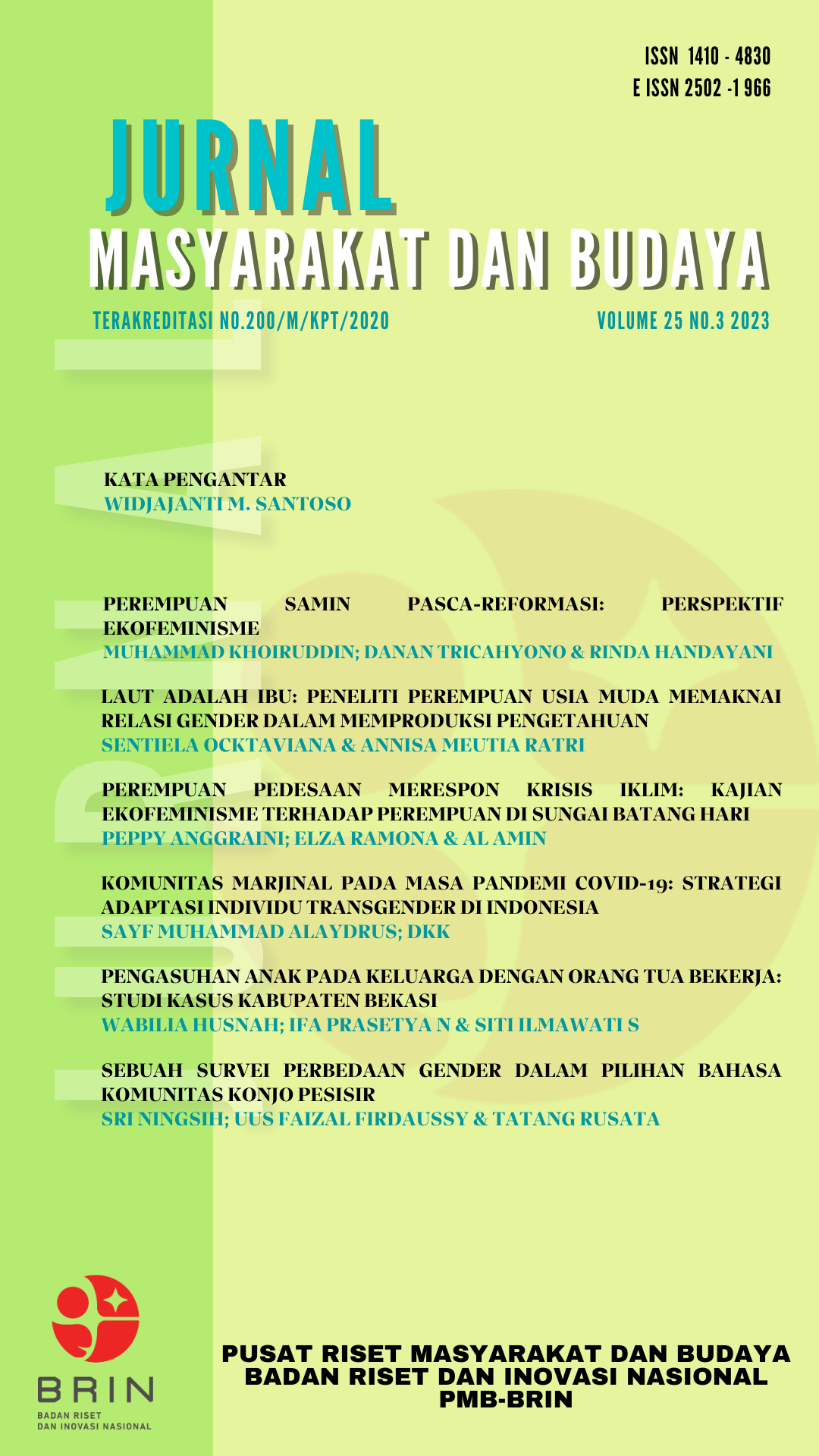
A SURVEY ON GENDER DIFFERENCES IN LANGUAGE CHOICE OF COASTAL KONJO COMMUNITY
Article Sidebar
Main Article Content
Abstract
Community language usage patterns are often fundamental to minority language maintenance. This study investigates the gender differences in language choice within the Coastal Konjo residing in South Sulawesi Province and explores the implications of its language maintenance. The contexts of language use are varied based on the speaker’s role, the topic of conversation, and the situation of the conversation to understand how gender influences language use and transmission practices. A survey method is used to gather information from 80 respondents, and SPSS is used for descriptive and inferential statistical analysis. Descriptive analysis shows that the Konjo language is the most widely spoken, followed by Bahasa Indonesia, Buginese, and mixed-use languages. The inferential statistical analysis also shows that there are no appreciable gender disparities in the Coastal Konjo community’s language choice (p > 0.005) in each context. However, the data reveals a distinct difference in how the Buginese is used, with females appearing to utilize it more frequently than males. This suggests that females have more language contact with Buginese who have long coexisted with coastal Konjo speakers in Bulukumba. Moreover, the findings indicate that males are more crucial to the maintenance of the Konjo language than females.
Article Details
References
Atmawati, D. (2018). Gender Bias in Javanese Society: A Study in Language Forms Choice to Men and Women. Humaniora, 9(3), 257–264. https://doi.org/10.21512/HUMANIORA.V9I3.4937
BUCHOLTZ, M., & HALL, K. (2004). Theorizing identity in language and sexuality research. Language in Society, 33(4), 469–515. https://doi.org/10.1017/S0047404504334020
Coates, J. (2015). Women, men and language: A sociolinguistic account of gender differences in language, third edition. In Women, Men and Language: A Sociolinguistic Account of Gender Differences in Language, Third Edition. https://doi.org/10.4324/9781315645612
DeFrank, M., & Kahlbaugh, P. (2019). Language Choice Matters: When Profanity Affects How People Are Judged. Journal of Language and Social Psychology, 38(1), 126–141. https://doi.org/10.1177/0261927X18758143
Eckert, P., & McConnell-Ginet, S. (2003a). Language and gender. In Language and Gender. Cambridge University Press. https://doi.org/10.1017/CBO9780511791147
Eckert, P., & McConnell-Ginet, S. (2003b). Think Practically and Look Locally: Language and Gender as Community-Based Practice. Https://Doi.Org/10.1146/Annurev.an.21.100192.002333, 21(1), 461–488. https://doi.org/10.1146/ANNUREV.AN.21.100192.002333
Fitriati, S. W., & Rata, E. (2021). Language, globalisation, and national identity: A study of English-medium policy and practice in Indonesia. Journal of Language, Identity & Education. https://doi.org/10.1080/15348458.2020.1777865
Friberg, T. (1995). Introduction to Individual Languages: Konjo. In D. T. Tryon (Ed.), Comparative Austronesian Dictionary: An Introduction to Austronesian Studies. Walter de Gruyter.
Grimes, C. E., & Grimes, B. D. (1987). Languages of South Sulawesi. The Australian National University. https://openresearch-repository.anu.edu.au/bitstream/1885/145413/1/PL-D78.pdf
Hassan, S., & Iqbal, A. (2023). Gender and Language Acquisition. Pakistan Journal of Social Research, 5(1), 392–397. www.pjsr.com.pk
Hellinger, M., & Bußmann, H. (2003). The linguistic representation of women and men. In M. Hellinger & H. Bußmann (Eds.), Gender across languages. John Benjamins Pub. Co.
Hoffmann, C. (2020). Language choice, language maintenance and language shift. Introduction to Bilingualism, 189–206. https://doi.org/10.4324/9781315842035-18/LANGUAGE-CHOICE-LANGUAGE-MAINTENANCE-LANGUAGE-SHIFT-CHARLOTTE-HOFFMANN
Holmes, J., Holmes, J., & Meyerhoff, Miriam. (2007). The Handbook of Language and Gender: Blackwell handbooks in linguistics 13. https://www.dawsonera.com:443/abstract/9780470756706
Johnson, A. G. (1997). The gender knot: unraveling our patriarchal legacy. 294.
Jupriono, D. (2010). Selayang Pandang Ketimpangan Gender Dalam Bahasa Indonesia. 10(01).
Lakoff, R. (1972). Language in Context. Language, 48(4), 907. https://doi.org/10.2307/411994
Lawless, S., Cohen, P., Mcdougall, C., Orirana, G., Siota, F., & Doyle, K. (2019). Gender norms and relations: implications for agency in coastal livelihoods. https://doi.org/10.1007/s40152-019-00147-0
Lawrence, L., & Nagashima, Y. (2020). The intersectionality of gender, sexuality, race, and native-speakerness: Investigating ELT teacher identity through duoethnography. Journal of Language, Identity & …. https://doi.org/10.1080/15348458.2019.1672173
Little, S. (2020). Whose heritage? What inheritance?: conceptualising family language identities. International Journal of Bilingual Education and Bilingualism, 23(2), 198–212. https://doi.org/10.1080/13670050.2017.1348463
Mangubhai, S., & Lawless, S. (2021). Exploring gender inclusion in small-scale fisheries management and development in Melanesia. Marine Policy, 123, 104287. https://doi.org/10.1016/J.MARPOL.2020.104287
Mills, S. (2008). Language and Sexism. Cambridge University Press. https://doi.org/10.1017/s0047404510001004
Nguyen, T. T. T., & Hamid, M. O. (2021). Language choice of Vietnamese ethnic minority students in family and community interactions: implications for minority language maintenance. International Multilingual Research Journal, 15(4), 317–331. https://doi.org/10.1080/19313152.2021.1889113
Ningsih, S. (2016). Factors Contributing to the Maintenance of Konjo Language in Heterogeneous Area of Bulukumba Regency: Ethical Lingua: Journal of Language Teaching and Literature, 3(2), 103–113. https://doi.org/10.30605/25409190.V3.02.103-113
Ningsih, S., Machmoed, H., Saleh, N. J., & Jubhari, R. (2021). The Ethnolinguistic Vitality of Konjo in Bulukumba Regency of South Sulawesi, Indonesia. ELS Journal on Interdisciplinary Studies in Humanities, 4(1), 29–40. https://doi.org/10.34050/elsjish.v4i1.13361
Ningsih, S., & Zulkhaeriyah, Z. (2021). Measuring the Vitality of Konjo Language in South Sulawesi Province of Indonesia. Proceedings of the International Congress of Indonesian Linguistics Society (KIMLI 2021), 622, 252–256. https://doi.org/10.2991/ASSEHR.K.211226.050
Park, M. Y. (2022). Language ideologies, heritage language use, and identity construction among 1.5-generation Korean immigrants in New Zealand. International Journal of Bilingual Education and Bilingualism, 25(7), 2469–2481. https://doi.org/10.1080/13670050.2021.1913988
R. A. Pelenkahu, D. (1971). Dialek Konjo di Sulawesi Selatan.
Rizki, D., Rangkuty, R. P., Kurniawati, & Kiram, M. Z. (2022). Acehnese Youth and Local Language: Their Social Identity in Public Space. Proceedings of the 2nd International Conference on Social Science, Political Science, and Humanities (ICoSPOLHUM 2021), 648, 200–206. https://doi.org/10.2991/ASSEHR.K.220302.029
Saimon, M. (2020). Sexist Expressions in Nyakyusa. Issues in Language Studies, 9(1), 144–154. https://doi.org/10.33736/ILS.2150.2020
Sampean, S., & Sjaf, S. (2021). The Reconstruction of Ethnodevelopment in Indonesia: A New Paradigm of Village Development in the Ammatoa Kajang Indigeneous Community, Bulukumba Regency, South Sulawesi. Masyarakat: Jurnal Sosiologi, 25(2). https://doi.org/10.7454/MJS.V25I2.12357
Selleck, C. (2022). The gendered migrant experience: a study of family language policy (FLP) amongst mothers and daughters in the Somali community, Bristol. Current Issues in Language Planning. https://doi.org/10.1080/14664208.2022.2047512
Statistics Indonesia Bulukumba Regency. (2023). Kabupaten Bulukumba Dalam Angka 2023.
Sugianto, R. (2018). Pola-Pola Pemilihan dan Penggunaan Bahasa Dalam Keluarga Bilingual. Jurnal Kependidikan: Jurnal Hasil Penelitian Dan Kajian Kepustakaan Di Bidang Pendidikan, Pengajaran Dan Pembelajaran, 4(1), 90–97. https://doi.org/10.33394/JK.V4I1.905
Susan M. Ervin-Tripp. (2005). Sociolinguistic Rules of Address. In Language, Communication and Education (pp. 1–457). Taylor and Francis. https://doi.org/10.4324/9780203975107
Tahir, D., Rahman, F., & Rahman, A. (2018). The Study of Buginese Reciprocal Verb in the Boegineesche Chrestomathies Manuscript. American Journal of Humanities and Social Sciences Research, 48–54. www.ajhssr.com
Tamrin, T. (2017). Pemilihan Bahasa Etnik Bugis dalam Ranah Keluarga Berdasarkan Hubungan Peran dan Kategori Pekerjaan di Kabupaten Donggala. Gramatika: Jurnal Ilmiah Kebahasaan Dan Kesastraan, 5(2), 141–155. https://doi.org/10.31813/GRAMATIKA/5.2.2017.114.141--155
Tondo, F. H. (2019). Language And Religion: The Use of Language In Christian Liturgy on Some Border Areas of Indonesia. Jurnal Masyarakat Dan Budaya, 20(3). https://doi.org/10.14203/JMB.V20I3.593
Utami, R. (2017). Language Choice Used by Javanese Students of English Language Education Department in Daily Conversation.
YILDIRIM, F. Ç. (2020). Language choice and identity: An investigation based on the comparison of language attitudes from two different localities. Journal of Language and Linguistic Studies. https://dergipark.org.tr/en/pub/jlls/article/759361