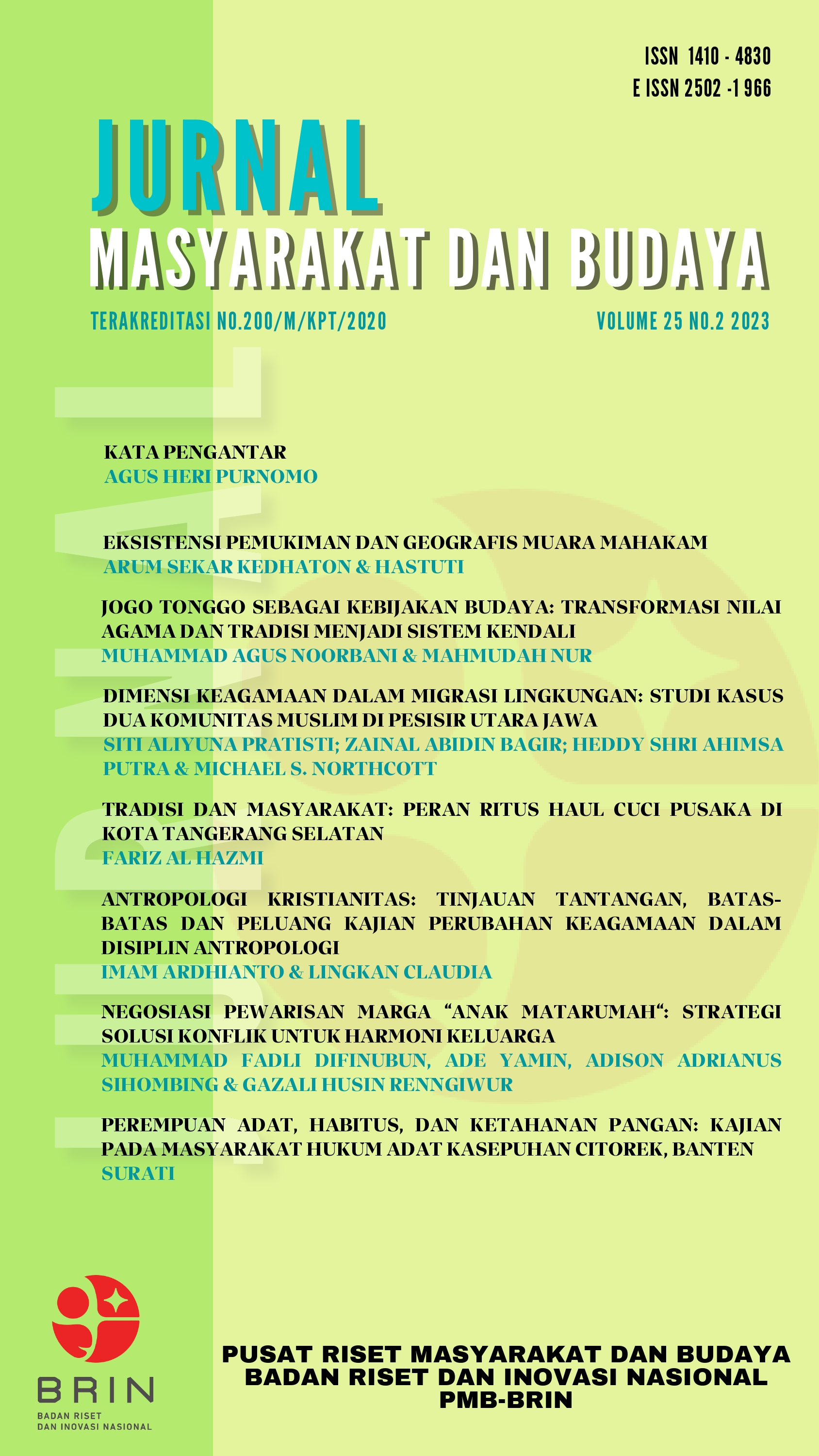
JOGO TONGGO AS A CULTURAL POLICY TRANSFORMING RELIGIOUS VALUES AND TRADITIONS INTO A CONTROL SYSTEM
Article Sidebar
Main Article Content
Abstract
This article aims to explain the effectiveness of the Jogo tonggo program initiated by the Provincial Central
Java Government in controlling the social and economic impacts of the Covid-19 pandemic on the people of Central
Java. This research uses interviews with residents and government officials to get an idea of the effectiveness of
this program. The results of this study found that Jogo tonggo goes from the caring practices carried out by the
Javanese community, which comes from the combination of various religious and cultural values that have been
mixed up over time. It is not a form of (Javanese) cultural glorification that has been practiced for a long time but
instead puts forward the aspect of how the public interest is served. Prioritizing citizen involvement in Jogo Tonggo
makes this movement a form of “third way.” The third way is marked by the increasing role of the community in
influencing various political policies based on the various traditional practices they have. By prioritizing the role
of communities and individuals as agencies, Jogo Tonggo can overcome the far-reaching impact of the Covid-19
pandemic by reinventing and relevating the various traditions of the Javanese people
Article Details

This work is licensed under a Creative Commons Attribution-ShareAlike 4.0 International License.
References
Ahearne, J. (2004). Between Cultural Theory and Policy: The cultural policy thinking of Pierre Bourdieu, Michel de Certeau and Régis Debray.
Ahearne, J. (2009). Cultural policy explicit and implicit: a distinction and some uses. International Journal of Cultural Policy, 15(2), 141–153. https://doi.org/10.1080/10286630902746245
Ahearne, J. (2011). Questions of Religion and Cultural Policy in France. International Journal of Cultural Policy, 17(2), 153–169. https://doi.org/DOI: 10.1080/10286632.2010.528837
Ahearne, J., & Bennett, O. (2011). Cultural policies and religion. International Journal of Cultural Policy, 17(2), 111–114. https://doi.org/10.1080/10286632.2010.551119
An, B. Y., & Tang, S. Y. (2020). Lessons From COVID-19 Responses in East Asia: Institutional Infrastructure and Enduring Policy Instruments. American Review of Public Administration, 50(6–7), 790–800. https://doi.org/10.1177/0275074020943707
ASPI. (2020). Island voices and Covid-19: vulnerability and resilience Views. In Australian Strategic Policy Institute.
Aziz, D. K. (2015). Akulturasi islam dan budaya jawa. Fikrah, I(2), 253–286.
Bappenas, K. P. (2021). Studi Pembelajaran Penanganan COVID-19 Indonesia.
Bell, D., & Oakley, K. (2015). Cultural Policy. New York: Routledge.
Bennett, O. (2009). On religion and cultural policy: notes on the Roman Catholic Church. International Journal of Cultural Policy, 15(2), 155–170. https://doi.org/10.1080/10286630802609972
Bilton, C., & Soltero, G. (2020). Cultural policy as mythical narrative. International Journal of Cultural Policy, 26(5), 681–696. https://doi.org/10.1080/10286632.2019.1624736
Bonet, L., & Négrier, E. (2018). The participative turn in cultural policy: Paradigms, models, contexts. Poetics, 66(June 2017), 64–73. https://doi.org/10.1016/j.poetic.2018.02.006
Daryono, D., & Syukur, S. (2021). The Moral Philosophy of Capitalism In the View of the Javanese Islamic Trade Ethos. Jurnal THEOLOGIA, 31(2), 165–184. https://doi.org/10.21580/teo.2020.31.2.6862
Dewi, K. H. (2012). Javanese women and Islam: Identity formation since the twentieth century. Southeast Asian Studies, 1(1), 109–140.
Diurlin, L., & Norén, F. (2021). Cultural policy as a governmental proxy tool for improved health: the Swedish National Board of Health and Welfare’s collaborations with cultural workers 1970–1975. International Journal of Cultural Policy, 27(5), 667–682. https://doi.org/10.1080/10286632.2020.1829609
Dubois, V. (2008). Cultural policy in France - Genesis of a public policy category Vincent. Strasbourg.
Dubois, V. (2015). Cultural Policy Regimes in Western Europe. International Encyclopedia of the Social & Behavioral Sciences: Second Edition, (February), 460–465. https://doi.org/10.1016/B978-0-08-097086-8.10419-2
Geertz, C. (1971). Islam Observed; Religious Development in Morocco and Indonesia Chicago & London (Phoenix Ed). Chicago & London: The University of Chicago Press.
Geertz, C. (1973). The Interpretation of Cultures: Selected Essays. https://doi.org/10.4324/9781912128310
Geertz, C. (1976). The Religion of Java (Phoenix). Chicago, London: The University of Chicago Press.
Geertz, H. (1983). Keluarga Jawa. Jakarta: Grafiti Press.
Hadley, S., & Belfiore, E. (2018). Cultural democracy and cultural policy. Cultural Trends, 27(3), 218–223. https://doi.org/10.1080/09548963.2018.1474009
Hong, A. H., & Sullivan, F. R. (2013). Towards an idea-centered, principle-base design to as creation approach support learning knowledge. Educational Technology Research and Development, 57(5), 613–627. https://doi.org/10.1007/sl
Hong, K. W. (2019). A historical trajectory of cultural policy in Korea: transforming cultural politics into cultural policy. International Journal of Cultural Policy, 25(1), 5–19. https://doi.org/10.1080/10286632.2018.1557648
Jones, T. (2005). Indonesian Cultural Policy, 1950-2003; Culture, Institutions, Government. Curtin University of Technology.
Jones, T. (2007). Liberalism and cultural policy in Indonesia. Social Identities, 13(4), 441–458. https://doi.org/10.1080/13504630701459123
Jones, T. (2012). Indonesian Cultural Policy in The Reform Era. Indonesia, 93, 147–176. https://doi.org/https://doi.org/10.5728/indonesia.93.0147
Kodiran. (1984). Kebudayaan Jawa. Manusia Dan Kebudayaan Di Indonesia, 390.
Koentjaraningrat. (1985). Kebudayaan, Mentalitas, dan Pembangunan (12th ed.). Jakarta: Gramedia.
Koentjaraningrat, R. (1960). The Javanese of South Central Java. In G. Murdock (Ed.), Social Structure in South-East Asia (pp. 88–115). Chicago: Quadrangle Books.
Koentjaraningrat, R. (1980). Javanese Terms for God and Supernatural Beings and tahe Idea of Power. In R. Schefold, J. W. Schoorl, & J. Tennekes (Eds.), Man , Meaning and History: Essays in Honour of H . G . Schulte Nordholt (pp. 127–139). London and New York: Brill.
Kurniawan, A. (2020). Ketakpastian Penyelenggaraan PSBB dalam Penanganan COVID-19 | The SMERU Research Institute. Smeru Research Institute. Retrieved from https://smeru.or.id/id/content/ketakpastian-penyelenggaraan-psbb-dalam-penanganan-covid-19
Lee, H. K., Chau, K. L.-F., & Terui, T. (2021). The Covid-19 crisis and ‘critical juncture’ in cultural policy: a comparative analysis of cultural policy responses in South Korea, Japan and China. International Journal of Cultural Policy, 00(00), 1–21. https://doi.org/10.1080/10286632.2021.1938561
Mayer, J. D., & Lewis, N. D. (2020). Challenges and Responses to COVID-19: Experience from Asia. Eurasian Geography and Economics, 61(4–5), 404–422. https://doi.org/10.1080/15387216.2020.1786425
Moise, D., Negescu Oancea, D. M., Diaconu, A., & Diaconu, S. (2021). CoVid19, a Threat or a Blessing to Globalization? SHS Web of Conferences, 92, 01033. https://doi.org/10.1051/shsconf/20219201033
Muadi, S., & Sofwani, A. (2018). Acculturation of Islam and Javanese. El Harakah, 20(2), 233–252. Retrieved from http://ejournal.uin-malang.ac.id/index.php/infopub/article/view/5355/pdf
Muhaimin, A. G. (2006). The Islamic Traditions of Cirebon: Ibadat and Adat Among Javanese Muslims. https://doi.org/10.26530/oapen_459298
Mulcahy, K. V. (2006). Cultural policy: Definitions and theoretical approaches. Journal of Arts Management Law and Society, 35(4), 319–330. https://doi.org/10.3200/JAML.35.4.319-330
Mulder, N. (1983). Abangan Javanese Religious Thought and Practice. Bijdragen Tot de Taal-, Land- En Volkenkunde, 139(2/3), 260–267.
Mulder, N. (2013). Abangan Javanese religious thought and practice. Bijdragen Tot de Taal-, Land- En Volkenkunde / Journal of the Humanities and Social Sciences of Southeast Asia, 139(2), 260–267. https://doi.org/10.1163/22134379-90003444
Nasir, M. A. (2019). Revisiting the Javanese Muslim Slametan: Islam, local tradition, honor and symbolic communication. Al-Jami’ah, 57(2), 329–358. https://doi.org/10.14421/ajis.2019.572.329-358
Newberry, J. (2007). Rituals of rule in the administered community: The Javanese slametan reconsidered. Modern Asian Studies, 41(6), 1295–1329. https://doi.org/10.1017/S0026749X06002575
Newberry, J. C. (1997). Making do in the Imagined Community: Domesticity and State formation in Working Class Java. 520.
Newberry, J. C. (2007). Rituals of Rule in the Administered Community: The Javanese Slametan Reconsidered. Modern Asian Studies, 41(6), 1295–1329. https://doi.org/10.1017/S0026749X06002575
Nurhajati, D., Kencanawati, D., Susanti, Y., & Putri, O. A. (2021). Jaga Tangga, Model Pendampingan Belajar dan Bermain Bahasa Inggris pada Anak-Anak Selama Pendemi di Pare, Kediri. Jurnal ABDINUS : Jurnal Pengabdian Nusantara, 5(2), 314–324.
Pacces, A. M., & Weimer, M. (2020). From diversity to coordination: A European approach to covid-19. European Journal of Risk Regulation, 11(2), 283–296. https://doi.org/10.1017/err.2020.36
Pillay, I. (2021). Culture, politics and being more equal than others in COVID-19: some psychological anthropology perspectives. South African Journal of Psychology, 51(2), 325–335. https://doi.org/10.1177/00812463211012646
Probosiwi, R., & Putri, A. L. (2021). Jaga Tangga : Solidaritas Masyarakat di Era Pandemi Covid-19. Sosio Konsepsia, 10(2), 177–192. https://doi.org/10.33007/ska.v10i2.2423
Purwanto, S. A. (2021). Kebijakan Budaya; Upaya Mengembangkan Komunitas dan Budaya Nusantara (Pidato Pengukuhan Guru Besar Antropologi). (November), 0–20.
Putnam, R. (1993). The Prosperous Community: Social Capital and Public Life. The American Prospect, 4(13), 35–42.
Putnam, R. (2000). Bowling Alone; The Collapse and Revival of American Community. New York, London, Toronto, Sydney, Tokyo, Singapore: Simon & Schuster.
Raffles, T. S. (1895). The History of Java (2nd ed.). London: John Murray.
Rose, N. (2021). Community, Citizenship, and the Third Way. In D. Meredyth & J. Minson (Eds.), Citizenship and Cultural Policy (pp. 1–17). Retrieved from http://ebookcentral.proquest.com/lib/indonesiau-ebooks/detail.action?docID=254708
Rubaidi, R. (2019). Javanese Islam: A Blend of Javanese Culture and Islamic Mystism Viewed From Post-Colonial Perspective. El Harakah (Terakreditasi), 21(1), 19–35. https://doi.org/10.18860/el.v21i1.6066
Rudyansjah, T. (2015). Émile Durkheim: Pemikiran Utama dan Percabangannya ke Radcliffe-Brown, Fortes, Lèvi-Strauss, Turner, dan Holbraad.
Ryan, J. M. (2020). COVID-19: Social Consequences and Cultural Adaptations. In J. M. Ryan (Ed.), COVID-19 Volume II: Social Consequences and Cultural Adaptations (pp. 1–8). London and New York: Routledge.
SDPI. (2021). Food Security Amid COVID-19: Money Can Never be A Substitute for Food.
Serafini, P., & Novosel, N. (2021). Culture as care: Argentina’s cultural policy response to Covid-19. Cultural Trends, 30(1), 52–62. https://doi.org/10.1080/09548963.2020.1823821
Shodiq, M. F. (2021). “Jaga Tangga” Efektivitas Kearifan Lokal, Solusi Pandemi Covid-19. SALAM: Jurnal Sosial Dan Budaya Syar-I, 8(2), 423–440. https://doi.org/10.15408/sjsbs.v8i2.19412
Siisiäinen, M. (2000). Two Concepts of Social Capital: Bourdieu vs. Putnam. In Sociological Forum. Dublin, Ireland.
Sugawara, S. E. (2021). Eliminating Human Agency: Why Does Japan Abandon Predictive Simulations? In Science Technology and Human Values. https://doi.org/10.1177/01622439211051777
Sulistiani, K., & Kaslam, K. (2020). Kebijakan Jaga Tangga Pemerintah Provinsi Jawa Tengah dalam Penanganan Pandemi Covid-19. Vox Populi, 3(1), 31. https://doi.org/10.24252/vp.v3i1.14008
Sumbulah, U. (2012). Islam Jawa dan Akulturasi Budaya: karakteristik, Variasi dan ketaatan ekspresif. El-HARAKAH (TERAKREDITASI), 14(1), 51–68. https://doi.org/10.18860/el.v0i0.2191
Susilo, D., Hidayat, E., & Marta, R. F. (2021). Village public innovations during COVID19 pandemic in rural areas: Phenomena in Madura, Indonesia. Cogent Social Sciences, 7(1). https://doi.org/10.1080/23311886.2021.1905919
Sutherland, H. (1979). The Making of a Bureaucratic Elite; The Colonial Transformation of The Javanese Priyayi. Singapore, Kuala Lumpur, Hong Kong: Heinemann Educational Books (Asia) Ltd.
Tanggap Covid-19 Provinsi Jawa Tengah. (2020). Ganjar Luncurkan Gerakan Jaga Tangga, Gerakan Saling Menjaga Antarwarga dari Corona. Provinsi Jawa Tengah.
Tuwu, D., Laksmono, B. S., Huraerah, A., & Harjudin, L. (2021). Dinamika Kebijakan Penanganan Pandemi COVID-19 Dalam Perspektif Kesejahteraan Sosial. Sosio Konsepsia, 10(2), 97–110. https://doi.org/10.33007/ska.v10i2.2158
Wiryawan, I. W. (2020). Kebijakan Pemerintah Dalam Penanganan Pandemi Virus Corona Disease 2019 (Covid-19) Di Indonesia. Prosiding Seminar Nasional Webinar Nasional Universitas Mahasaraswati Denpasar, 2019(6), 179–188. Retrieved from https://e-journal.unmas.ac.id/index.php/webinaradat/article/view/1180/1012
World Health Organization. (2020). Strengthening Preparedness for COVID-19 in Cities and Urban Settings; Interim Guidance for Local Authorities (p. 20). p. 20. WHO.
Yan, B., Zhang, X., Wu, L., Zhu, H., & Chen, B. (2020). Why Do Countries Respond Differently to COVID-19? A Comparative Study of Sweden, China, France, and Japan. American Review of Public Administration, 50(6–7), 762–769. https://doi.org/10.1177/0275074020942445
You, J. (2020). Lessons From South Korea’s Covid-19 Policy Response. American Review of Public Administration, 50(6–7), 801–808. https://doi.org/10.1177/0275074020943708