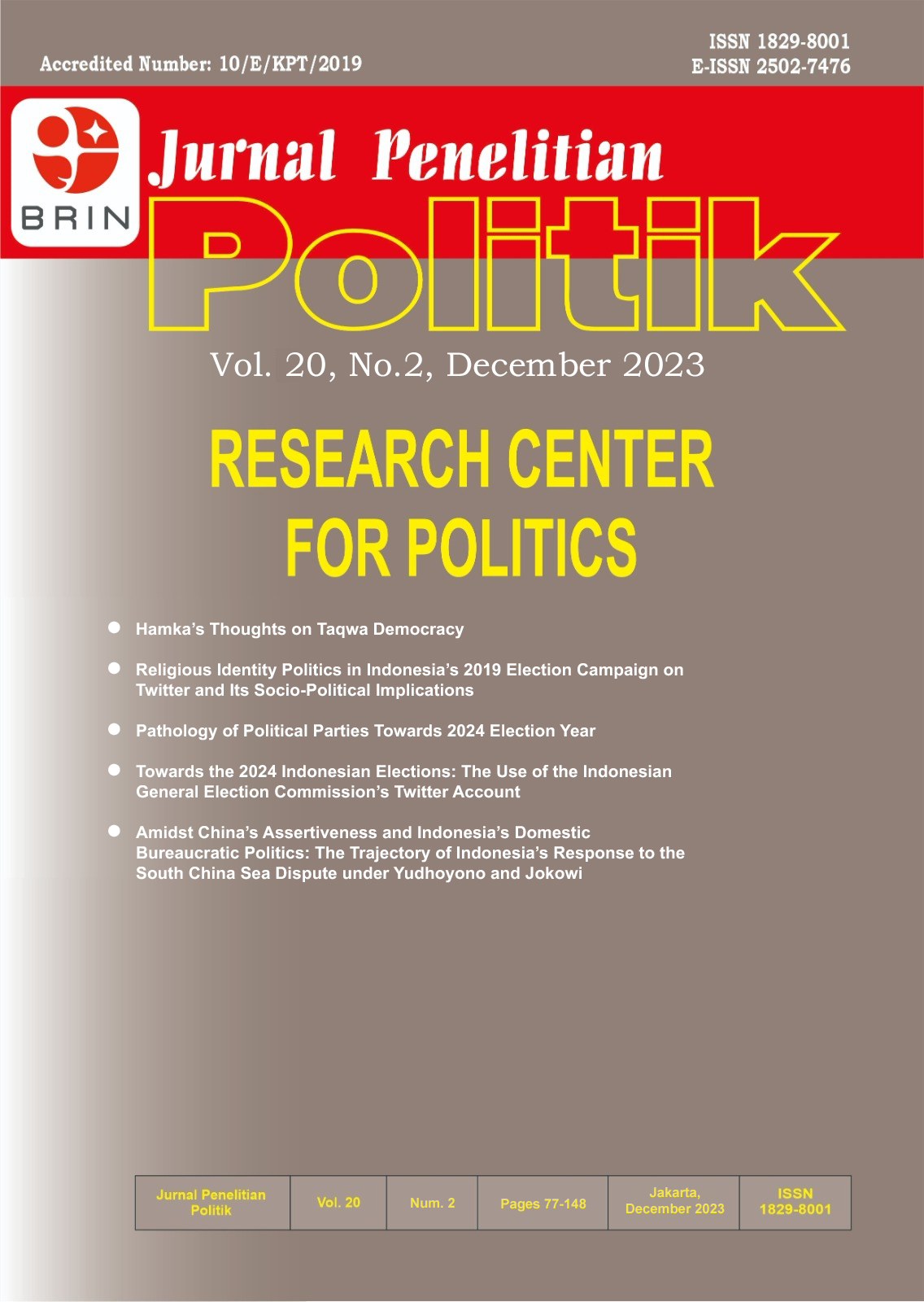
HAMKA’S THOUGHTS ON TAQWA DEMOCRACY
DOI:
https://doi.org/10.14203/jpp.v20i2.1487Keywords:
Western democracy, politics, Islam, Hamka, Taqwa democracyAbstract
The phenomenon of Western democracy as an ideal political system, has been continuously debatable among
Muslims. Muslim societies respond to Western democracy with three groups of attitudes, namely acceptance
(“pro”), rejection (contra, “con”) and critical accommodation. The main argument of the contra camp is the
rejection of secularism as the main characteristic of Western democracy. On the other hand, the pro and critical
accommodative camps consider democracy to achieve Islamic goals. One of the prominent Indonesian thinkers in
the critical accommodative camp was Hamka or Haji Abdul Malik Karim Amrullah. Hamka (1908–1981), one of the
leading Islamic intellectuals in Indonesia in the modern era, was known for his monumental work, Tafsir Al Azhar.
Hamka was well-known as an Indonesian ulama (cleric), Muhammadiyah activist, and Masyumi Party politician
who was directly involved in the ideological debates in the Constituent Assembly in Bandung (1956–1959). This
paper presents a descriptive-analytical research report conducted in 2015–2019. This aims to explain Hamka’s view
of democracy through Islamic perspective. Hamka believes that democracy is the way to achieve Islamic goals.
Tauhid and shura are the basis of Hamka’s thoughts about democracy. In contrast to secular Western democracy,
Hamka coined the Islamic concept of democracy, which was named “Taqwa Democracy”
Downloads
Published
How to Cite
Issue
Section
License
Copyright (c) 2023 Author (s)

This work is licensed under a Creative Commons Attribution-ShareAlike 4.0 International License.