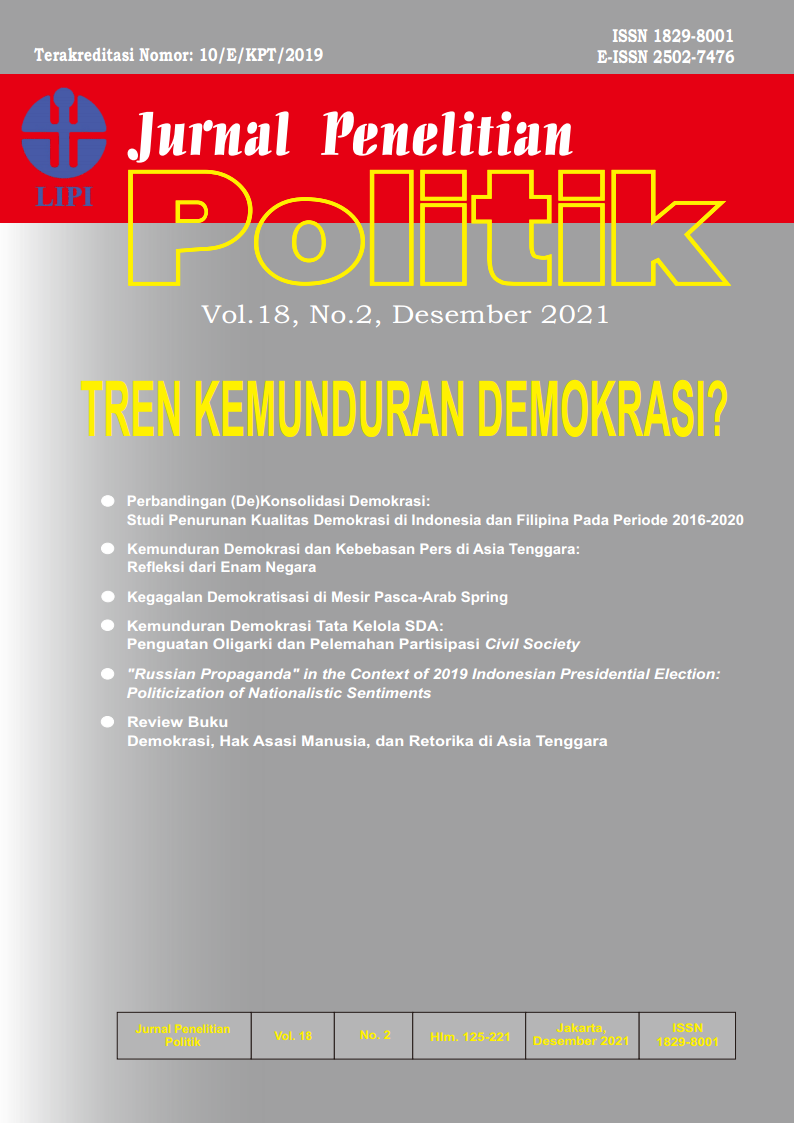
KEGAGALAN DEMOKRATISASI DI MESIR PASCA-ARAB SPRING
DOI:
https://doi.org/10.14203/jpp.v18i2.1051Keywords:
Arab Spring, democracy, Egypt, military coup, economic crisisAbstract
The Arab Spring had a domino effect on Egypt’s political stability. The political transition that occurred after
Hosni Mubarak’s resignation from power did not indicate an improving Egyptian democratic climate. The election
of Morsi from among civilians to become President democratically did not make the democratic process in Egypt
run well. This study aims to analyze the failure of democracy after the Arab Spring and to review the dominance of
the military in Egyptian politics. The results of this study indicate that the failure of democracy in Egypt occurred
due to the division of the Egyptian political elite which gave birth to polarizing sentiments, the Egyptian economic
crisis, and the dominance of the military in Egyptian politics which made it easier for the military to carry out a
coup. In this case, the military cannot be separated from its role in national politics because a special order has
been formed that strengthens the military domination in Egypt.
References
Al-Amin, E. (19 Juli 2013). The Grand Scam: Spinning Egypt's Military Coup Counter. http://www.counterpunch. org/2013/07/19/the-grand-scam-spinning-egypts-military-coup/, diakses pada 18 Juli 2021.
Alfian, & Syamsudin, N. (1988). Masa Depan Kehidupan Politik Indonesia. Rajawali.
Basyar, M. H. (2015). Pertarungan dalam berdemokrasi: Politik di Mesir, Turki, dan Israel. UI Press.
BBC. (8 Juli 2012). Egyptian President Mursi reverses parliament dissolution. https://www.bbc.com/news/world-middle-east-18761403, diakses pada17 Juli 2021.
Brown, N. J. (2013). Islam and Politics in the New Egypt. Carnegie Endowment for International Peace, 12.
Cruz, G. (2007). Only a day in Tunisia. Cruise Travel Magazine, 32.
Diamond, L., & Marc, F. P. (2001). Hubungan Sipil Militer dan Konsolidasi Demokrasi. PT Raja Grafindo Persada.
Dunne, M., & Hamzawy, A. (2008). The Ups and Downs of Political Reform in Egypt. Carnegie Endowment for International Peace.
Economist, T. (30 Maret 2018). Abdel-Fattah Al-Sisi wins a second term in Egypt., https://www.economist.com/middle-east-and-africa/2018/03/30/abdel-fattah-al-sisi-wins-a-second-term-in-egypt, diakses pada 18 Juli 2021.
Ghafur, M. F. (2014). Agama dan Demokrasi: Munculnya kekuatan Politik Islam di Tunisia, Mesir, dan Libya. Jurnal Penelitian Politik.
Hassan, M. H. (2010). State versus society in Egypt: Consolidating democracy or upgrading autocracy. African Journal of Political Science and International Relations, 319-320.
Hidriyah, S. (2012). Terpilihnya Muhammad Mursi dan Babak baru Demokrasi di Mesir. Info Singkat Hubungan Internasional.
Kahana, E., & Stivi-Kerbis, S. (2014). The Assassination of Anwar Al-Sadat: An Intelligence Failure . International Journal of Intelligence and Counter Intelligence , 183-185.
Kartini, I. (2015). Kegagalan Empat Negara Arab dan Keberhasilan Indonesia dalam masa Transisi Demokrasi. Jurnal Hubungan Internasional, 53.
Kirkpatrick, D. D., & Sheikh, M. E. (2012, November 23). Citing Deadlock, Egypt‟s Leader Seizes New Power and Plans Mubarak Retrial. https://www.nytimes.com/2012/11/23/world/middleeast/egyptspresidentMursigiveshimselfnewpowers.html, diakses pada 17 Juli 2021.
KomNasKDM. (2014). Buku Putih: Tragedi kemanusiaan Pasca Kudeta Militer di Mesir. KomNasKDM.
Kuncahyono, T. (2013). Tahrir Square: jantung Revolusi Mesir. Kompas.
Dam, S. (2001). Militer dan Demokratisasi di NIgeria, Mesir dan Afrika Selatan. P2P-LIPI.
Machmudi, Y. (2021). Timur Tengah dalam Sorotan: Dinamika Timur Tengah dalam perspektif Indonesia. Bumi Aksara.
Mushlih, A., & Hurriyah. (2016). Aktor Politik dan Gagalnya Transisi Demokrasi Mesir tahun 2011-2013. Politik 2, 51.
Nordinger, E. A. (1990). Milter dalam Politik: Kudeta dan Pemerintahan. Rineka CIpta.
Pappalarado, J. (2011, Februari 2). Analysis: Dissecting America and Egypt's Military Relationship. http://www.popularmechanics. com/technology/military/news/dissecting-america-and-egyptsmilitary-relationship-5168761, diakses pada 18 Juli 2021.
Ramly, L. N., & Irenewaty, R. T. (2015). Kebijakan Politik Muhammad Mursi sebagai Presiden Mesir (2012-2013). SOCIA Jurnal Ilmu Sosial, 95.
Sahide, A. (2015). The Arab Spring: Membaca Kronologi dan Faktor Penyebabnya. Jurnal Hubungan Internasional, Vol. 4, 121.
Sahrasad, H. (2014). Pergolakan Mesir: Dari Revolusi ke Transisi Demokrasi. Konfrontasi Jurnal: Culture, Economy, and social changes, 47.
Selim, G. M. (2015). The International Dimensions of Democratization in Egypt.Springer.
Stein, E. (2012). After the Arab Spring: power shift in the Middle East?: revolutionary Egypt: promises and perils. The London School of Economics and Political Science, 24.
Wahyudi, N., Basyar, M., Mashad, D., & Ghafur, M. F. (2020). Many faces of Political Islam in the Middle East: Arah Baru Gerakan Politik Islam Pasca-Arab Spring. LIPI Press.
Wangke, H. (2014). Masyarakat Sipil dan Transisi Demokrasi di Timur Tengah”, Info Singkat Hubungan Internasional. Info Singkat Hubungan Internasional, 7.
Yumitro, G., & Estriani, H. N. (2017). The Quo Vadis of Democratization in Post-Egypt Arab Spring. CIRR.
Downloads
Published
How to Cite
Issue
Section
License
Copyright (c) 2021 Author(s)

This work is licensed under a Creative Commons Attribution-ShareAlike 4.0 International License.

