
Optical Properties of Pristine and Li-Adatom-Functionalized B2N Monolayers: A First-Principles Prediction of Anisotropic and Tunable Response
DOI:
https://doi.org/10.55981/jsmi.2026.15982Abstract
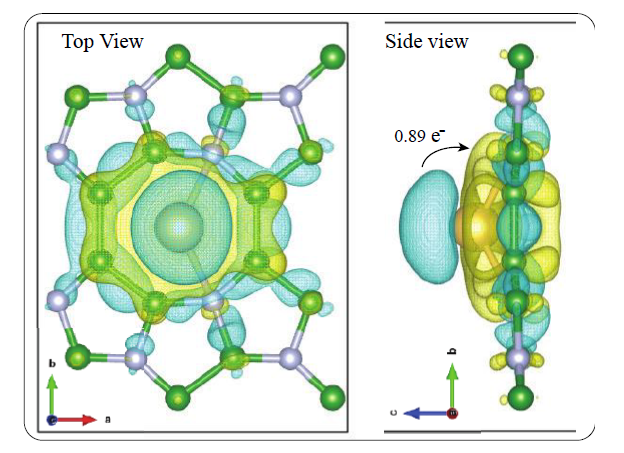
This study investigates the electronic structure and linear optical response of pristine and Li-adatom-functionalized B2N monolayers using first-principles density functional theory (DFT). To account for the inherent in-plane anisotropy of B2N, a comprehensive set of linear optical functions including the dielectric function, absorption coefficient, refractive index, extinction coefficient, reflectivity, and optical conductivity was systematically evaluated for incident light polarized along the crystallographic x, y, and z axes. For pristine B2N, a direct bandgap of 0.70 eV and an optical absorption onset at 2.8 eV were identified, indicating significant in-plane optical anisotropy. Upon Li functionalization, the bandgap narrows to an indirect 0.50 eV, while the absorption onset exhibits a redshift to 2.4 eV, accompanied by a distinct modulation in the anisotropic spectral profiles. These results characterize the fundamental optical properties of B2N and demonstrate that Li-adatom functionalization facilitates polarization-sensitive photodetection operating within the visible-light spectrum.
Downloads
References
[1]. J. Zhou et al., “Optoelectronic polymer memristors with dynamic control for power-efficient in-sensor edge computing,” Light: Science & Applications, vol. 14, no. 1, p. 309, 2025.
[2]. S. Aftab et al., “Advancements in nanomaterials for solar energy harvesting: Challenges, innovations, and future prospects,” Chemical Engineering Journal, vol. 516, p. 164224, 2025.
[3]. P. VP et al., “Remarkable fast-response visible light photodetectors based on SnS thin films on silicon substrates,” Applied Physics A, vol. 131, no. 1, p. 80, 2025.
[4]. Y. Pan et al., “Modulation anisotropy of nanomaterials toward monolithic integrated polarization-sensitive photodetectors,” Nanoscale, vol. 17, pp. 7533–7551, 2025.
[5]. R. Jonuarti, S. Zulaehah, et al., “CO adsorption on ultra-small carbon nanotubes decorated with single transition metal atoms,” Physica B: Condensed Matter, vol. 654, p. 414681, 2023.
[6]. N. Goel et al., “Growth of single-crystalline 2D materials for advanced quantum sensing devices,” Applied Physics Reviews, vol. 12, no. 3, p. 031312, 2025.
[7]. M. A. Hasan and H. A. Abdulhussein, “Beyond the surface—exploring the complexities of 2D materials with density functional theory,” Journal of Materials Science, pp. 1–45, 2025.
[8]. L. Xie et al., “Carbon-nanomaterial-enabled terahertz technology,” Nature Reviews Physics, pp. 1–15, 2025.
[9]. W. Ahmad et al., “Two-dimensional indium chalcogenides: From fundamental properties to next-generation optoelectronic devices,” Advanced Optical Materials, vol. 13, no. 24, p. e01067, 2025.
[10]. D. Xu et al., “Two-dimensional janus NbOClI: A promising anisotropic unit for multifunctional optoelectronic devices,” Physical Review B, vol. 111, no. 15, p. 155405, 2025.
[11]. D. Rai, Y. Jaiswal, and S. Sinha, “Graphene quantum dots synthesis using waste unburnt carbon: implications for optoelectronics,” Applied Surface Science, vol. 653, p. 159386, 2024.
[12]. I. Shahbaz, M. Tahir, L. Li, and Y. Song, “Advancements in 2D transition metal dichalcogenides (TMDs) inks for printed optoelectronics: A comprehensive review,” Materials Today, vol. 77, pp. 142–184, 2024.
[13]. Z. Arbaoui et al., “First-principles analysis of the optoelectronic and thermoelectric properties of black phosphorene for energy harvesting applications,” Phase Transitions, vol. 98, no. 6-7, pp. 472–483, 2025.
[14]. N. R. Innis, C. Marichy, C. Journet, and C. Bousige, “Borophene bottom-up syntheses: a critical review,” 2D Materials, vol. 12, no. 2, p. 022005, 2025.
[15]. S. H. Aleithan and W. Ahmad, “Anisotropic photodetection in borophene: exploiting directional optical responses for next-generation polarization-sensitive devices,” Nanoscale, vol. 17, no. 33, pp. 19070–19085, 2025.
[16]. N. Katoch, J. Kumar, A. Kumar, P. Ahluwalia, and R. Pandey, “Optoelectronic and photocatalytic properties of stable pentagonal B2S and B2Se monolayers,” Computational Materials Science, vol. 211, p. 111524, 2022.
[17]. E. Marinho Jr et al., “Optoelectronic properties of boron monochalcogenide monolayers: Quasiparticle and excitonic effects from first principles,” Physical Review B, vol. 111, no. 23, p. 235305, 2025.
[18]. X. Zhou et al., “Two-dimensional boron-rich monolayer BxN as high capacity for Lithium-ion batteries: a first-principles study,” ACS Applied Materials & Interfaces, vol. 13, no. 34, pp. 41169–41181, 2021.
[19]. J. Qi et al., “B5N3 and B7N5 monolayers with high carrier mobility and excellent optical performance,” The Journal of Physical Chemistry Letters, vol. 12, no. 20, pp. 4823–4832, 2021.
[20]. S. Lin et al., “A B2N monolayer: a direct band gap semiconductor with high and highly anisotropic carrier mobility,” Nanoscale, vol. 14, no. 3, pp. 930–938, 2022.
[21]. R. Rahimi, M. Solimannejad, and A. Horri, “DFT study of the adsorption properties and sensitivity of a B2N monolayer toward harmful gases,” Scientific Reports, vol. 14, no. 1, p. 29282, 2024.
[22]. R. Rahimi and M. Solimannejad, “Exploring the adsorption behavior of O-containing VOCs in human breath on a B2N monolayer using DFT-simulations,” Physical Chemistry Chemical Physics, vol. 26, no. 39, pp. 25567–25580, 2024.
[23]. Z. Qiu, J. Guo, Q. Wang, H. Wang, and X. Tan, “Reversible hydrogen storage and release mechanism of a B2N monolayer: a first-principles insight,” Physical Chemistry Chemical Physics, vol. 26, no. 33, pp. 22240–22251, 2024.
[24]. F. Fan, J. Ren, Y. He, and X. Chen, “DFT study of Mg decorated on the planar B2N as a novel hydrogen storage media,” Results in Physics, vol. 46, p. 106263, 2023.
[25]. Y. Wei et al., “Single-atom transition metals doping two-dimensional BXN materials (x=2, 3, 5) with promising electrocatalytic activity for efficient hydrogen production in the entire pH range,” Materials Advances, vol. 5, no. 16, pp. 6586–6595, 2024.
[26]. Y. Wei et al., “Computational screening of single-atom transition metals on boron-rich boron nitride nanosheets for efficient hydrogen evolution catalysis in all pH range,” The Journal of Chemical Physics, vol. 161, no. 14, p. 144108, 2024.
[27]. X. Fan, W. Zheng, and J.-L. Kuo, “Adsorption and diffusion of Li on pristine and defective graphene,” ACS Applied Materials & Interfaces, vol. 4, no. 5, pp. 2432–2438, 2012.
[28]. G. Barik and S. Pal, “Defect induced performance enhancement of monolayer MoS2 for Li- and Na-ion batteries,” The Journal of Physical Chemistry C, vol. 123, no. 36, pp. 21852–21865, 2019.
[29]. A. Sanna et al., “First-principles and angle-resolved photoemission study of lithium doped metallic black phosphorous,” 2D Materials, vol. 3, no. 2, p. 025031, 2016.
[30]. X. Li and S. Li, “Investigations of electronic and nonlinear optical properties of single alkali metal adsorbed graphene, graphyne and graphdiyne systems by first-principles calculations,” Journal of Materials Chemistry C, vol. 7, no. 6, pp. 1630–1640, 2019.
[31]. Z. Yang, Y. Zhang, M. Guo, and J. Yun, “Adsorption of hydrogen and oxygen on graphdiyne and its BN analog sheets: A density functional theory study,” Computational Materials Science, vol. 160, pp. 197–206, 2019.
[32]. Y. Yong et al., “Ultrahigh capacity and reversible hydrogen storage media based on Li-decorated T-BN monolayers,” Journal of Energy Storage, vol. 72, p. 108169, 2023.
[33]. P. Giannozzi et al., “Quantum espresso: a modular and open-source software project for quantum simulations of materials,” Journal of Physics: Condensed Matter, vol. 21, no. 39, p. 395502, 2009.
[34]. P. Giannozzi et al., “Advanced capabilities for materials modelling with quantum espresso,” Journal of Physics: Condensed Matter, vol. 29, no. 46, p. 465901, 2017.
[35]. J. P. Perdew and Y. Wang, “Accurate and simple analytic representation of the electron-gas correlation energy,” Physical Review B, vol. 45, no. 23, p. 13244, 1992.
[36]. D. Hamann, “Optimized norm-conserving vanderbilt pseudopotentials,” Physical Review B, vol. 88, no. 8, p. 085117, 2013.
[37]. S. Grimme, “Semiempirical GGA-type density functional constructed with a long-range dispersion correction,” Journal of Computational Chemistry, vol. 27, no. 15, pp. 1787–1799, 2006.
[38]. J. Heyd, G. E. Scuseria, and M. Ernzerhof, “Hybrid functionals based on a screened coulomb potential,” The Journal of Chemical Physics, vol. 118, no. 18, pp. 8207–8215, 2003.
[39]. A. V. Krukau, O. A. Vydrov, A. F. Izmaylov, and G. E. Scuseria, “Influence of the exchange screening parameter on the performance of screened hybrid functionals,” The Journal of Chemical Physics, vol. 125, no. 22, p. 224106, 2006.
[40]. N. Brener, “Random-phase-approximation dielectric function for diamond, with local field effects included,” Physical Review B, vol. 12, no. 4, p. 1487, 1975.
[41]. M. A. Nazir et al., “Electronic, optical and elastic properties of cubic zirconia (c-ZrO2) under pressure: A DFT study,” Physica B: Condensed Matter, vol. 604, p. 412462, 2021.
[42]. G. Henkelman, A. Arnaldsson, and H. Jónsson, “A fast and robust algorithm for bader decomposition of charge density,” Computational Materials Science, vol. 36, no. 3, pp. 354–360, 2006.
[43]. Z. Xie, L. Hui, J. Wang, G. Zhu, Z. Chen, and C. Li, “Electronic and optical properties of monolayer black phosphorus induced by bi-axial strain,” Computational Materials Science, vol. 144, pp. 304–314, 2018.
[44]. N. Christensen and I. Gorczyca, “Optical and structural properties of iii-v nitrides under pressure,” Physical Review B, vol. 50, no. 7, p. 4397, 1994.
[45]. R. Beiranvand and S. Valedbagi, “Electronic and optical properties of h-BN nanosheet: A first principles calculation,” Diamond and Related Materials, vol. 58, pp. 190–195, 2015.
[46]. D. Evans et al., “Determination of the optical band-gap energy of cubic and hexagonal boron nitride using luminescence excitation spectroscopy,” Journal of Physics: Condensed Matter, vol. 20, no. 7, pp. 075233, 2008.
Downloads
Published
How to Cite
Issue
Section
License
Copyright (c) 2026 Siti Zulaeahh, Eqwar Saputra, Syaukaty Yasinta, Alfiah Zahro Nuraini, Anwar Ma’ruf

This work is licensed under a Creative Commons Attribution-ShareAlike 4.0 International License.









