Development of Chitosan–Activated Carbon Composite Adsorbent Films for Fe²⁺ Removal: A Full Factorial Design Approach
DOI:
https://doi.org/10.55981/jsmi.2026.16721Keywords:
Chitosan, Activated carbon , Composite membrane, Iron adsorption, Full factorial designAbstract
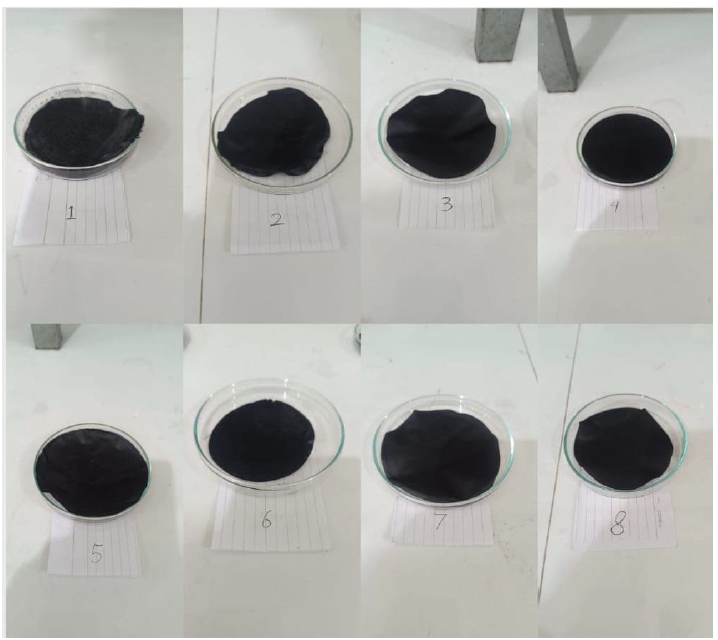
Iron (Fe)-contaminated wastewater from industrial activities poses significant environmental challenges, motivating the development of efficient and sustainable treatment technologies. This study investigated a chitosan–activated carbon composite adsorbent film for Fe²⁺ removal using a 2³ full factorial design. The material was prepared by solvent casting, with polyethylene glycol (PEG) used as a pore-forming agent and activated carbon as the principal adsorbent. The effects of PEG concentration, activated carbon loading, and stirring time on residual Fe concentration were evaluated. The term “membrane” in the original study is used here only in the fabrication sense; the material was evaluated as an adsorptive film rather than as a size-selective nanofiltration or microfiltration membrane. Direct porosity or pore-size characterization was not performed, so the proposed roles of PEG in pore formation and of chitosan/activated carbon in Fe²⁺ uptake are interpreted from the fabrication procedure, adsorption trends, and FTIR observations rather than from direct pore-structure measurements. FTIR spectra were consistent with retention of characteristic hydroxyl (–OH), amino (–NH₂), C–N, and C–O–C functional groups, although baseline drift and spectral noise limit the conclusiveness of the FTIR evidence. Among the eight experimental runs, the lowest residual Fe concentration observed was 7.750 mg L⁻¹ at 750 mg PEG, 40 wt% activated carbon, and 4 h stirring. The unreplicated factorial model gave R² = 0.924, but the overall model and individual factor effects were not statistically significant at the 95% confidence level (p > 0.05), with only one residual degree of freedom. Accordingly, the reported formulation is the best-performing experimental run within the tested design space, not a statistically validated optimum. Replicated experiments, porosity characterization, and microscopy are recommended to establish the controlling factors and adsorption mechanism more rigorously.
Downloads
References
[1] W. J. Keijok, L. A. C. Alvarez, A. M. Gomes, F. V. Campos, J. P. de Oliveira, and M. C. C. Guimarães, "Optimized synthesis and stabilization of superparamagnetic iron oxide nanoparticles for enhanced biomolecule adsorption," ACS Omega, vol. 10, no. 2, pp. 1976–1987, 2025, doi: 10.1021/acsomega.4c07371.
[2] M. N. Pervez, M. A. Jahid, M. R. Mishu, M. E. Talukder, A. Buonerba, T. Jiang, et al., "Tuning the surface functionality of polyethylene glycol-modified graphene oxide/chitosan composite for efficient removal of dye," Scientific Reports, vol. 13, no. 1, 2023, doi: 10.1038/s41598-023-40701-9.
[3] M. Abbas, "Potential role of nanoparticles in treating the accumulation of amyloid-beta peptide in Alzheimer's patients," Polymers, vol. 13, no. 7, p. 1051, 2021, doi: 10.3390/polym13071051.
[4] A. Labena, A. E. Abdelhamid, S. Husien, T. Youssef, E. Azab, A. A. Gobouri, and G. Safwat, "Grafting of acrylic membrane prepared from fibers waste for dyes removal: Methylene blue and Congo red," Separations, vol. 8, no. 4, p. 42, 2021, doi: 10.3390/separations8040042.
[5] M. Abdolmaleki, O. M. Jazani, H. Moradi, M. Malayeri, and F. Mehradnia, "Novel polyethylene glycol/nanosilica-reinforced polyurethane mixed matrix nanocomposite membrane with enhanced gas separation properties," Brazilian Journal of Chemical Engineering, vol. 42, no. 1, pp. 357–371, 2023, doi: 10.1007/s43153-023-00407-x.
[6] X. You, Y. Hou, J. Wang, L. Li, and M. He, "Preparation and characterization of SA/GO/PEG gel beads and their adsorption properties for Pb2+," Journal of Applied Polymer Science, vol. 143, no. 12, 2026, doi: 10.1002/app.70338.
[7] J. Lewis, A. Alshami, M. J. Talukder, A. Owoade, K. Baker, and S. A. Onaizi, "Agglomeration tendency and activated carbon concentration effects on activated carbon-polysulfone mixed matrix membrane performance: A design of experiment formulation study," Journal of Applied Polymer Science, vol. 139, no. 37, 2022, doi: 10.1002/app.52875.
[8] P. Chatzidopavlaki, E. Triantafyllopoulou, N. Pippa, G. Valsami, and P. P. Dallas, "Recent advances in the technology of effervescent tablets: Lessons learned and future perspectives," RSC Pharmaceutics, vol. 2, no. 1, pp. 8–18, 2025, doi: 10.1039/d4pm00229f.
[9] M.-T. Talianu, C. Dinu-Pîrvu, M. V. Ghica, V. Anuța, R. M. Prisada, and L. Popa, "Development and characterization of new miconazole-based microemulsions for buccal delivery by implementing a full factorial design modeling," Pharmaceutics, vol. 16, no. 2, p. 271, 2024, doi: 10.3390/pharmaceutics16020271.
[10] I. K. Abbas, "Self-nanoemulsifying drug delivery system: Liquid, supersaturable, and solid dosage forms," Al-Rafidain Journal of Medical Sciences, vol. 3, pp. 98–108, 2022, doi: 10.54133/ajms.v3i.91.
[11] S. Xiang, Y. Tan, and Y. Gao, "Synthesis of comb-polyurethane-modified polycarboxylate at indoor temperature and its interaction with Portland cement," Frontiers in Materials, vol. 8, 2021, doi: 10.3389/fmats.2021.725328.
[12] A. O. Adeola and P. N. Nomngongo, "Advanced polymeric nanocomposites for water treatment applications: A holistic perspective," Polymers, vol. 14, no. 12, p. 2462, 2022, doi: 10.3390/polym14122462.
[13] O. Agboola, O. S. I. Fayomi, A. O. Ayeni, E. E. Alagbe, S. E. Sanni, E. E. Okoro, et al., "A review on polymer nanocomposites and their effective applications in membranes and adsorbents for water treatment and gas separation," Membranes, vol. 11, no. 2, p. 139, 2021, doi: 10.3390/membranes11020139.
[14] S. Manzoor, M. W. Ashraf, S. Tayyaba, M. I. Tariq, and M. K. Hossain, "Recent progress of fabrication, characterization, and applications of anodic aluminum oxide (AAO) membrane: A review," Computer Modeling in Engineering & Sciences, vol. 135, no. 2, pp. 1007–1052, 2023, doi: 10.32604/cmes.2022.022093.
[15] M. Lehocký, "Environmental applications of chitosan derivatives and chitosan composites," Polymers, vol. 17, no. 19, p. 2583, 2025, doi: 10.3390/polym17192583.
[16] M. Oprea and Ș. I. Voicu, "Cellulose acetate-based materials for water treatment in the context of circular economy," Water, vol. 15, no. 10, p. 1860, 2023, doi: 10.3390/w15101860.
[17] C. Tseng, H. Wu, A. Shiue, C. Hsu, Y. Huang, and G. Leggett, "Performance of coated activated carbon filters used in the building environment," Journal of Chemical Technology & Biotechnology, vol. 97, no. 9, pp. 2511–2518, 2022, doi: 10.1002/jctb.7111.
[18] G. Rando, S. Sfameni, and M. R. Plutino, "Development of functional hybrid polymers and gel materials for sustainable membrane-based water treatment technology: How to combine greener and cleaner approaches," Gels, vol. 9, no. 1, p. 9, 2023, doi: 10.3390/gels9010009.
[19] L. Șenilă, E. Kovács, and M. Șenilă, "A review of polylactic acid (PLA) and poly(3-hydroxybutyrate) (PHB) as bio-sourced polymers for membrane production applications," Membranes, vol. 15, no. 7, p. 210, 2025, doi: 10.3390/membranes15070210.
[20] K. Kashima, T. Takahashi, R. Nakayama, and M. Imai, "Innovative separation technology utilizing marine bioresources: Multifaceted development of a chitosan-based system leading to environmentally friendly processes," in Marine Bioresources. London, U.K.: IntechOpen, 2021, doi: 10.5772/intechopen.95839.
[21] G. G. Kaya and H. Deveci, "Morphological, textural and thermal properties of low-cost silica aerogel composites," Konya Journal of Engineering Sciences, vol. 9, no. 3, pp. 787–796, 2021, doi: 10.36306/konjes.969489.
[22] S. Mulyati, A. Luthfiana, A. C. Ambarita, C. R. Nanda, and C. M. Rosnelly, "Characterization and performance of CA/chitosan membrane from golden snail shell in the application of humic acid purification," Key Engineering Materials, vol. 999, pp. 27–34, 2024, doi: 10.4028/p-fx06ge.
[23] Y. Dong, Z. Wang, and Z. Zhang, "Stimuli-responsive crystalline smart materials: From rational design and fabrication to applications," Accounts of Chemical Research, vol. 55, no. 7, pp. 1047–1058, 2022, doi: 10.1021/acs.accounts.2c00027.
[24] C. Yang, Z. Cheng, P. Li, and B. Tian, "Exploring present and future directions in nano-enhanced optoelectronic neuromodulation," Accounts of Chemical Research, vol. 57, no. 9, pp. 1398–1410, 2024, doi: 10.1021/acs.accounts.4c00086.
[25] S. M. Rao, M. V. Varsha, and G. Nageswaran, "Bimetallic metal-organic frameworks (BMOFs) and BMOF-incorporated membranes for energy and environmental applications," ChemPlusChem, vol. 88, no. 3, p. e202200420, 2023, doi: 10.1002/cplu.202200420.
[26] S. Feizolahi, M. Pakizeh, and M. Namvar-Mahboub, "Multilayer-coated polyphenylsulfone membranes with superior antifouling properties of PEG-NH2 hydrogel for ultrafiltration process," Journal of Applied Polymer Science, vol. 141, no. 44, p. e56184, 2024, doi: 10.1002/app.56184.
[27] R. S. Dassanayake, S. Acharya, and N. Abidi, "Recent advances in biopolymer-based dye removal technologies," Molecules, vol. 26, no. 15, p. 4697, 2021, doi: 10.3390/molecules26154697.
[28] C. Gao, Q. Zhang, Y. Yang, Y. Li, and W. Lin, "Recent trends in therapeutic application of engineered blood purification materials for kidney disease," Biomaterials Research, vol. 26, no. 1, 2022, doi: 10.1186/s40824-022-00250-0.
[29] A. F. Zakaria, S. Kamaruzaman, and N. A. Rahman, "Electrospun polyacrylonitrile/lignin/poly(ethylene glycol)-based porous activated carbon nanofiber for removal of nickel(II) ion from aqueous solution," Polymers, vol. 13, no. 20, p. 3590, 2021, doi: 10.3390/polym13203590.
[30] A. Sahu, R. Dosi, C. O. Kwiatkowski, S. Schmal, and J. C. Poler, "Advanced polymeric nanocomposite membranes for water and wastewater treatment: A comprehensive review," Polymers, vol. 15, no. 3, p. 540, 2023, doi: 10.3390/polym15030540.
[31] O. Agboola, G. A. Oginni, O. Oladokun, V. E. Efeovbokhan, A. O. Ayeni, A. A. Adedamola, et al., "Synthesis of PET-magnesium oxide-chitosan nanocomposite membranes for the dehydration of natural gas," Periodica Polytechnica Chemical Engineering, vol. 67, no. 2, pp. 213–224, 2023, doi: 10.3311/PPCH.20729.
[32] A. S. Norfarhana, R. A. Ilyas, N. Ngadi, S. Sharma, M. H. Sayed, A. S. El-Shafay, and A. H. Nordin, "Natural fiber-reinforced thermoplastic ENR/PVC composites as potential membrane technology in industrial wastewater treatment: A review," Polymers, vol. 14, no. 12, p. 2432, 2022, doi: 10.3390/polym14122432.
[33] A. Kausar, "Evolving scientific aptitude of poly(ethylene glycol) filled with carbonaceous nanofillers," Journal of Plastic Film & Sheeting, vol. 37, no. 4, pp. 490–509, 2021, doi: 10.1177/8756087921999094.
[34] R. Albash, M. Hassan, A. M. Agiba, W. H. Abd-Elsalam, D. E. Aziz, Y. R. Hassan, A. B. Kassem, A. Saleh, and M. A. Eltabeeb, "PEGylated terpesome-loaded 3D-printed aripiprazole ocuserts for the treatment of ocular candidiasis," Pharmaceutics, vol. 17, no. 12, p. 1616, 2025, doi: 10.3390/pharmaceutics17121616.
[35] S. Badivi, S. Kazemi, M. Eskandarisani, N. A. Moghaddam, G. Mesbahian, S. Karimifard, and E. Afzali, "Targeted delivery of bee venom to A549 lung cancer cells by PEGylated liposomal formulation: An apoptotic investigation," Scientific Reports, vol. 14, no. 1, 2024, doi: 10.1038/s41598-024-68156-6.
[36] S. A. Cahyani and N. Kusumawati, "Optimization of polysulfone/polyethylene glycol (PSf/PEG) casted solution composition as a membrane electrolyte in a dye-sensitized solar cell (DSSC)," Jurnal Pijar MIPA, vol. 19, no. 3, pp. 499–506, 2024, doi: 10.29303/jpm.v19i3.6610.
[37] K. Jagaran and M. Singh, "Copolymer-green-synthesized copper oxide nanoparticles enhance folate-targeting in cervical cancer cells in vitro," Polymers, vol. 15, no. 10, p. 2393, 2023, doi: 10.3390/polym15102393.
[38] N. A. Jamaludin and N. F. C. Harun, "A facile conjugation of 6-hydroxylflavone biomolecule with polyethylene glycol for enhancing conjugate stability," International Journal of Technology, vol. 13, no. 3, p. 575, 2022, doi: 10.14716/ijtech.v13i3.5336.
[39] A. Kausar, "Evolving scientific aptitude of poly(ethylene glycol) filled with carbonaceous nanofillers," Journal of Plastic Film & Sheeting, vol. 37, no. 4, pp. 490–509, 2021, doi: 10.1177/8756087921999094.
[40] G. Moradi, M. Rahimi, S. Zinadini, and S. Hadidi, "Fabrication of the polyethersulfone/functionalized mesoporous carbon nanocomposite nanofiltration membrane for dyes and heavy metal ions removal: Experimental and quantum mechanical simulation method," Polymers for Advanced Technologies, vol. 34, no. 1, pp. 89–109, 2022, doi: 10.1002/pat.5869.
[41] M. Purwanto, N. C. Kusuma, M. A. Sudrajat, J. Jaafar, A. M. Nasir, M. H. A. Aziz, M. H. D. Othman, M. A. Rahman, Y. Raharjo, and N. Widiastuti, "Seawater desalination by modified membrane distillation: Effect of hydrophilic surface-modifying macromolecules addition into PVDF hollow fiber membrane," Membranes, vol. 11, no. 12, p. 924, 2021, doi: 10.3390/membranes11120924.
[42] Z. Zangeneh, T. Mohammadi, S. Zarghami, and M. A. Tofighy, "Fabrication optimization of polyethersulfone adsorptive mixed matrix membrane for enhanced dynamic methylene blue removal: Response surface methodology approach," Polymer Engineering & Science, vol. 64, no. 4, pp. 1858–1876, 2024, doi: 10.1002/pen.26669.
[43] M. Zenze and M. Singh, "Receptor targeting using copolymer-modified gold nanoparticles for pCMV-Luc gene delivery to liver cancer cells in vitro," International Journal of Molecular Sciences, vol. 25, no. 9, p. 5016, 2024, doi: 10.3390/ijms25095016.
[44] M. T. ALSamman and J. Sánchez, "Adsorption of copper and arsenic from water using a semi-interpenetrating polymer network based on alginate and chitosan," Polymers, vol. 15, no. 9, p. 2192, 2023, doi: 10.3390/polym15092192.
[45] N. F. Al-Harby, E. F. Albahly, and N. A. Mohamed, "Synthesis and characterization of novel uracil-modified chitosan as a promising adsorbent for efficient removal of Congo red dye," Polymers, vol. 14, no. 2, p. 271, 2022, doi: 10.3390/polym14020271.
[46] F. Ardian, I. Putra, K. J. Wonua, S. Pintowantoro, Y. Setiyorini, and R. Paramyta, "Analysis of platinum (Pt) ion biosorption performance using chitosan," E3S Web of Conferences, vol. 543, p. 03007, 2024, doi: 10.1051/e3sconf/202454303007.
[47] W. A. El-Fattah, A. Guesmi, N. B. Hamadi, R. Yahya, T. S. Alraddadi, A. Shahat, and R. F. M. Elshaarawy, "A sustainable approach to the development and characterization of chitosan thiomer beads for the efficient removal of Cd(II) ions from aqueous effluents," RSC Advances, vol. 15, no. 40, pp. 33695–33707, 2025, doi: 10.1039/D5RA04050G.
[48] E. S. A. El-Sayed, S. Dacrory, H. Essawy, H. S. Ibrahim, N. S. Ammar, and S. Kamel, "Sustainable grafted chitosan-dialdehyde cellulose with high adsorption capacity of heavy metal," BMC Chemistry, vol. 17, no. 1, 2023, doi: 10.1186/s13065-023-01035-9.
[49] S. S. Fatullayeva, D. B. Tagiyev, N. A. Zeynalov, S. Mammadova, and E. Aliyeva, "Recent advances of chitosan-based polymers in biomedical applications and environmental protection," Journal of Polymer Research, vol. 29, no. 7, 2022, doi: 10.1007/s10965-022-03121-3.
[50] E. Fayad, M. Alsunbul, R. S. Alazragi, A. Ebada, H. S. Ali, and M. F. Mubarak, "Magnetic chitosan kaolinite cellulose nanofibril cryogel beads for efficient removal of methylene blue from water," Scientific Reports, vol. 15, no. 1, 2025, doi: 10.1038/s41598-025-28126-y.
[51] Y. Feng, R. Jing, X. Yuju, Z. Wang, and D. Xin, "Preparation and selective adsorption properties of Cu2+-imprinted chitosan membranes," Environmental Progress & Sustainable Energy, vol. 45, no. 1, 2025, doi: 10.1002/ep.70114.
[52] C. Huang, Y. Huang, T. Xie, W. Yu, and S. Ai, "Adsorption mechanism of bentonite with dispersed chitosan for cadmium ions," Chemical Engineering & Technology, vol. 44, no. 3, pp. 441–448, 2021, doi: 10.1002/ceat.202000505.
[53] J. Jia, Y. Liu, and S. Sun, "Preparation and characterization of chitosan/bentonite composites for Cr(VI) removal from aqueous solutions," Adsorption Science & Technology, 2021, doi: 10.1155/2021/6681486.
[54] J. Lassoued, F. Zili, and S. Sadok, "Eco-friendly cellulose-based aerogels from Posidonia oceanica waste: Effect of microcellulose extraction route and natural biopolymers on adsorption performance," Chemistry & Biodiversity, vol. 23, no. 5, 2026, doi: 10.1002/cbdv.202503863.
[55] E. Mendizábal, N. Ríos-Donato, C. F. Jasso-Gastinel, and I. P. Verduzco-Navarro, "Removal of arsenate by fixed-bed columns using chitosan-magnetite hydrogel beads and chitosan hydrogel beads: Effect of the operating conditions on column efficiency," Gels, vol. 9, no. 10, p. 825, 2023, doi: 10.3390/gels9100825.
[56] S. Srivastava, A. Bajpai, S. M. Musthaq, and K. Biswas, "Recovery of rare earth elements (Nd, Dy) from discarded hard disk magnets using EDTA-functionalised chitosan," RSC Sustainability, vol. 2, no. 4, pp. 1088–1100, 2024, doi: 10.1039/D3SU00427A.
Downloads
Published
How to Cite
Issue
Section
License
Copyright (c) 2026 Agung Prabowo, Rafi Raihan Nugraha, kusyanto, Dwiyan Satria Prakasa, Ibnu Eka Rahayu, Muh. Irwan, Cindi Amborowati, Yuli Patmawati, Marlinda

This work is licensed under a Creative Commons Attribution-ShareAlike 4.0 International License.