
Biodegradable Pickering Emulsions Stabilized by Cellulose Nanocrystals Derived from Pongamia pinnata Fruit Peel Waste
DOI:
https://doi.org/10.55981/jsmi.2026.16759Keywords:
Cellulose Nanocrystals (CNC), Pongamia pinnata, Pickering emulsion, agricultural waste, biodegradable stabilizersAbstract
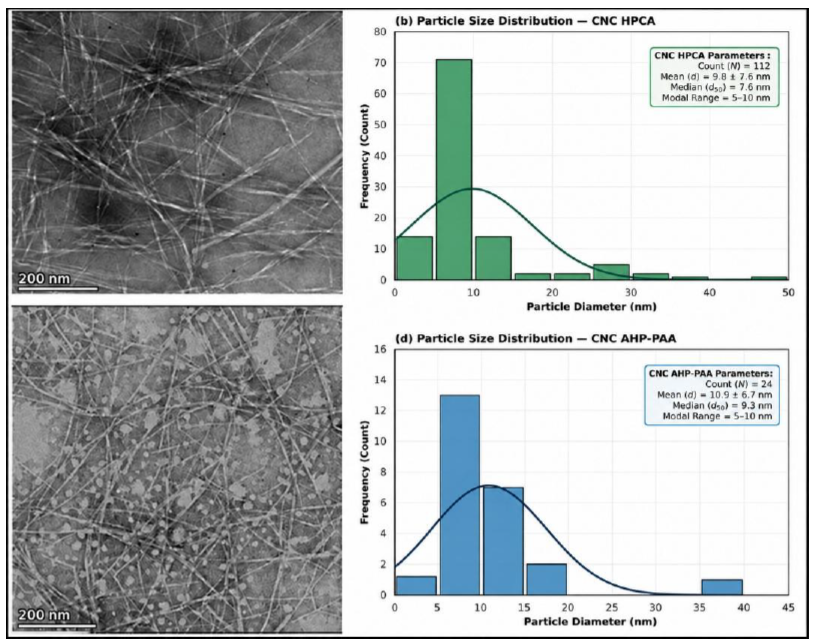
Agricultural residues can be used as alternative sources of cellulose for the preparation of functional nanomaterials. In this study, Pongamia pinnata fruit peel was investigated as a cellulose source for the production of cellulose nanocrystals (CNCs) and their application in oil-in-water (O/W) Pickering emulsions. The fruit peel was subjected to alkaline treatment, two-step bleaching, and sulfuric acid hydrolysis. The sequential treatment yielded 63% purified cellulose. Fourier transform infra-red (FTIR) analysis showed the removal of bands associated with non-cellulosic components, while X-ray diffraction (XRD) analysis indicated a cellulose I structure and an increase in crystallinity index from approximately 63% for purified cellulose to 77% for the CNCs. Thermogravimetric analysis-derivative thermogravimetry (TGA/DTG) analysis showed changes in the thermal decomposition behavior after acid hydrolysis. Transmission electron microscopy (TEM) analysis revealed rod-like CNCs with lengths of approximately 200–400 nm, with mean diameters of 9.8 ± 7.6 nm for the hydrogen peroxide–citric acid (HPCA)-derived CNCs and 10.9 ± 6.7 nm for the alkaline hydrogen peroxide–peracetic (AHP–PAA)-derived CNCs. The CNCs were modified with cetyltrimethylammonium bromide (CTAB) and evaluated at concentrations of 0.4%, 0.5%, and 0.6% (w/v) in O/W Pickering emulsions. Among the tested formulations, the 0.6% CNC–CTAB emulsion showed the lowest visible phase separation during seven days of storage. These results indicate that P. pinnata fruit peel can be used as a cellulose feedstock for CNC production and that CTAB-modified CNCs can contribute to Pickering emulsion stabilization.
Downloads
References
[1] J.-Y. Lee, S.-E. Lee, and D.-W. Lee. “Current Status and Future Prospects of Biological Routes to Bio-Based Products Using Raw Materials, Wastes, and Residues as Renewable Resources.” Crit. Rev. Environ. Sci. Technol., vol. 52, no. 14, pp. 2453–2509, 2022.
[2] S. Ahmed. Biobased nanomaterials. Singapore: Springer Nature, 2024.
[3] A. B. Rashid, M. E. Hoque, N. Kabir, F. F. Rifat, H. Ishrak, A. Alqahtani, and M. E. H. Chowdury. “Synthesis, Properties, Applications, and Future Prospective of Cellulose Nanocrystals.” Polymers (Basel)., vol. 15, no. 20, p. 4070, 2023.
[4] M. Raza and B. Abu-Jdayil. “Cellulose Nanocrystals From Lignocellulosic Feedstock: A Review of Production Technology and Surface Chemistry Modification.” Cellulose, vol. 29, no. 2, pp. 685–722, 2022.
[5] F. B. de Carvalho-Guimarães, K. L. Correa, T. P. de Souza, J. R. Rodriguez Amado, R. M. Ribeiro-Costa, and J. O. C Silva-Júnior. “A Review of Pickering Emulsions: Perspectives and Applications.” Pharmaceuticals, vol. 15, no. 11, p. 1413, 2022.
[6] F. Heidari-Dalfard, S. Tavasoli, E. Assadpour, R. Miller, and S. M. Jafari. “Surface Modification of Particles/Nanoparticles to Improve the Stability of Pickering Emulsions: A Critical Review.” Adv. Colloid Interface Sci., vol. 336, p. 103378, 2025.
[7] S. H. Teo, C. Y. Chee, M. Z. Fahmi, S. C. Wibawa Sakti, and H. V. Lee. “Review of Functional Aspects of Nanocellulose-Based Pickering Emulsifier for Non-Toxic Application and Its Colloid Stabilization Mechanism.” Molecules, vol. 27, no. 21, 2022.
[8] J. P. S. Morais, M. D. F. Rosa, E. S. D. Brito, H. M. C. D. Azeredo, and M. C. B. D. Figueirêdo. “Sustainable Pickering Emulsions With Nanocellulose: Innovations and Challenges.” Foods, vol. 12, no. 19, p. 3599, 2023.
[9] Z. Li, S. Anankanbil, J. N. Pedersen, M. Nadzieja, and Z. Guo. “Nanocellulose Fractionated From TEMPO-Mediated Oxidation of Cellulose as an Energy-Free Ingredient for Stabilizing Pickering Emulsion.” Biochem. Eng. J., vol. 191, p. 108795, 2023.
[10] P. M. Reque and A. Brandelli. “Encapsulation of Probiotics and Nutraceuticals: Applications in Functional Food Industry.” Trends Food Sci. Technol., vol. 114, pp. 1–10.
[11] A. Ahmad, H. P. S. Abdul Khalil, R. D. Bairwan, M. I. Ahmad, A. A. A. Abdullah, C. K. Abdullah, E. B. Yahya, M. S. C. Zain, and S. A. Hamid. “Sustainable Cellulose Extraction: Unlocking the Potential of Tropical Fruit Peels for Advanced Materials.” Clean Technol. Environ. Policy, vol. 27, no. 2, pp. 919–951, 2025.
[12] S. Prabhakaran, D. Pandey, J. K. Nayak, and R. Chauhan. “Plant Breeding, Genetics and Biotechnology on Pierre (Pongamia pinnata L.).” Breed. Biotechnol. Grass Bast Fiber Crop., pp. 721–753, 2025.
[13] X. Gong, M. F. Ismail, and Y. Boluk. “Interactions Between Cetyltrimethylammonium Bromide Modified Cellulose Nanocrystals and Surfaces: An Ellipsometric Study.” Surfaces, vol. 7, no. 2, pp. 428–441, 2024.
[14] W. Thongsomboon, Y. Baimark, and P. Srihanam. “Valorization of Cellulose-Based Materials From Agricultural Waste: Comparison Between Sugarcane Bagasse and Rice Straw.” Polymers (Basel)., vol. 15, no. 15, p. 3190, 2023.
[15] R. Md Salim, J. Asik, and M. S. Sarjadi. “Chemical Functional Groups of Extractives, Cellulose and Lignin Extracted From Native Leucaena leucocephala Bark.” Wood Sci. Technol., vol. 55, no. 2, pp. 295–313, 2021.
[16] R. Vârban, I. Crișan, D. Vârban, A. Ona, L. Olar, A. Stoie, and R. Ștefan. “Comparative FT-IR Prospecting for Cellulose in Stems of Some Fiber Plants: Flax, Velvet Leaf, Hemp and Jute.” Appl. Sci., vol. 11, no. 18, p. 8570, 2021.
[17] B. Shao, Z. Han, R. Pang, D. Wu, B. Xie, and Y. Su. “The Crystalline Structure Transition and Hydrogen Bonds Shift Determining Enhanced Enzymatic Digestibility of Cellulose Treated by Ultrasonication.” Sci. Total Environ., vol. 876, p. 162631, 2023.
[18] E. Apaydın Varol, and U. Mutlu. “TGA-FTIR Analysis of Biomass Samples Based on the Thermal Decomposition Behavior of Hemicellulose, Cellulose, and Lignin.” Energies, vol. 16, no. 9, p. 3674, 2023.
[19] J. Wang, X. Zhao, A. Wu, Z. Tang, L. Niu, F. Wu, F. Wang, T. Zhao, and Z. Fu. “Aggregation and Stability of Sulfate-Modified Polystyrene Nanoplastics in Synthetic and Natural Waters.” Environ. Pollut., vol. 268, p. 114240, 2021.
[20] C. Huang, H. Yu, S. Y. H. Abdalkarim, Y. Li, X. Chen, X. Yang, Y. Zhou, and L. Zhang. “A Comprehensive Investigation on Cellulose Nanocrystals With Different Crystal Structures From Cotton via an Efficient Route.” Carbohydr. Polym., vol. 276, p. 118766, 2022.
[21] G. Peng and D. Wu. “Insight Into Different Roles of Chitin Nanocrystals and Cellulose Nanocrystals Towards Stabilizing Pickering Emulsions.” Hydrocolloids, vol. 131, p. 107808, 2022.
[22] C. Miao, M. N. Mirvakili, and W. Y. Hamad. “A Rheological Investigation of Oil-in-Water Pickering Emulsions Stabilized by Cellulose Nanocrystals.” J. Colloid Interface Sci., vol. 608, pp. 2820–2829, 2022.
[23] A. Ghaffarkhah, S. A. Hashemi, A. A. Isari, M. Panahi-Sarmad, F. Jiang, T. P. Russell, ... and M. Arjmand. “Chemistry, Applications, and Future Prospects of Structured Liquids.” Chem. Soc. Rev., 2024
Downloads
Published
How to Cite
Issue
Section
License
Copyright (c) 2026 Irma Pinondang Sihaloho, Vivi Purwandari, Nanang Masruchin, Cut Masyitah, L. Zai

This work is licensed under a Creative Commons Attribution-ShareAlike 4.0 International License.









