
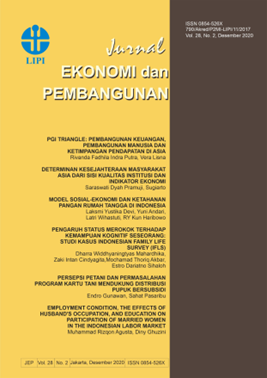
SEGITIGA KEMISKINAN-PERTUMBUHAN-KETIMPANGAN(PGI TRIANGLE): PEMBANGUNAN KEUANGAN, PEMBANGUNAN MANUSIA, DAN KETIMPANGAN PENDAPATAN DI ASIA
Keywords:
Financial Development, Income Inequality, Human Development, Panel RegressionAbstract
One of the issues faced by countries in Asia is income inequality. Economic development is expected to improve people’s living standards to minimize the gap between low-income and high-income populations. One of economic development is through financial development. The financial sector plays an important role in the economy of a country, the development of the financial sector will indirectly increase the output of other sectors so as to tie the value of the Gross Domestic Product (GDP). In addition to equality and economic growth, economic development also needs to see whether the two are related to human development as described in the poverty-growth-inequality triangle (PGI Triangle). The purpose of this study is to see a picture of the inequality of income distribution, financial development and human development in six Asian countries. The analysis used descriptive statistics and panel data regression, specifically fixed effect model (FEM) and the random effect model (REM). The result showed that there is a significant influence between financial development and human development on income inequality, the higher the financial development will reduce the level of inequality of a country. Meanwhile, the high value of human development actually increases inequality.Downloads
References
Astuti, S. P. (2013). FINANCIAL DEVELOPMENT DAN KESENJANGAN PENDAPATAN: KAJIAN EMPIRIS NEGARA-NEGARA DI KAWASAN UNI EROPA DAN ASEAN+6.
Bank Indonesia. (2014). Buku Saku Keuangan Inklusif: Survey Neraca Rumah Tangga BI.
Bappenas. (2012). Rasio Gini di Indonesia dalam Lima Tahun Terakhir Trend Peningkatan Ketimpangan.
Bourguignon, F. (2004). The Poverty-Growth-Inequality Triangle.
Buhaerah, P. (n.d.). Pengaruh Finansialisasi Terhadap Ketimpangan Pendapatan Di Asean : Analisis Data Panel. 335–352.
Carroll, A. E., & Frakt, A. (2017). What Makes Singapore’s Health Care So Cheap? The New York Times. Diambil dari https://www.nytimes.com/2017/10/02/upshot/what-makes-singapores-health-care-so-cheap.html
Galor, O., & Zeira, J. (1993). Income Distribution and Macroeconomics. Review of Economic Studies, 60(1), 35–52.
Kopf, D. (2017). China ’ s extreme income inequality finally appears to be falling.
Kuznets, S. (1955). The American Economic Review. American Economic Association, 45(1), 1–28. https://doi.org/10.1257/aer.99.1.i
Levine, R. (2005). Chapter 12 Finance and Growth: Theory and Evidence. Handbook of Economic Growth. https://doi.org/10.1016/S1574-0684(05)01012-9
Rajan, R. G., & Zingales, L. (2003). The great reversals: The politics of financial development in the twentieth century. Journal of Financial Economics. https://doi.org/10.1016/S0304-405X(03)00125-9
Sen, A. (1976). Poverty: An Ordinal Approach to Measurement. Econometrica. https://doi.org/10.2307/1912718
Shaw, E., & McKinnon, R. (1973). World Economy Financial Repression 1. Money.
Todaro, M. P. (2006). Pembangunan Ekonomi Di Dunia Ketiga. In Economic Development. https://doi.org/2003
Tukey, J. W. (1977). Exploratory Data Analysis. Addison Wesley.
UNDP. (2013). Human Development Report 2013 Summary. In Vasa.
Published
How to Cite
Issue
Section
License
Copyright (c) 2020 Jurnal Ekonomi Pembangunan

This work is licensed under a Creative Commons Attribution-NonCommercial-ShareAlike 4.0 International License.