
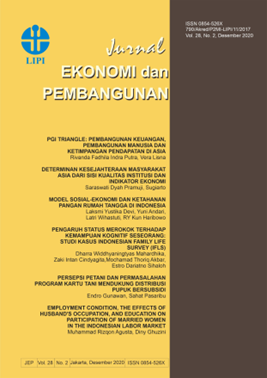
PENGARUH STATUS MEROKOK TERHADAP KEMAMPUAN KOGNITIF SESEORANG
STUDI KASUS INDONESIAN FAMILY LIFE SURVEY (IFLS)
DOI:
https://doi.org/10.14203/JEP.28.2.2020.117-129Keywords:
Cognitive Ability, Smoking Status, IFLSAbstract
Smoking is one of the biggest health problems in Indonesia. One of the problems caused by smoking is a decrease in one’s cognitive abilities. The number of smokers in Indonesia is always increasing from year to year. According to the Basic Health Research (Riskesdas) data in 2018, the number of smokers aged over 15 years old was 33.8% with the 62.9% of smokers being men and 4.8% of smokers being female. This research aims to analyze how much influence smoking status has on a person’s cognitive abilities. The authors use longitudinal data from the Indonesian Family Life Survey (IFLS), which follows data from 7,970 individuals aged 15 and over from 2007 (IFLS 4) to 2014 (IFLS 5). Using panel data regression with a random effect model and controlling for socioeconomic characteristics and trends effect, the results show that being a smoker has a negative and significant effect on a person’s cognitive abilities. The results also show that being a smoker is associated with lower cognitive levels of 0.1 Standard Deviation (SD) compared to nonsmokers. When the smoking status was broken down according to the level of addiction (namely light, medium, and heavy smokers), the effects of cognitive decline became bigger, respectively 0.08, 0.11, and 0.25 SD.Downloads
References
Al-Thaqib, A., Al-Sultan, F., Al-Zahrani, A., Al-Kahtani, F., Al-Regaiey, K., Iqbal, M., & Bashir, S. (2018). Brain Training Games Enhance Cognitive Function in Healthy Subjects. Medical Science Monitor Basic Research, 24, 63–69. https://doi.org/10.12659/msmbr.909022
Astuti, P. A. S., Mulyawan, K. H., Sebayang, S. K., Kurniasari, N. M. D., & Freeman, B. (2019). Cigarette retailer density around schools and neighbourhoods in Bali, Indonesia: A GIS mapping. Tobacco Induced Diseases, 17(July), 1–12. https://doi.org/10.18332/tid/110004
Azagba, S., Shan, L., Manzione, L. C., Latham, K., Rogers, C., & Qeadan, F. (2020). Single cigarette purchasers among adult U.S. smokers. Preventive Medicine Reports, 17(January), 101055. https://doi.org/10.1016/j.pmedr.2020.101055
Bashir, S., Alghamd, F., Alhussien, A., Alohali, M., Alatawi, A., Almusned, T., & Habib, S. S. (2017). Effect of Smoking on Cognitive Functioning in Young Saudi Adults. Medical Science Monitor Basic Research, 23, 31–35. https://doi.org/10.12659/msmbr.902385
Benowitz, N. L. (2009). Pharmacology of Nicotine: Addiction, Smoking-Induced Disease, and Therapeutics. Annual Review of Pharmacology and Toxicology, 49, 57–71. https://doi.org/10.1146/annurev.pharmtox.48.113006.094742
Benowitz, N. L. (2010). Nicotine addiction. New England Journal of Medicine, 13(12), 1240–1249. https://doi.org/10.1056/NEJMra0809890
Benowitz, N. L., & Brunetta, P. G. (2016). Smoking Hazards and Cessation. In Murray and Nadel’s Textbook of Respiratory Medicine (pp. 807–821). https://doi.org/10.1016/b978-1-4557-3383-5.00046-4
Bergen, A. W., & Caporaso, N. (1999). Cigarette smoking. Journal of the National Cancer Institute, 91(16), 11365–11375. https://doi.org/10.1093/jnci/91.16.1365
Bloom, D. E., Canning, D., & Sevilla, J. (2004). The effect of health on economic growth: A production function approach. World Development, 32(1), 1–13. https://doi.org/10.1016/j.worlddev.2003.07.002
Boyede, G. O., Lesi, F. E. A., Ezeaka, V. C., & Umeh, C. S. (2013). Impact of sociodemographic factors on cognitive function in school-aged HIV-infected Nigerian children. HIV/AIDS - Research and Palliative Care, 5, 145–152. https://doi.org/10.2147/HIV.S43260
Downloads
Published
How to Cite
Issue
Section
License
Copyright (c) 2020 Jurnal Ekonomi Pembangunan

This work is licensed under a Creative Commons Attribution-NonCommercial-ShareAlike 4.0 International License.

