
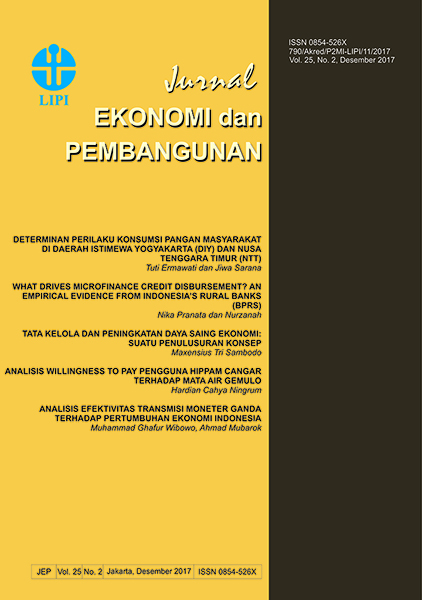
WHAT DRIVES MICROFINANCE CREDIT DISBURSEMENT? AN EMPIRICAL EVIDENCE FROM INDONESIA’S RURAL BANKS (BPRs)
DOI:
https://doi.org/10.14203/JEP.25.2.2017.21-32Keywords:
microfinance, MSEs, credit disbursement determinants, rural banks, Indonesia, BPRAbstract
The paper investigates determinants of Indonesia’s microfinance credit disbursement, case taken from Indonesia’s rural banks (BPRs) which primarily focus on providing funding to the Micro and Small Enterprises (MSEs). The study applies Autoregressive Distributed Lag (ARDL) model by using monthly data over the period of January 2009 to January 2016. Result indicates that rural banks credit disbursement is more determined by demand side rather than supply side as variable representing demand side (production index) has significant effect to credit disbursement both long run and short run. In terms of supply side, the amount of credit disbursement is affected by interbank fund in the long run, whereas in the short run the significant variables are customer fund and internal fund. In addition, Consumer Price Index (CPI) and Non-Performing Loan (NPL) impose significant effect to the microfinance credit disbursement; yet, interestingly, interest rate is not a significant factor in microfinance’s case.Downloads
References
Akinlo, A. E. and Oni, I. O. 2015. Determinants of bank credit growth in Nigeria 1980-2010. European Journal of Sustainable Development, 4(1), 23.
Arwin, M. 2015. Pengaruh Tingkat Suku Bunga Terhadap Volume Kredit Pada PT. Bank Perkreditan Rakyat Gerbang Masa Depan Galesong Kabupaten Takalar. Sekolah Tinggi Ilmu Ekonomi (STIE) Tri Dharma Nusantara, Makassar.
Assefa, M. 2014. Determinants of Growth in Bank Credit to the Private Sector in Ethiopia: A Supply Side Approach. Research Journal of Finance and Accounting, 5(17).
Barran, F., Coudert, V., Mojon, B., and others. 1995. Interest rates, banking spreads and credit supply: the real effects. CEPII.
Berry, A., Rodriguez, E., and Sandee, H. 2001. Small and medium enterprise dynamics in Indonesia. Bulletin of Indonesian Economic Studies, 37(3), 363–384.
Bittencourt, M. 2011. Inflation and financial development: Evidence from Brazil. Economic Modelling, 28(1), 91–99.
Boyd, J. H., Levine, R., and Smith, B. D. 2001. The impact of inflation on financial sector performance. Journal of Monetary Economics, 47(2), 221–248.
Central Bank of Indonesia. 2016. Pemetaan dan Strategi Peningkatan Daya Saing UMKM dalam Menghadapi Masyarakat Ekonomi ASEAN (MEA) 2015 dan Pasca MEA 2025.
Choi, S., Smith, B. D., and Boyd, J. H. 1996. Inflation, Financial Markets, and Capital Formation. Federal Reserve Bank of St. Louis Review, 78, 9–35.
Égert, B., Backé, P., and Zumer, T. 2006. Credit growth in central and eastern Europe: new (over) shooting stars?
Financial Service Authority of Indonesia. 2016. Indonesian Banking Statistics 2016.
Hadad, M. 2015. Financial Inclusion, Financial Regulation and Financial Education in Asia: Case of Indonesia. Tokyo. Retrieved from http://www.fsa.go.jp/frtc/kenkyu/event/20150305/s4_1.pdf
Hamada, M. 2016. Excess capital and bank behavior: evidence from Indonesia.
Harvie, C. 2010. Easft Asian production networks--the role and contribution of SMEs. International Journal of Business and Development Studies, 2(1), 27–62.
Huang, H.-C., Lin, S.-C., Kim, D.-H., and Yeh, C.-C. 2010. Inflation and the finance--growth nexus. Economic Modelling, 27(1), 229–236.
Imran, K., and Nishat, M. 2011. Determinants of bank credit in Pakistan. In Proceedings of 2nd International Conference on Business Management, Institute of BusinessAdministration, Karachi, Pakistan (pp. 1–32).
Januar, T. H. 2015. Pengaruh Modal Kerja dan Perilaku Kewirausahaan Terhadap Pendapatan. Repository UPI.
Mourougane, A. 2012. Promoting SME development in Indonesia. OECD EconomicDepartment Working Papers, (995), 0_1.
Nurfachrizi, Fair. 2015. Bank dan Lembaga Keuangan. Politeknik Universitas Surabaya. Retrieved from: https://www.slideshare.net/FairNurfachrizi/2014-perbankan-minggu-1-bank-dan-lembaga-keuangan.
Onoja, A. O., Onu, M. E., and Ajodo-Ohiemi, S. 2011. Contributions of Financial Sector Reforms and Credit Supply to Nigerian Agricultural Sector (1978-2009). CBN Journal of Applied Statistics, 2(2), 83–98.
Otoritas Jasa Keuangan. 2014. Peraturan Otoritas Jasa Keuangan Nomor 20/POJK.03/2014 Tentang Bank Perkreditan Rakyat. Retrieved from: http://www.ojk.go.id/id/regulasi/otoritas-jasa-keuangan/peraturan-ojk/Documents/POJK20Kelembagaan BankPerkreditanRakyat_1417076232.pdf.
Pesaran, M. H., Shin, Y. 1999. An autoregressive distributed lag modelling approach to cointegration analysis. In Econometrics and Economic Theory in the 20th Century: The Ragnar Frisch Centennial Symposium.(pp. 1–31). https://doi.org/10.1017/CCOL521633230
Pesaran, M. H., Shin, Y., and Smith, R. J. 2001. Bounds testing approaches to the analysis of long run relationships. Journal of Applied Econometric, 16, 289–326. https://doi.org/10.1002/jae.616
Rahman, H. 2004. SMEs in Indonesia Economy and Policies to Enhance Development and Empowerment of Indonesia SMEs. In The 1st International SEPNet Workshop on International Comparisons on PrivateSector Development StrategiInternational Comparisons on Private Sector DevelopmentStrategies. Haikou City.
Rosengard, J. K., and Prasetyantoko, A. 2011. If the banks are doing so well, why can’t I get a loan? Regulatory constraints to financial inclusion in Indonesia. Asian Economic Policy Review, 6(2), 273–296.
Sato, Y. 2000. How Did The Crisis Affect Small and Medium-Sized Enterprises? From a Field Study of The Metal-Working Industry in Java. The Developing Economies, 38(4), 572–595.
Shijaku, G., and Kalluci, I. 2013. Determinants of bank credit to the private sector: The case of Albania.
State Ministry of Cooperatives and SMEs. 2001. Co-operatives and Small/Medium Enterprises Development in Indonesia. Journal of Economics Cooperation, 22(3), 1–26.
Stepanyan, V., and Guo, K. 2011. Determinants of bank credit in emerging market economies. International Monetary Fund.
Suryanto, S. 2015. Non Performing Loans on Regional Development Bank in Indonesia and Factors that Influence. Mediterranean Journal of Social Sciences, 6(4), 280.
Susilo, N. 2015. Usaha Kecil Tak Terpengaruh Kenaikan Bunga Kredit. Retrieved from https://m.tempo.co/read/news/2005/ 09/06/05666218/usaha-kecil-tak-terpengaruh-kenaikan-bunga-kredit
Talavera, O., Tsapin, A., and Zholud, O. 2012. Macroeconomic uncertainty and bank lending: the case of Ukraine. Economic Systems, 36(2), 279–293.
Tambunan, T. 2008. SME Development in Indonesia: Do Economic Growth and Government Supports Matter?
Tambunan, T. 2009. SMEs in Asian developing countries. Springer.
Tambunan, T. 2010. The Indonesian experience with two big economic crises. Modern Economy, 1(3), 156.T
Tang, T. C. 2003. Japanese aggregate import demand function: reassessment from the “bounds” testing approach. Japan and the World Economy, 15(4), 419–436.
Ter Wengel, J., and Rodriguez, E. 2006. SME export performance in Indonesia after the crisis. Small Business Economics, 26(1), 25–37.
Tinoco-Zermeño, M. Á., Venegas-Martinez, F., & Torres-Preciado, V. H. 2014. Growth, bank credit, and inflation in Mexico: evidence from an ARDL-bounds testing approach. Latin American Economic Review, 23(1), 8.
Yokoi-Arai, M., and Yoshino, N. 2006. Concept of competitiveness in the financial sector. Financial Research and Training Center.
World Bank. 2010. Improving Access to Financial Services in Indonesia. Jakarta: Indonesia.
Downloads
Published
How to Cite
Issue
Section
License
Copyright (c) 2018 Jurnal Ekonomi Pembangunan

This work is licensed under a Creative Commons Attribution-NonCommercial-ShareAlike 4.0 International License.

