
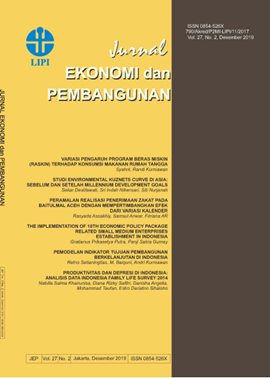
STUDI ENVIRONMENTAL KUZNETS CURVE DI ASIA: SEBELUM DAN SETELAH MILLENNIUM DEVELOPMENT GOALS
DOI:
https://doi.org/10.14203/JEP.27.2.2019.11-25Keywords:
Well-being, Environmental Economics, Kuznets Curve, GDP per CapitaAbstract
The environmental pollution can reduce subjective well-being.Thus study aims to prove the validity of the Environmental Kuznets Curve (EKC) hypothesis in high and middle income countries in Asia, also to analyze the differences in the effect of GDP per capita, energy consumption, and population on CO2 emissions in the same region before and after the MDGs. Data obtained from the World Bank for the period 1987-2014, where the analysis uses quantitative methods and expose facto, and through panel data regression equations to achieve research objectives. The results show that until 2014 the EKC hypothesis in the form of U-reversal has not occurred in the high income countries studied, but will occur when GDP per capita has reached USD 51.44 thousand. Whereas in the lower middle income countries, the pattern of the relationship between GDP per capita and CO2 emissions still forms a U curve, or in other words the ECC hypothesis will not occur in these countries, because in some countries it is still in the early stages of development. The results also showed that prior to the MDGs (2000), GDP per capita, energy consumption and population in high income countries contributed to the increase in CO2 emissions, but after the MDGs, rising GDP per capita was able to reduce CO2 emissions. Whereas in low middle income countries, at the beginning of the study before the MDGs, the data showed that CO2 was already high at a time when GDP per capita was still low, and after MDGs, increases in GDP per capita still contributed to rising CO2 emissions.Downloads
References
Abdurahman, D. A. (2012). Dampak pertumbuhan dan keterbukaan ekonomi terhadap degradasi lingkungan. Departemen Ilmu Ekonomi Fakultas Ekonomi Dan Manajemen Institut Pertanian Bogor, 1–142.
Ali, A., Khatoon, S., Ather, M., & Akhtar, N. (2015). Modeling Energy Consumption , Carbon Emission and Economic Growth : Empirical Analysis for Pakistan. International Journal of Energy Economics and Policy, 5(2), 624–630.
Beck, K. A., & Joshi, P. (2015). An Analysis of the Environmental Kuznets Curve for Carbon Dioxide Emissions: Evidence for OECD and Non-OECD Countries. European Journal of Sustainable Development, 4(3), 33–45. https://doi.org/10.14207/ejsd.2015.v4n3p33
Beckerman, W. (1992). Economic growth and the environment: Whose growth? whose environment? World Development, 20(4), 481–496. https://doi.org/10.1016/0305-750X(92)90038-W
Dasgupta, S., Laplante, B., Wang, H., & Wheeler, D. (2002). Confronting the Environmental Kuznets Curve. Journal of Economic Perspectives, 16(1), 147–168. https://doi.org/10.1257/0895330027157
Endeg, T. W. (2015). Economic growth and environmental degradation in Ethiopia: An environmental Kuznets curve analysis approach. Journal of Economics and International Finance, 7(4), 72–79. https://doi.org/10.5897/JEIF2015.0660
Galeotti, M. (2007). Economic growth and the quality of the environment: Taking stock. Environment, Development and Sustainability, 9(4), 427–454. https://doi.org/10.1007/s10668-006-9030-y
Grossman, G. M., & Krueger, A. B. (1995). Economic Growth and the Environment. The Quarterly Journal of Economics, 110(2), 353–377. https://doi.org/10.2307/2118443
Gujarati, D. (2010). Dasar-Dasar Ekonometrika. Jakarta: Salemba Empat.
Halkos, G. (2009). Environment and Sustainable Development. International Journal of Global Environmental Issues, (17), 111–116.
Harris, J. M. (2002). Environmental and Natural Resource Economics: A Contemporary Approach. Boston: Houghton Mifflin Co.
Kementerian Negara Lingkungan Hidup. (2009). Bahan Ajar Pelatihan Penilaian AMDAL.
Kuswantoro, D. P. (2009). Pembangunan Ekonomi dan Deforestasi Hutan Tropis.
Lean, H. H., & Smyth, R. (2010). CO2emissions, electricity consumption and output in ASEAN. Applied Energy, 87(6), 1858–1864. https://doi.org/10.1016/j.apenergy.2010.02.003
Maryam, J., Mittal, A., & Sharma, V. (2017). CO2 Emissions, Energy Consumption and Economic Growth in BRICS:An Empirical Analysis. IOSR Journal of Humanities and Social Science, 22(2), 53–58. https://doi.org/10.9790/0837-2202055358
Mrabet, A., Achairi, R., & Ellouze, A. (2014). The Two-Way relationship between Economic Growth and CO2 Emissions. 2(6), 32–35.
OECD. (2015). Survey Ekonomi OECD Indonesia.
Panayotou, T. (1993). Empirical Test and Policy Analysis of Environmental Degradation at Different Stages of Economic Development. In WORLD EMPLOYMENT PROGRAMME RESEARCH. https://doi.org/http://sci-hub.tw/http://www.ilo.org/public/libdoc/ilo/1993/93B09_31_engl.pdf
Pao, H. T., & Tsai, C. M. (2011). Modeling and forecasting the CO2 emissions, energy consumption, and economic growth in Brazil. Energy, 36(5), 2450–2458. https://doi.org/10.1016/j.energy.2011.01.032
Phimphanthavong, H. (2013). The Impacts of Economic Growth on Environmental Conditions in Laos. 4(5), 766–774.
Pratama, M. I. A. (2016). Hipotesis Environmental Kuznets Curve di Indonesia Tahun 1960-2013. Universitas Diponogoro.
Shaharir, b. M. Z., & Alinor, M. b. A. K. (2013). The Need for a New Definition of Sustainability. Journal of Indonesian Economy and Business, 28(2), 251–268. https://doi.org/10.1007/978-94-007-2285-9
Suparmoko, M. (2000). Ekonomi Sumber Daya Alam dan Lingkungan. Yogyakarta: BPFE.
Susanti, E. D. (2018). Environmental Kuznet Curve: Hubungan Pertumbuhan Ekonomi dengan Degradasi Kualitas Udara Dalam Pencapaian MilleniumDevelopment Goals (MDGs) di Indonesia. Universitas Negeri Yogyakarta.
UNFCC. (2007). Sekilas Tentang Perubahan Iklim. Retrieved from http://unfccc.int/files/meetings/cop_13/press/application/pdf/sekilas_tentang_perubahan_iklim.pdf.
United Nation. (2007). Perkembangan Pencapaian MDGs Indonesia. Jakarta.
WEF. (2017). Global Shapers Survey. Global Shapers Community. Retrieved from http://www.shaperssurvey2017.org/static/data/WEF_GSC_Annual_Survey_2017.pdf
WMO. (2017). WMO Statement on The State of The Global Climate in 2017. Retrieved from https://library.wmo.int/doc_num.php?explnum_id=4453
World Resource Institute. (2016). Rising To The Challenge.
Zhu, Q., & Peng, X. (2012). The impacts of population change on carbon emissions in China during 1978-2008. Environmental Impact Assessment Review, 36, 1–8. https://doi.org/10.1016/j.eiar.2012.03.003
Downloads
Published
How to Cite
Issue
Section
License
Copyright (c) 2019 Jurnal Ekonomi Pembangunan

This work is licensed under a Creative Commons Attribution-NonCommercial-ShareAlike 4.0 International License.