
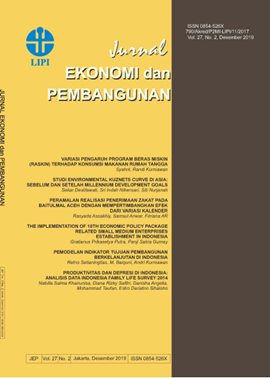
PRODUKTIVITAS DAN DEPRESI DI INDONESIA
ANALISIS DATA INDONESIAN FAMILY LIFE SURVEY 2014
DOI:
https://doi.org/10.14203/JEP.27.2.2019.75-84Keywords:
Depression, Productivity, IndonesiaAbstract
Depression is part of mental health. Depression is caused by changes in individual cognitive thinking that cause changes in their emotional. Indonesian Specialist Doctor Association (PDSKJI) said that in 2019, there were 15.6 million Indonesians who were depressed. This research aims to see the factors that influenced depression in Indonesia. This reserach uses Indonesian data from the 2014 Indonesia Family Life Survey (IFLS). This research uses an ordered probit regression research model with STATA software. This research found that the factors that drive depression in Indonesia are productivity, gender, increased age, and length of sleep. While the factors that reduce the risk of depression are religiosity, marital status, and length of schooling.Downloads
References
Alauddin, M., & Tisdell, C. (2006). Economic Theory, Application nad Isues. School of Economics, The Univesity of Queensland, Australia. Economic Theory, 3(2), 297–314.
Anderson, R. G. (2018). How Well Do Wages Follow Productivity Growth? Economic Synopses, 2007(7), 2007. https://doi.org/10.20955/es.2007.7
Eide, E. R., & Showalter, M. H. (2012). Sleep and student achievement. Eastern Economic Journal, 38(4), 512–524. https://doi.org/10.1057/eej.2011.33
Fry, A. (1994). Research summaries. Strength and Conditioning, 16(4), 74–76. https://doi.org/10.1519/1073-6840(1994)016<0074:RS>2.3.CO;2
Hebert, R. S., Dang, Q., & Schulz, R. (2007). Religious beliefs and practices are associated with better mental health in family caregivers of patients with dementia: Findings from the reach study. American Journal of Geriatric Psychiatry, 15(4), 292–300. https://doi.org/10.1097/01.JGP.0000247160.11769.ab
Kliewer, S. P., Saultz, J., Kliewer, S. P., & Saultz, J. (2018). The impact of spirituality. Healthcare and Spirituality, 63–83. https://doi.org/10.1201/9781315379692-4
Mayer, F., Roy, P.-M., Emond, A., & Pineault, R. (2006). Unemployment and Mental Health: A Longitudinal Analysis. The Canadian Journal of Economics, 24(3), 551. https://doi.org/10.2307/135579
Murphy, G. C., & Athanasou, J. A. (1999). The effect of unemployment on mental health. Journal of Occupational and Organizational Psychology, 72(1), 83–99. https://doi.org/10.1348/096317999166518
Near, J. P., Arthaud-Day, M. L., Rode, J. C., Mooney, C. H., Bommer, W. H., Baldwin, T. T., & Rubin, R. S. (2011). Life Satisfaction and Student Performance. Academy of Management Learning & Education, 4(4), 421–433. https://doi.org/10.5465/amle.2005.19086784
Ortega-go, R., & Hechanova, G. (2016). Work-Family Conflict , Stress , and Satisfaction among Dual-Earning Couples, (June).
Pamela Forward. (2017). Инновационные подходы к обеÑпечению качеÑтва в здравоохраненииNo Title. ВеÑтник РоÑздравнадзора, 6, 5–9.
Paul, K. I., & Moser, K. (2009). Unemployment impairs mental health: Meta-analyses. Journal of Vocational Behavior, 74(3), 264–282. https://doi.org/10.1016/j.jvb.2009.01.001
Prasetyo, A. Y., Fathoni, A., & Malik, D. (2018). ANALISIS PENGARUH KONFLIK KELUARGA-PEKERJAAN, HARDINESS, SELF EFFICACY TERHADAP STRESS KERJA DENGAN DUKUNGAN SOSIAL SEBAGAI VARIABEL MODERASINYA (Studi Pada Guru Demak). Journal of Management, 4(4).
Prillerman, S. L., Myers, H. F., & Smedley, B. D. (1989). Stress, well-being, and academic achievement in college. Black students: Psychosocial issues.
Ramayani, C. (2012). Analisis Produktivitas Tenaga Kerja dan Ekonomi Indonesia. Jurnal Kajian Ekonomi, 1(1), 41–54. Retrieved from http://ejournal.unp.ac.id/index.php/ekonomi/article/view/738
Riskesdas. (2018). Hasil Utama Riskesdas Tentang Prevalensi Diabetes Mellitus di Indonesia 2018. Hasil Utama Riskesdas Tentang Prevalensi Diabetes Melitus Di Indonesia 2018, 8. https://doi.org/1 Desember 2013
Santoso, M. B., Siti Asiah, D. H., & Kirana, C. I. (2018). Bunuh Diri Dan Depresi Dalam Perspektif Pekerjaan Sosial. Prosiding Penelitian Dan Pengabdian Kepada Masyarakat, 4(3), 390. https://doi.org/10.24198/jppm.v4i3.18617
Simon, R. W. (2002). Revisiting the Relationships among Gender, Marital Status, and Mental Health. American Journal of Sociology, 107(4), 1065–1096. https://doi.org/10.1086/339225
Smith, C. S., Sulsky, L. M., & Uggerslev, K. L. (2012). Effects of Job Stress on Mental and Physical Health. Handbook of Mental Health in the Workplace, 75(5), 61–82. https://doi.org/10.4135/9781452229386.n4
Soekiman, A., Pribadi, K. S., Soemardi, B. W., & Wirahadikusumah, R. D. (2011). Factors relating to labor productivity affecting the project schedule performance in Indonesia. Procedia Engineering, 14, 865–873. https://doi.org/10.1016/j.proeng.2011.07.110
Sparrowe, R. T., Liden, R. C., Wayne, S. J., & Kraimer, M. L. (2001). Social networks and the performance of individuals and groups. Academy of Management Journal, 44(2), 316–325. https://doi.org/10.2307/3069458
Sugiyarto, G., Oey-Gardiner, M., & Triaswati, N. (2006). Labor markets in Indonesia: Key challenges and policy issues. Labor Markets in Asia: Issues and Perspectives, (November 2005), 301–366. https://doi.org/10.1057/9780230627383
Warr, P., Jackson, P., & Banks, M. (1988). Unemployment and Mental Health: Some British Studies. Journal of Social Issues, 44(4), 47–68. https://doi.org/10.1111/j.1540-4560.1988.tb02091.x
Way, S. F., Morgan, A. C., Larremore, D. B., & Clauset, A. (2019). Productivity, prominence, and the effects of academic environment. Proceedings of the National Academy of Sciences, 201817431. https://doi.org/10.1073/pnas.1817431116
World Health Organization. (2003). M E N Ta L H E a Lt H. Retrieved from www.who.int/mental_health
Zulhanafi, Aimon, H., & Syofyan, E. (2013). Analisis Faktor-Faktor Yang Mempengaruhi Produktivitas Dan Tingkat Pengangguran Di Indonesia. Jurnal Kajian Ekonomi, II(03), 85–109.
Downloads
Published
How to Cite
Issue
Section
License
Copyright (c) 2019 Jurnal Ekonomi Pembangunan

This work is licensed under a Creative Commons Attribution-NonCommercial-ShareAlike 4.0 International License.

