
Comparison of Rahwana’s Depiction in Prambanan Temple and Panataran Temple Perbandingan Penggambaran Tokoh Rahwana pada Candi Prambanan dan Candi Panataran dalam Perspektif Ikonografi Komparatif
Article Sidebar
Main Article Content
Abstract
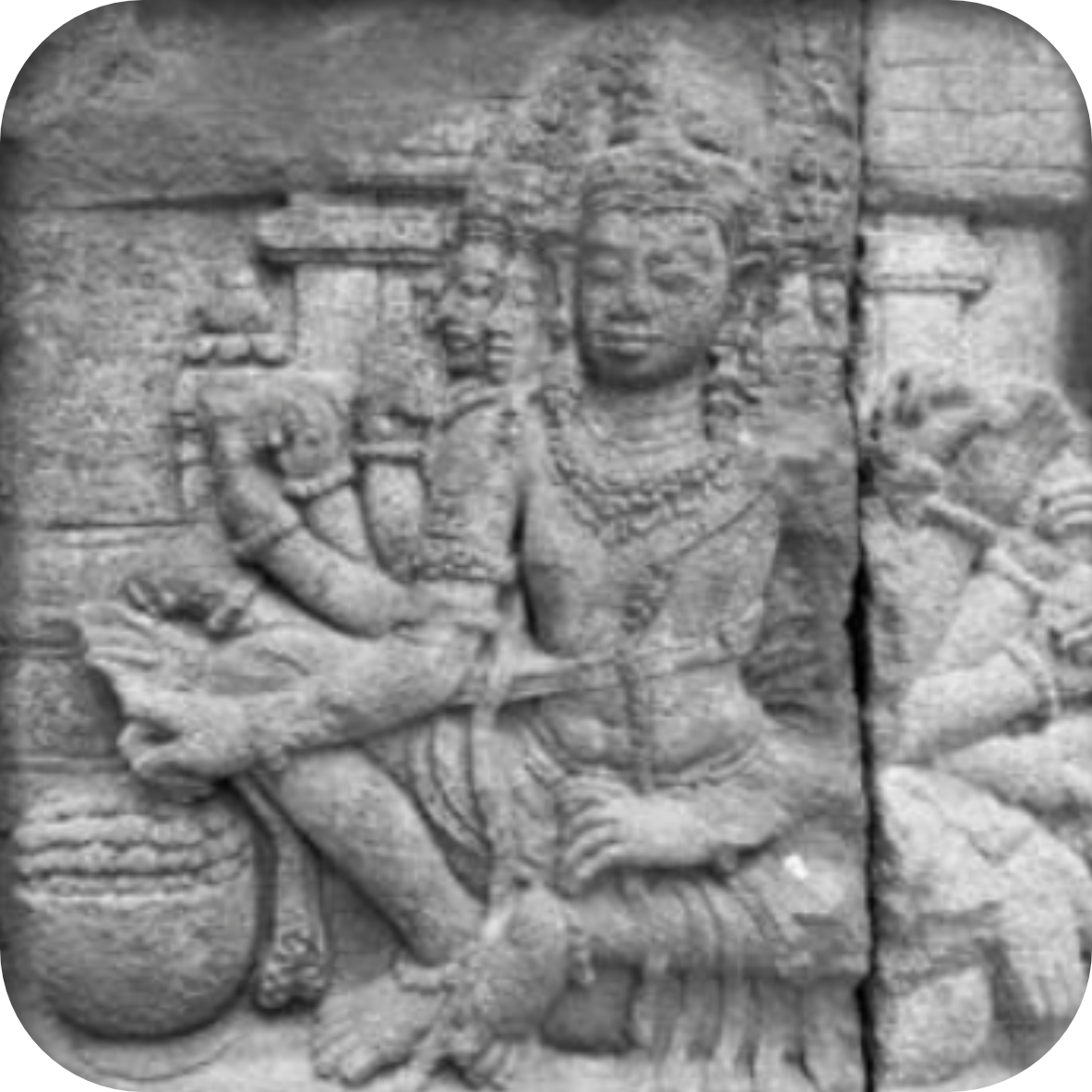
This study discusses about the comparison of Rahwana depiction in reliefs of the Ramayana story found in Candi Prambanan (9th century) and Candi Panataran (14th century) through a comparative iconographic analysis based on Panofsky’s theory. Rahwana at Candi Prambanan is depicted in supernatural form, possessing multiple heads and hands in a naturalistic and ideal style. This depiction is rooted in classical Indian art which was later adapted by Old Javanese artists. This portrayal affirms royal legitimacy through association with the divine. In the other hand, Rahwana in Candi Panataran presents in a more rigid, wayang kulit (shadow puppet) form, as an ordinary human lacking mythological features. This representation serves as a political allegory, symbolizing real-world threats within the context of ancient Javanese society. These differences reflect a shift in both artistic style and symbolic meaning, as Rahwana transform form a mythic villain in Indian epic tradition to a political metaphor shaped by Javanese socio-political realities, emphasizing the differing historical backdrops of the two temple eras.
Article Details

This work is licensed under a Creative Commons Attribution-NonCommercial-ShareAlike 4.0 International License.
References
Acri, A. (2016). Editing and translating the Old Javanese Kakavin Ramayana: Hendrik Kern, Ramayana. The story of Rama and Sita in Old Javanese, romanized edition by Willem van der Molen and Stuart Robson, Old Javanese Ramayana. Bulletin de l’École française d’Extrême-Orient , 102, 451–465.
Adwina, R., Jauharatna, K., & Mahmud, M. I. (2023). Perbandingan penggambaran tokoh Hanuman pada relief candi masa Hindu-Buddha (9-15 M). PANALUNGTIK, 6(01), 21–37. https://doi.org/10.55981/panalungtik.2023.789
Ayatrohaedi, Wibowo, A. S., Wuryantoro, E., Jafar, H., Magetsari, N., & Nurhadi, Ny. S. (1981). Kamus istilah Arkeologi I (Vol. 1). Pusat Pembinaan dan Pengembangan Bahasa Departemen Pendidikan dan Kebudayaan.
Bosch. F.D.K. (1960). The golden germ: an introduction to Indian symbolism. Mouton & Co.
Brandes, J. L. (1902). Notulen der derde Directievergadering, gehouden op Maandag den 24 Maart 1902.
Casparis, J. G. De. (1956). Selected inscriptions from the 7th to the 9th century A.D (II). Masa Baru.
Coomaraswamy, A. (1927). History of Indian and Indonesian art. E. Weyhe.
Finegan, J. (1952). The archeology of world religions. Princeton University Press.
Fontain, J., Soekmono, & Suleiman, S. (1972). Kesenian Indonesia purba: Djawa Tengah dan Djawa Timur (Soetjipto Surjohandoko, Penerj.). The Asia Society Inc.
Goldman, R. (1986). The Rāmāyaṇa of Vālmīki: an epic of ancient India Vol. II Ayodhyākāṇḍa. Princeton University Press.
Goldman, R., & Shutherland, S. (1984). The Ramayana of Valmiki: an epic of ancient India: Vol. I. Princeton University Press.
Hardianti, E. S. (2002). Aspek arsitektural dan aspek simbolik bangunan candi. Dalam R. Siagian (Ed.), Candi sebagai warisan seni dan budaya Indonesia. Yayasan Cempaka Kencana.
Heine-Geldern, R. (1982). Konsepsi tentang negara dan kedudukan raja di Asia Tenggara. CV. Rajawali.
Hooykaas, C. (1963). Old Javanese Ramayana. The Journal of Oriental Research Madras, 20(4').
Hopkins, W. (1915). Epic mythology. Karl J. Trubner.
Jordaan, R. (1996). In praise of Prambanan: Dutch essays on the Loro Jonggrang temple complex.
Jouveau-Dubreuil, G. (1937). Iconography of Southern India (A. C. Martin, Penerj.). Librairie Orientaliste Paul Geuthner.
Kats, J. (1927). The Rāmāyana in Indonesia. Bulletin of the School of Oriental Studies, University of London, 4(3), 579–585.
Kern, H. (2015). Ramayana: the story of Rama and Sita in Old Javanese (W. van der Molen, Ed.). Research Institute for Languages and Cultures of Asia and Africa, Tokyo University of Foreign Studies.
Kieven, L. (2010). Hanuman, the flying monkey: the symbolism of the Rāmāyaṇa reliefs at the main temple of Caṇḍi Panataran. Dalam A. Acri, A. Griffiths, & H. Creese (Ed.), From Lanka Eastward: The Ramayana in the Literature and Visual Arts of Indonesia. Brill.
Kieven, Lydia. (2013). Following the cap-figure in Majapahit temple reliefs : a new look at the religious function of East Javanese temples, fourteenth and fifteenth centuries. Brill.
Kinney, A. (2003). Worshiping Siva Buddha: the temple art of East Java. University of Hawaii Press.
Krom, N. J. (1923). Inleiding tot de Hindoe-Javaansche Kunst II. Martinus Nijhoff-s’ Gravenhage.
Kusen. (1986). Ramayana di Jawa: studi tentang perkembangan bentuk penggambaran tokoh-tokohnya. Departemen Pendidikan dan Kebudayaan, Direktorat Jenderal Kebudayaan.
Kusen. (1990). Ramayana in Java, a study of visual art style transformation. Berkala Arkeologi, 11(1), 1–12. https://doi.org/10.30883/jba.v11i1.547
Levine, C. (1999). The Rāmāyana of Loro Jonggrang: Indian antecedents and Javanese impetus [Dissertation]. New York University.
Magetsari, N. (1982). Masalah agama dan kebudayaan dalam arkeologi klasik Indonesia. Pertemuan Ilmiah Arkeologi II.
Moertjipto, Prasetyo, B., & Darmoyo, I. D. (1991). Relief Ramayana di Candi Prambanan. Penerbit Kanisius.
Muljana, S. (2005). Menuju Puncak Kemegahan: Sejarah Kerajaan Majapahit. LKiS.
Munandar, A. (1989). Relief masa Jawa Timur: suatu pengamatan gaya. Pertemuan Ilmiah Arkeologi V, 277–303.
Panofsky, E. (1939). Studies in Iconology. Oxford University Press.
Rao, G. (1916). Elements of Hindu iconography. Dalam Element of Hindu Inconography (Vol. 2). Cornel University Library.
Restiyadi, A. (2020). The reliefs of Ramayana and Kṛṣṇa story at Lara Jonggrang temple and reign shift of the ancient Mataram in 9th century AD. Berkala Arkeologi, 40(1), 45–62. https://doi.org/10.30883/jba.v40i1.478
Robson, S. (2015). The Old Javanese Ramayana (English Translation). Research Institute for Languages and Cultures of Asia and Africa, Tokyo University of Foreign Studies.
Santiko, H. (2012). Candi Panataran: candi kerajaan masa Majapahit. Kalpataru, Majalah Arkeologi, 21(1), 20–29.
Stutley, M. (1985). The illustrated dictionary of Hindu iconography. Routledge.
Stutterheim, W. (1925). Rama-legends and Rama-reliefs in Indonesia: Vol. I (L. Chandra, Ed.; C. D. Paliwal & R. P. Jain, Penerj.). National Academic of Indian Culture.
Sugijanti, S. (1983). Perbandingan antara relief Ramayana Candi Ciwa Larajonggrang Prambanan dengan Kakawin Ramayana [Skripsi]. Universitas Indonesia.
Tunggono, E. R. (1987). Perbandingan bentuk penyajian beberapa adegan cerita Ramayana dalam bentuk relief pada Candi Ciwa Prambanan dan Candi Induk Panataran. Fakultas Sastra Universitas Indonesia.
Wheeler, J. T. (1867). The Rámáyana and the Brahmanic. Dalam The History of India from the Earliest Ages: Vol. II. N.Trubner.
Wiwoho, R. H. (1982). Tinjauan kembali atas tokoh Hayam Wuruk dan Gajah Mada (sebuah analisa hipotesis) [Skripsi]. Fakultas Sastra, Universitas Indonesia.
Zoetmulder. (1974). Kalangwan: a survey of Old Javanese literature. Martinus Nijhoff.
