
Ornaments of Setyaki Temple: its Contribution to the Periodization of Dieng Temples Ragam Hias Candi Setyaki: Kontribusinya terhadap Periodisasi Percandian Dieng
Article Sidebar
Main Article Content
Abstract
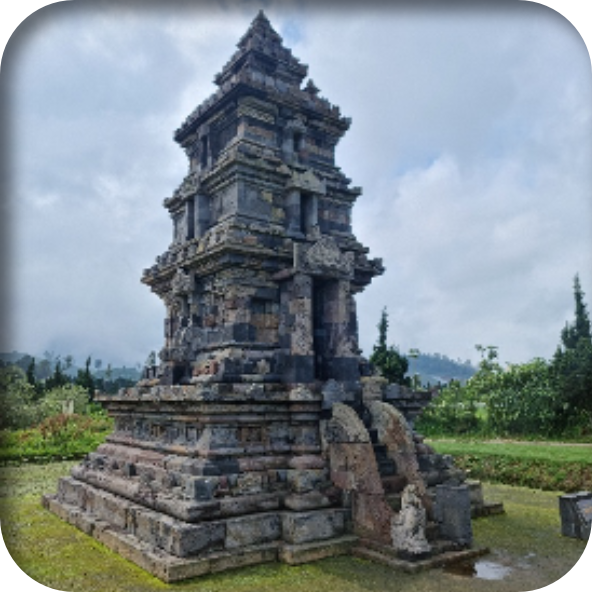
Setyaki Temple is one of the temples in the Dieng Temple Complex that was fully restored in 2023, particularly through the reconstruction of its roof. This restoration makes Setyaki Temple the only temple in Dieng whose decorative motifs have not yet been comprehensively studied in the context of periodization. This research identifies the forms and styles of Setyaki Temple’s decorative motifs following restoration, particularly the kala motif, paired animal motifs, and the gana motif, through stylistic analysis and comparison with other Central Javanese period temples. The analysis reveals that Setyaki Temple’s ornamentation differs significantly from the other Dieng temples and instead shows stylistic affinities with temples associated with the Late Central Javanese phase (post-830 AD), particularly the Prambanan Complex and surrounding temples. This finding demonstrates that the Dieng Temple Complex contains at least one temple constructed considerably later than the initial construction phase of the other Dieng temples, and strengthens Klokke’s suggestion that the Dieng Plateau Temples contain Late Central Javanese elements.
Article Details

This work is licensed under a Creative Commons Attribution-NonCommercial-ShareAlike 4.0 International License.
References
Chihara, D. (1996). Hindu-Buddhist architecture in Southeast Asia. Brill.
Degroot, V. (2009). Candi space and landscape: A study on distribution, orientation, and spatial organization of Central Javanese temple remains. Mededeligen van het Rijksmuseum voor Volkenkunde.
Dumarcay, J. (1986). The temples of Java. Oxford University Press.
Dumarcay, J. (1988). Architectural composition in Java from the eighth to fourteenth centuries. Oxford University Press.
Harriyadi, H. (2020). Makna ragam hias śaṅkha bersayap pada candi Hindu Dan Budha. Purbawidya: Jurnal Penelitian dan Pengembangan Arkeologi, 9(2), 113–130. https://doi.org/10.24164/pw.v9i2.377.
Jordaan, R. E. (1996). In praise of Prambanan; Dutch essays on the Loro Jonggrang temple complex. Brill. https://doi.org/10.26530/OAPEN_417723.
Jordaan, R. E. (2011). Candi Badut and the trajectory of Hindu-Javanese temple architecture. Artibus Asiae , 71(1), 55–74.
Klokke, M. J. (1993). Tantri reliefs on Javanese candi. KITLV Press.
Klokke, M. J. (2000). Ornamental motifs: The stylistic method applied to ancient Javanese temple art. In R. S. Lobo W. (Ed.), Southeast Asian Archeology 1998 (pp. 85–98). Centre for Southeast Asian Studies, University of Hull.
Klokke, M. J. (2006). The history of Central Javanese architecture: Architecture and sculptural decoration as complementary sources of information. In H Chambert-Loir & B Dagens. (Eds.), Anamorphoses: Hommage à Jacques Dumarçay (pp. 49–68).
Klokke, M. J. (2007). An Indonesian sculpture in the Kröller-Müller Museum. Aziatische Kunst, 37(4), 3–14.
Klokke, M. J. (2008). The Buddhist temples of the Śailendra dynasty in Central Java. Arts Asiatiques, 63, 154–167. http://www.jstor.org/stable/43486580.
Krom, N. J. (1923). Inleiding tot de Hindoe-Javaansche Kunst (Vol. 3). Martinus Nijhoff.
Pradnyawan, D. (2019). Kisah tiga candi di Jawa. In D. A. Tanudirjo (Ed.), Kuasa Makna (pp. 115–150). Departemen Arkeologi FIB UGM.
Pradnyawan, D. (2023). Arsitektur dan seni Candi Kedulan. Purbawidya: Jurnal Penelitian dan Pengembangan Arkeologi, 12(1), 1–16. https://doi.org/10.55981/purbawidya.2023.93.
Pradnyawan, D. (2024). Ragam hias dan periodisasi Candi Badut: Tinjauan perbandingan bentuk seni dengan candi-candi periode Jawa Tengah. Berkala Arkeologi, 44(1), 19–40. https://doi.org/10.55981/ba.44.1.2884-2.
Purnastuti, I. (2000). Periodisasi percandian Dieng berdasarkan arsitektur [Skripsi. Universitas Gadjah Mada].
Romain, J. (2011). Indian architecture in the ‘Sanskrit Cosmopolis’: The temples of the Dieng Plateau. In P.-Y. Manguin, A. Mani, & G. Wade (Eds.), Early interactions between South and Southeast Asia: Reflections on cross-cultural exchange (pp. 299–316). ISEAS Publishing. https://doi.org/10.1355/9789814311215.
Sedyawati, E., Santiko, H., Djafar, H., Maulana, R., Ramelan, W. D. S., & Ashari, C. (2013). Candi Indonesia: Seri Jawa. Direktorat Pelestarian Cagar Budaya dan Permuseuman. Kementerian Pendidikan dan Kebudayaan.
Soebroto, P. H. (1984). Kompleks Candi Dieng [Laporan penelitian]. Fakultas Sastra, Universitas Gadjah Mada.
Soekmono, R. (1979). The archaeology of Central Java before 800 A.D. In R. B.-W. W. Smith (Ed.), Early South East Asia: Essays in archaeology, history and historical geography. Oxford University Press.
Susilo. (1996). Latar belakang penempatan Dewa Trimurti pada Candi Srikandi, Dieng. [Skripsi, Universitas Gadjah Mada].
Suyamto, H. (1997). Karakteristik Candi Bima di Dieng (Tinjauan berdasarkan data arsitektural) [Skripsi, Universitas Gadjah Mada].
Vogler, E. B. (1949). De monsterkop uit het omlijstingsornament van tempeldoor gangen en –nissen in de Hindoe-Javaanse bouwkunst. Brill.
Williams, J. (1981). The date of Barabudur in relation to other Central Javanese monuments. In L. O.-W. H. W. Gómez (Ed.), Barabudur: History and significance of a Buddhist monument (pp. 25–46). University of California Press.
Wirjosuparto, S. (1957). Sejarah bangunan kuno Dieng. Kalimosodo.
