
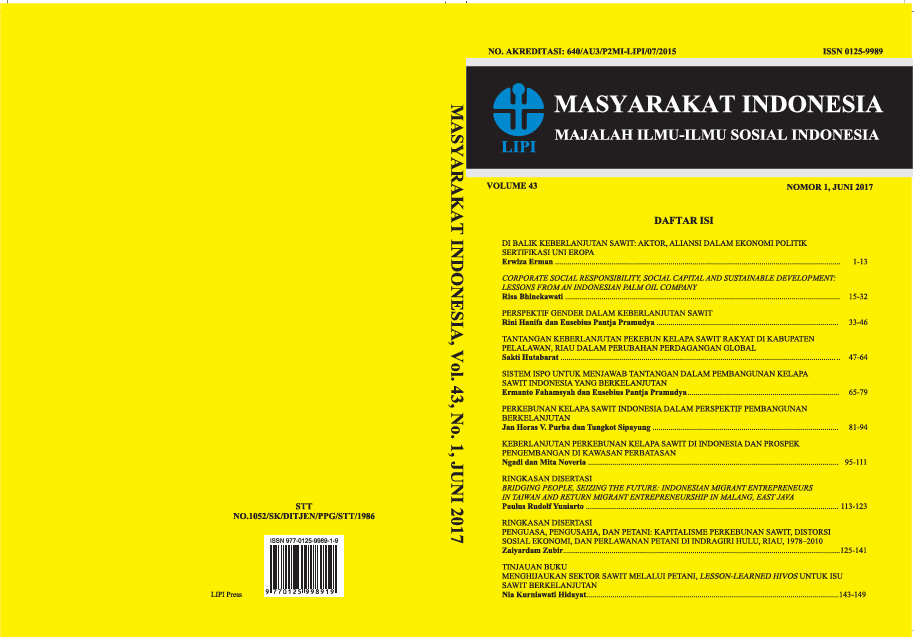
SISTEM ISPO UNTUK MENJAWAB TANTANGAN DALAM PEMBANGUNAN KELAPA SAWIT INDONESIA YANG BERKELANJUTAN
DOI:
https://doi.org/10.14203/jmi.v43i1.718Keywords:
ISPO, Development, Palm Oil, Sustainable, IndonesiaAbstract
The implementation of ISPO certification system which has been running since 2011 in addition to having experienced various achievements and developments also encountered various obstacles, problems, challenges and demands. The formulation of the problems analyzed and answered in this study are: what aspects should be formulated in order to strengthen ISPO system? To analyze and answer the problem formulation is used framework thinking about legal system theory or Legal System Theory developed by Lawrence M. Friedman. The research method used in this study is more focused on normative legal research. Based on the analysis, it can be concluded that the aspects that must be formulated in order to strengthen ISPO system include: First, related to the aspect of law substance, ISPO system arrangement must be increased from the level of Minister of Agriculture Regulation to the level of Presidential Regulation. Through this Presidential Regulation is expected to become a stronger legal umbrella in the implementation of ISPO system. Second, in relation to aspects of its legal apparatus, the institutional mechanisms of ISPO certification shall be enhanced and strengthened. Third, from the legal culture aspect, there must be a common understanding about the definition and concept of sustainability in the management and development of oil palm Indonesia.
References
Filstead, W. J. (1978). Qualitative method: A needed perspective in evaluation research. Dalam Thomas D. Cook & Charles S. Reichard (ed.), Qualitative and Quantitative Research in Evaluation Research, 38. London: Sage Publications.
Friedman, L. M. (1984). American law. United States of America: W.W. Norton & Company.
Friedman, L. M. (2001). Hukum Amerika: Sebuah pengantar (American Law: An Introduction, 2nd Edition). Diterjemahkan oleh Wishnu Basuki. Jakarta: Tatanusa.
Gillespie, P. & Harjanthi, R. S. (2 November 2012). ISPO, RSPO: Two sides of the same coin? The Jakarta Post.
Hidayat & Samekto. (2007). Kajian Kritis Penegakan Hukum Lingkungan di Era Otonomi Daerah. Cet. I. Semarang: Badan Penerbitan Universitas Diponegoro.
Kospa, H. S. D. (Desember 2016). Konsep Perkebunan Kelapa Sawit Berkelanjutan. Jurnal Tekno Global, 5(1), 1–10.
Kementerian Pertanian Republik Indonesia. (2015). Peraturan Menteri Pertanian Nomor 11/Permentan/OT.140/3/2015 tentang Sistem Sertifikasi
Kelapa Sawit Berkelanjutan Indonesia (Indonesian Sustainable Palm Oil Certification System/ISPO). Berita Negara No. 432 Tahun 2015. Jakarta: Kementerian Pertanian.
Kementerian Koordinator Perekonomian Republik Indonesia. (2016, 25 Oktober). Policy brief rancangan peraturan presiden tentangpenguatan ISPO. Jakarta: Kementerian Koordinator Perekonomian.
Marin-Burgos, V., Clancy, J. S., & Lovett, J. C. (2015). Contesting legitimacy of voluntary sustainability certification schemes: Valuation languages and power asymmetries in the Roundtable on Sustainable Palm Oil in Colombia. Ecological Economics. 117, 303–313.
Marzuki, P. M. (2005). Penelitian hukum. Jakarta: Kencana.
Republik Indonesia. (1945). Undang-Undang Dasar Negara Republik Indonesia Tahun 1945.
_____. (2007). Undang-Undang No. 25 Tahun 2007 tentang Penanaman Modal, LN No. 67 Tahun 2007, TLN No. 4724.
_____. (2014). Undang-Undang No. 3 Tahun 2014 tentang Perindustrian, LN. No. 4 Tahun 2014, TLN No. 5492.
_____. (2014) Undang-Undang No. 39 Tahun 2014 tentang Perkebunan, LN No. 308 Tahun 2014, TLN No. 5613.
RSPO. (2013). Principles and criteria for the production of sustainable palm oil.
_____. (2016a). RSPO Factsheet.
_____. (2016b) RSPO Impact Report 2016. Sahide, M. A. K., Burns, S., Wibowo, A., Nurrochmat,
D. R., & Giessen, L. (December 2015). Towards state hegemony over agricultural certification: From voluntary private to mandatory state regimes on palm oil in Indonesia. Jurnal Manajemen Hutan Tropis, 21(3), 162–171.
Schouten, G. & Glasbergen, P. (2012). Private multistakeholder governance in the agricultural market place: An analysis of legitimization processes of the roundtables on sustainable palm oil and responsible soy. International Food and Agribusiness Management Review, 15, Special Issue B.
Sidharta, B. A. (2000). Refleksi tentang struktur ilmu hukum. Cet. II. Bandung: Mandar Maju.
Soekanto, S. & Mahmudji, S. (2001). Penelitian hukum normatif suatu tinjauan singkat. Jakarta: PT Raja Grafindo Persada.
Soekanto, S. (2006). Pengantar penelitian hukum. Jakarta: UI-Press.
Wijaya, A. & Glasbergen, P. (2016). Toward a new scenario in agricultural sustainability certification? The response of the Indonesian national government to private certification. Journal of Environment & Development, 25(2), 219–246.
Downloads
Published
How to Cite
Issue
Section
License
Copyright (c) 2018 Author(s)

This work is licensed under a Creative Commons Attribution-ShareAlike 4.0 International License.

