
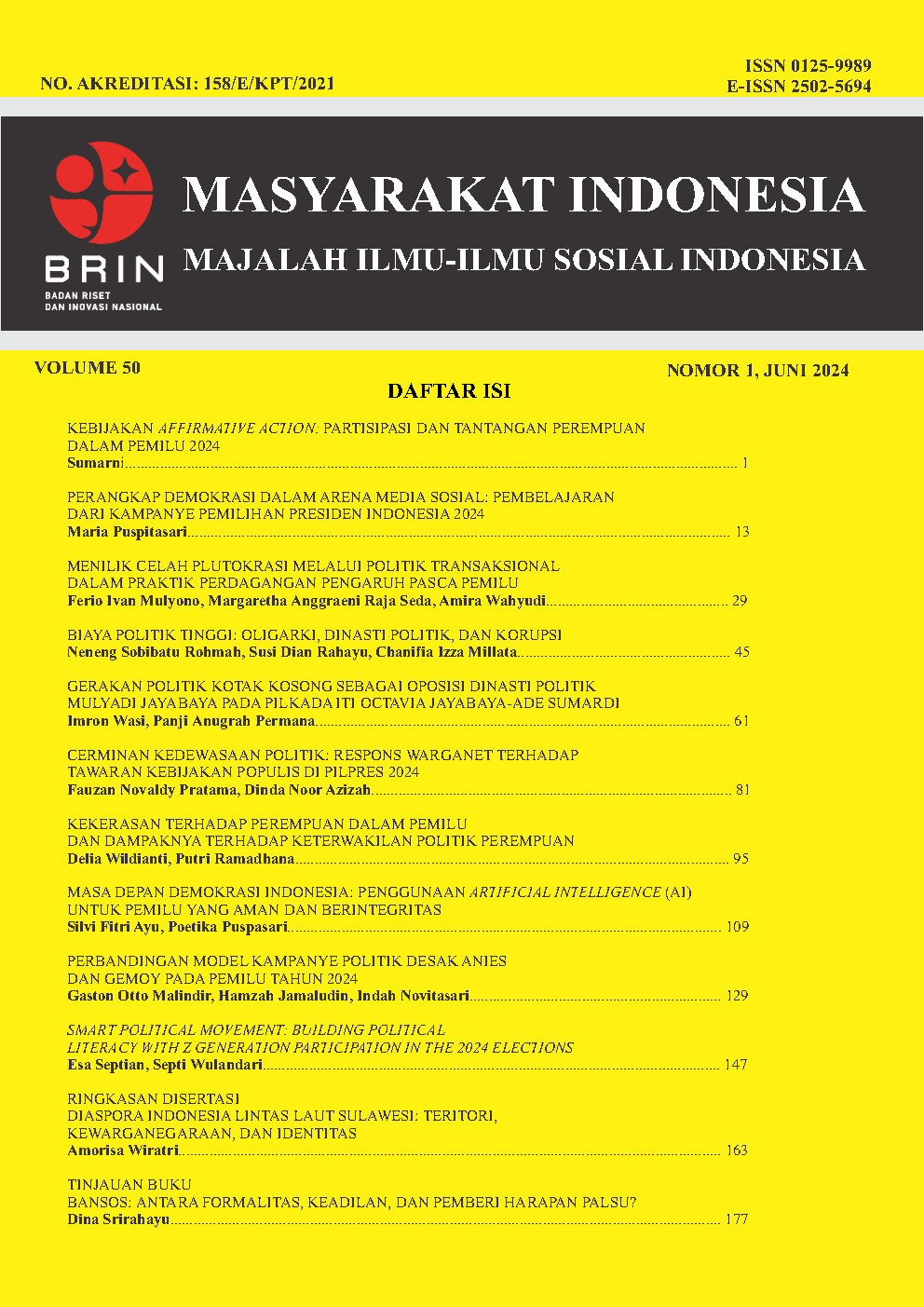
DIASPORA INDONESIA LINTAS LAUT SULAWESI: TERITORI, KEWARGANEGARAAN, DAN IDENTITAS
DOI:
https://doi.org/10.55981/jmi.2024.8713Keywords:
diaspora, teritorialisasi, Sangir, Filipina SelatanAbstract
Disertasi ini membahas mengenai hubungan antara komunitas diaspora dan negara asal-negara penerima melalui gagasan teritorialisasi, seperti yang dikembangkan oleh Deleuze dan Guattari. Argumen utama untuk disertasi ini adalah komunitas diaspora Sangir di Filipina selatan terus menerus menegosiasikan posisinya dengan negara asal dan tuan rumah, mencptakan hubungan yang dinamis, cair, dan berlapis. Negosiasi komunitas diaspora Sangir dapat dilihat dari pemahaman mereka tentang wilayah, identitas, dan kewarganegaraan. Alih-alih berfokus pada persepsi komunitas diaspora dari pandangan negara, disertasi ini menekankan narasi diaspora dan identifikasi wilayah dari pandangan komunitas diaspora itu sendiri. Pengumpulan data untuk disertasi ini dilakukan melalui wawancara dengan delapan puluh anggota komunitas diaspora Sangir dari generasi yang berbeda, termasuk generasi pertama hingga keempat di empat desa di Filipina Selatan. Karena penelitian ini dilakukan selama pandemi COVID-19, wawancara dilakukan melalui metode hybrid: online, dengan bantuan asisten peneliti, dan beberapa wawancara tatap muka setelah pembatasan pandemi berakhir.
References
Addeo, F., Paoli, A.D., Esposito, M., Bolcato. (2020). Doing social research on online communities: The benefits of netnography. Athens Journal of Social Sciences, 7(1), 9-38. https://doi.org/10.30958/ajss.7-1-1
Adkins, B. (2015). Deleuze and Guattari's A Thousand Plateaus: A critical introduction and guide. Edinburgh University Press. http://www.jstor.org/stable/10.3366/j.ctt1g0b18p.18
Airoldi, M. (2018). Ethnography and the digital fields of social media. International Journal of Social Research Methodology, 21(6), 661-673, https://doi.org/10.1080/13645579.2018.1465622
Appadurai, A. (1996). Modernity at large: Cultural dimensions of globalization. University of Minnesota Press.
Bagga-Gupta, S., & Dahlberg, G.M. (2021). On studying peoples' participation across contemporary time spaces: Disentangling analytical engagement. Outlines. Critical Practice Studies, 22(1), 49–88. https://doi.org/10.7146/ocps.v22i.125861
Basa, M. (2018, January 3). 'Filipino' receives Indonesian passport. Rappler. https://www.rappler.com/nation/192847-indonesian-mindanao-passports/
Beaman, J. (2016). Citizenship as cultural: Towards a theory of cultural citizenship. Sociology Compass, 10(10), 849– 857. https://doi.org/10.1111/soc4.12415
Benmayor, R. (2002). Narrating cultural citizenship: Oral histories of first-generation college students of Mexican origin. Social Justice, 29(4(90)), 96-121. https://www.jstor.org/stable/29768151
Bhabha, J. (1999). Belonging in Europe: citizenship and post-national rights. International Social Science Journal, 51(159), 11-23. https://doi.org/10.1111/1468-2451.00173
Champollion, P. (2006). Territory and territorialization: Present state of the CAENTI thought. In Proceeding International Conference of Territorial Intelligence (pp. 51-58). Romania: WP4T CAENTI.
Chang, W.C. (2014). Beyond Borders: Stories of Yunnanese Chinese migrants of Burma. Cornell University Press.
Cheva-Isarakul, J., & Sperfeldt, C. (2023). Citizenship and statelessness among mobile maritime populations: The case of the Moken in Thailand. Citizenship Studies, 27(4), 530-547. https://doi.org/10.1080/13621025.2023.2178638
Christin, A. (2020). The ethnographer and the algorithm: Beyond the black box. Theory and Society, 49, 897-918. https://doi.org/10.1007/s11186-020-09411-3
Coleman, D. (2016). Indigenous place and diaspora space: Of literalism and abstraction. Settler Colonial Studies, 6(1), 61–76. https://doi.org/10.1080/2201473X.2014.1000913
Crowley, J. (1999). The Politics of belonging: Some theoretical considerations. In A. Favell and A. Geddes (Eds.), The Politics of belonging: Migrants and minorities in contemporary Europe (pp. 15-41). Ashgate.
Danny (2020, December 23). Your guide to remote ethnographic research. Cyber-duck. https://www.cyber-duck.co.uk/insights/your-guide-to-remote-ethnographic-research
Delanty, G. (2003). Citizenship as a learning process: Disciplinary citizenship versus cultural citizenship, Int. of Lifelong Education, 22(6), 597-605. https://doi.org/10.1080/0260137032000138158
Deleuze, G., & Guattari, F. L. (1987). A Thousand plateaus: Capitalism and schizophrenia. (B. Massumi, Trans.). University of Minnesota Press.
Elden, S. (2010). Land, terrain, territory. Progress in Human Geography, 34(6), 799-817. https://doi.org/10.1177/0309132510362603
Fabinyi, M., Pido, M., de Leon, E. M. P., las Alas, M. A. D., Buenconsejo, J., Bitara, A. U., Harani, B. & Caceres, J. (2014). Fisheries trade and social development in the Philippine-Malaysia maritime border zone. Development Policy Review, 32(6), 715-732. https://doi.org/10.1111/dpr.12086
Getrich, C. M. (2008). Negotiating boundaries of social belonging: Second-generation Mexican youth and the immigrant rights protests of 2006. American Behavioral Scientist, 52(4), 533–556. https://doi.org/10.1177/0002764208324605
Gilroy, P. (1994). Diaspora. Paragraph, 17(1), 207-212.
Glaser, B. G., & Strauss, A. L. (2006). The discovery of grounded theory: Strategies for qualitative research. Aldine Transaction.
Gumelar, D. L., & Dhanwani, N. D. (2018). Lapisan marginalisasi dan konstruksi ilegalitas dalam masyarakat perbatasan di perbatasan Indonesia Filipina. Jurnal Masyarakat Indonesia, 44(2), 60-75.
Handayani, S. (2017, August 20). Keturunan Indonesia di Filipina raih status kewarganegaraan. Republika. https://news.republika.co.id/berita/ouywx6328/keturunan-indonesia-di-filipina-raih-status-kewarganegaraan
Ho, E. L. -E. (2011). 'Claiming' the diaspora: Elite mobility, sending state strategies and the spatialities of citizenship. Progress in Human Geography, 35(6), 757- 772. https://doi.org/10.1177/0309132511401463
Huang, H. (2015). Indigeneity, diaspora, and ethical turn in Anzaldúa's Borderlands/La Frontera. CLCWeb: Comparative Literature and Culture, 17(5), 9. https://doi.org/10.7771/1481-4374.2741
Kastoryano, R. (2008). Territoriality in diasporas and transnational communities. In O. Schmidtke & S. Ozcurumez (Eds.), Of states, rights, and social closure (pp. 179-201). Palgrave Macmillan. https://doi.org/10.1057/9780230610484_9
Kozinets, R. V. (1998). On netnography: Initial reflections on consumer research investigations of cyberculture. In J. W. Alba & J. W. Hutchinson (Eds.), Advances in consumer research (25) (pp. 366-371). Association for Consumer Research.
Liu, R. -F. (2022). Hybrid ethnography: Access, positioning, and data assembly. Ethnography, 0(0), 1–18. https://doi.org/10.1177/14661381221145451
Malkki, L. (1992). National geographic: The rooting of peoples and the territorialization of national identity among scholars and refugees. Cultural Anthropology, 7(1), 24-44. https://doi.org/10.1525/can.1992.7.1.02a00030
Manigbas, A. M. (2016) Indonesians in Mindanao. Hurights Osaka. https://www.hurights.or.jp/archives/focus/section3/2016/06/indonesians-in-mindanao.html
Mavroudi, E. (2008). Palestinians and pragmatic citizenship: Negotiating relationships between citizenship and national identity in diaspora. Geoforum, 39(1), 307–318. https://hdl.handle.net/2134/8834
McNevin, A. (2006). Political belonging in a neoliberal era: The struggle of the Sans-Papiers. Citizenship Studies, 10(2), 135-151. https://doi.org/10.1080/13621020600633051
Mendoza, M. (2013). Citizenship and belonging in uncertain times. Oregon Historical Quarterly, 114(4), 432-440. https://doi.org/10.1353/ohq.2013.0004
Merlan, F. (2009). Indigeneity: Global and local. Current Anthropology, 50(3), 303-333. https://doi.org/10.1086/597667
Mertus, J. A. (2009). Introduction: Surviving field research. In C. L. Sriram (Ed.), Surviving field research: Working in violent and difficult situations (pp. 1-7). Routledge.
Murthy, D. (2008). Digital ethnography: An examination of the use of new technologies for social research. Sociology, 42(5), 837–855. https://doi.org/10.1177/0038038508094565
Niezen, R. (2003). The origins of ndigenism: Human rights and the politics of identity. University of California Press.
Nolde, L. (2009). Great is our relationship with the sea: Charting the maritime realm of the Sama of Southeast Sulawesi. Explorations, 9, 15-33. https://scholarspace.manoa.hawaii.edu/bitstreams/c8d82697-a38b-4acd-a5e2-c148cef8ab91/download
Ong, A. (2004). The Chinese axis: Zoning technologies and variegated sovereignty. Journal of East Asian Studies, 4(1), 69-96. https://doi.org/10.1017/S1598240800004392
Pakulski, J. (1997). Cultural citizenship. Citizenship Studies, 1(1), 73-86. https://doi.org/10.1080/13621029708420648
Pristiwanto. (2016). Dinamika Pisang (Filipina-Sangihe) di perbatasan Indonesia-Filipina. Antropologi Indonesia, 37(1), 40-52.
Przybylski, L. (2020). Hybrid thnography: Online, offline, and in between. SAGE Publishing.
Rosaldo, R. (1994). Cultural citizenship and educational democracy. Cultural Anthropology, 9(3), 402-411. https://www.jstor.org/stable/656372
Schetter, C. (2005). Ethnoscapes, national territorialisation and the Afghan War. Geopolitics, 10(1), 50-75. https://doi.org/10.1080/14650040590907712
Silvestrini, B. (1997). The world we enter when claiming rights: Latinos and their quest for culture. In W. V. Flores & R. Benmayor (Eds.), Latino cultural citizenship (pp. 39-53). Beacon Press.
Strauss, A. L., & Corbin, J. M. (1990). The basics of qualitative research: Grounded theory procedures and techniques. SAGE.
Tanggol, F. (2017, May 12). Philippine and Indonesian Governments work together to end statelessness in Mindanao. UNHCR. http://www.unhcr.org/ph/11753-philippine-indonesian-governments-work-together-end-statelessness-mindanao.html
The World Bank. (2023). Indigenous Peoples. https://www.worldbank.org/en/topic/indigenouspeoples#:~:text=Indigenous%20Peoples%20are%20distinct%20social,which%20they%20have%20been%20displaced
Theriault, N. (2019). Unravelling the strings attached: Philippine indigeneity in law and practice. Journal of Southeast Asian Studies, 50(1), 107-128. https://doi.org/10.1017/S0022463419000018
Tie, Y. C., Birks, M., & Francis, K. (2019). Grounded theory research: A design framework for novice researchers. SAGE Open Medicine, 7, 1–8. https://doi.org/10.1177/2050312118822927
Vandergeest, P., & Peluso, N.L. (1995). Territorialization and state power in Thailand. Theory and Society, 24(3), 385-426. https://doi.org/10.1007/BF00993352
Velasco, D. (2009). Fluid boundaries: Toward a people-centred approach to border issues in North Sulawesi. Asian Transformations in Action: The Work of the 2006/2007 API Fellows (pp. 95-102). Abeno Printing Co.
Wang, L. J. (2013). Towards cultural citizenship? Cultural rights and cultural policy in Taiwan. Citizenship Studies, 17(1), 92-110. https://doi.org/10.1080/13621025.2012.716213
Warren, J. F. (1997). The Sulu zone, the world capitalist economy and the historical imagination: Problematizing global-local interconnections and inter-dependencies. Southeast Asian Studies (Tonan Ajia Kenkyu), 35(2), 177-222. https://kyoto-seas.org/pdf/35/2/350201.pdf
Yuval-Davis, N. (2006). Belonging and the politics of belonging. Patterns of Prejudice, 40(3), 197-214. https://doi.org/10.1080/00313220600769331
Zimmerman, O. (2018). Becoming indigenous: A story of the Moklen people. WWU Honors College Senior Projects, 87. https://cedar.wwu.edu/wwu_honors/87/
Published
How to Cite
Issue
Section
License
Copyright (c) 2024 Amorisa Wiratri

This work is licensed under a Creative Commons Attribution-ShareAlike 4.0 International License.