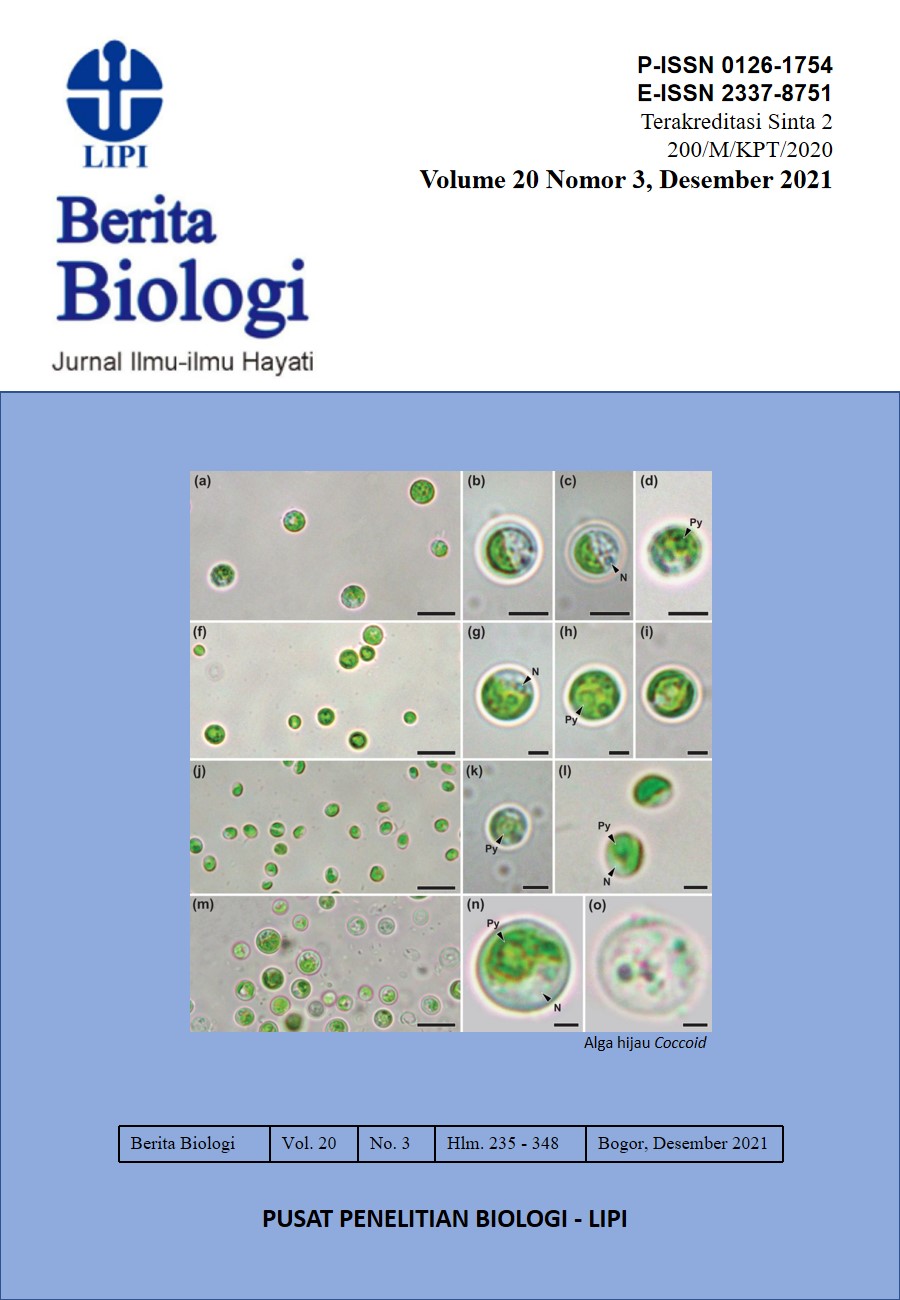
VARIASI MUSIMAN FITOPLANKTON DAN KUALITAS PERAIRAN PULAU KOTOK BESAR
DOI:
https://doi.org/10.14203/beritabiologi.v21i3.3997Keywords:
Bioindikator, Fitoplankton, Musim kemarau dan hujan, Pulau Kotok Besar, Struktur komunitasAbstract
Phytoplankton are affected by it environmental conditions such as chemical-physical, aquatic nutrients and seasons. Purpose of research is
to analyze community structure and abundance of phytoplankton in Kotok Besar Island waters under dry and rainy seasons as
bioindicators of water quality. Researchers determine point sampling by purposive sampling based on cardinal directions then samples was
taken by filtration method. Based on KepMen LH No. 51 of 2004, temperature and TDS of Western Kotok Besar Island in both seasons
within the quality standard, except pH in dry season which is higher than quality standard. Phytoplankton composition in both seasons
indicate oligotrophic waters and dominated by Bacillariophyceae. Diversity (H’), Evenness (E), and Dominance (D) indeces in dry seasons
each of them were 2.37 (moderate diversity); 0.82 (high individual number evenness); and 0.3 (no dominance) while in rainy seasons each
of them were 1.44 (moderate diversity); 0.63 (high individual number evenness); and 0.05 (no dominance). Saprobic index is 1 in both
seasons with nutrient status β-mesosaprobic.
References
Adriana, A., Siregar, S. H., & Metode, B. (2017). Struktur Komunitas Fitoplankton di Perairan Tanjung Balai Kota Kabupaten Karimun Provinsi Kepulauan Riau The Structure of Phytoplankton Community in Tanjung Balai Kota Karimun District , Kepulauan Riau Province Pendahuluan. Jurnal Perikanan dan kelautan, 22(2), 18–26.
Aisyah, R., Arini, W., & Suwarno, H. (2013). Komposisi dan Kemelimpahan Fitoplanton dI Laguna Glagah Kabupaten Kulonprogo Provinsi Daerah Istimewa Yogyakarta. Jurnal, 1–7.
Al-Yamani, F., Saburova, M., & Polikarpov, I. (2012). A preliminary assessment of harmful algal blooms in Kuwait’s marine environment. Aquatic Ecosystem Health and Management, 15, 64–72. https://doi.org/10.1080/14634988.2012.679450
Allen, W. E., & Cupp, E. A. (1935). Plankton diatoms of the java sea. J Brill. California.
Amri, K., Priatna, A., & Suprapto. (2014). Oceanographycal Characteristic and Phytoplankton Abundance in Sunda Strait in East Monsoon. Bawal, 6(1), 11–20.
APHA. (2005). Standart Method for the Examination of Water and Watewater 21th ed. Washington DC : American Public Health.
Aprisanti, R., Mulyadi, A., & Siregar, S. (2013). Struktur Komunitas Diatom Epilitik Perairan Sungai Senapelan dan Sungai Sail, Kota Pekanbaru Rizka Aprisanti. Jurnal Ilmu Lingkungan, 7(2), 241–252.
Bagaskara, W. B., Ario, R., & Riniatsih, I. (2020). Kualitas Perairan di tinjau dari Distribusi Fitoplankton serta Indeks Saprobik di Pantai Marina Semarang Jawa Tengah. Journal of Marine Research 9(3), 333–342.
Balzano, S., Ellis, A. V., Le Lan, C., & Leterme, S. C. (2015). Seasonal changes in phytoplankton on the north-eastern shelf of Kangaroo Island (South Australia) in 2012 and 2013. Oceanologia, 57(3), 251–262. https://doi.org/10.1016/j.oceano.2015.04.003
Bellinger, E. G., & Sigee, D. C. (2010). Freshwater Algae : Identification and Use as Bioindicators. Willey-Blackwell. file:///C:/Users/youhe/Downloads/kdoc_o_00042_01.pdf
Campbell, P. E., Manning, J. A., Webber, M. K., & Webber, D. F. (2008). Planktonic communities as indicators of water quality in mangrove lagoons; a Jamaican case study. Transitional Waters Bulletin, 2(3), 39–63. https://doi.org/10.1285/i1825229Xv2n3p39
Choirun, A., Sari, S. H. J., & Iranawati, F. (2015). IDENTIFIKASI FITOPLANKTON SPESIES HARMFULL ALGAE BLOOM (HAB) SAAT KONDISI PASANG DI PERAIRAN PESISIR BRONDONG, LAMONGAN, JAWA TIMUR. Journal of Chemical Information and Modeling, 53(9), 1689–1699. https://doi.org/10.1017/CBO9781107415324.004
Dresscher, & Mark, van der. (1976). A Simplified Method For The Biological Assessment Of The Quality Of Fresh And Slightly Brackish Water Th . G . N . DRESSCHER * & H . van der MARK ** ** Roerstraat 5 , Emmeloord . The Netherlands Received April 22 , 1974 Keywords : Saprobic index . Biologi. Hydrobiologia, 48, 199–201.
Gao, X., & Song, J. (2005). Phytoplankton distributions and their relationship with the environment in the Changjiang Estuary, China. Marine Pollution Bulletin, 50(3), 327–335. https://doi.org/10.1016/j.marpolbul.2004.11.004
Garno, yudhi sutrisno. (2013). Kualitas Air Dan Dinamika Fitoplankton Di Perairan Harapan. Journal of Chemical Information and Modeling, 53(9), 1689–1699. https://doi.org/10.1017/CBO9781107415324.004
GEOHAB. (2001). Global Ecology and Oceanography of Harmful Algal Blooms (GEOHAB) (Vol 84). SCOR and IOC.
Gharib, S. M., El-Sherif, Z. M., Abdel-Halim, A. M., & Radwan, A. A. (2011). Phytoplankton and environmental variables as a water quality indicator for the beaches at Matrouh, south-eastern Mediterranean Sea, Egypt: An assessment. Oceanologia, 53(3), 819–836. https://doi.org/10.5697/oc.53-3.819
Japa, L., & Khairuddin. (2014). Komunitas Fitoplankton Perairan Pantai Utara, Timur, Dan Selatan Pulau Lombok. Jurnal Biologi Tropis, 14(2). https://doi.org/10.29303/jbt.v14i2.137
Karacaoǧlu, D., Dere, Ş., & Dalkiran, N. (2004). A taxonomic study on the phytoplankton of Lake Uluabat (Bursa). Turkish Journal of Botany, 28(5), 473–485.
Manal, A., Faiza, A., & Kholood, A. (2009). Marine Phytoplankton Atlas of Kuwait Waters. Kuwait Institute for Scientific Research.
Mardiansyah Assuyuti, Y., Farhan Rijaluddin, A., Ramadhan, F., & Bayu Zikrillah, R. (2016). Estimasi Jumlah Biomassa Lamun Di Pulau Pramuka, Karya Dan Kotok Besar, Kepulauan Seribu, Jakarta. Depik, 5(2), 85–93. https://doi.org/10.13170/depik.5.2.4914
Meirinawati, H., & Muchtar, M. (2017). Fluktuasi Nitrat, Fosfat dan Silikat di Perairan Pulau Bintan. Jurnal Segara, 13(3), 141–148. https://doi.org/10.15578/segara.v13i3.6493
Moran, S. (2018). Clean water characterization and treatment objectives (Chapter 6). Elsevier inc. https://doi.org/https://doi.org/10.1016/B978-0-12-811309-7.00006-0
Mujiyanto, M., & Syam, A. (2011). Pencemaran perairan pada lokasi penempatan terumbu karang buatan di Pulau Kotok dan Pulau Harapan Kepulauan Seribu. Prosiding Forum Nasional Pemacuan Sumber Daya Ikan III.
Mutmainah, H., & Adnan, I. (2018). Status Kualitas Perairan Kawasan Terpadu Pelabuhan Perikanan Samudera Bungus Menggunakan Metode Indeks Golongan Air. Jurnal Teknologi Lingkungan, 19(1), 107. https://doi.org/10.29122/jtl.v19i1.2030
Nastiti, A. S., & Hartati, S. T. (2013). Struktur Komunitas Plankton Dan Kondisi Lingkungan Perairan Di Teluk Jakarta Plankton Community Structure and Their Environment As One of Factors To Support Fish Resources Management in. BAWAL Widya Riset Perikanan Tangkap, 5(1), 131–150.
Nontji, A. (2006). Tiada Kehidupan di Bumi Tanpa Keberadaan Plankton. Lembaga Ilmu Pengetahuan Indonesia (LIPI).Pusat Penelitian Oseanografi.
Novia, R., Adnan, & Ritonga, I. R. (2016). Hubungan parameter fisika-kimia perairan dengan kelimpahan plankton di Samudera Hindia bagian Barat Daya. Depik, 5(2). https://doi.org/10.13170/depik.5.2.4912
Nufus, H., Karina, S., & Agustina, S. (2017). Analisis Sebaran Klorofil-A Dan Kualitas Air Di Sungai Krueng Raba Lhoknga , Aceh Besar. Jurnal Ilmiah Mahasiswa Kelautan Dan Perikanan Unsyiah, 2(1), 58–65.
Odum, E. p. (1998). Dasar-dasar Ekologi. Yogyakarta : Gadjah Mada University Press.
Onyema, I. C. (2007). The Phytoplankton Composition, Abundance and Temporal Variation of a Polluted Estuarine Creek in Lagos, Nigeria. Turkish Journal of Fisheries and Aquatic Sciences, 7(2), 89–96.
Prihantini, N. B., Wardhana, W., Hendrayanti, D., Widyawan, A., Ariyani, Y., & Rianto, R. (2008). Biodiversitas Cyanobacteria Dari Beberapa Situ/Danau Di Kawasan Jakarta-Depok-Bogor, Indonesia. MAKARA of Science Series, 12(1), 44–54. https://doi.org/10.7454/mss.v12i1.309
Rahayu, N. D., Sasmito, B., & Bashit, N. (2018). Analisis Pengaruh Fenomena Indian Ocean Dipole (Iod) Terhadap Curah Hujan Di Pulau Jawa. Jurnal Geodesi Undip, 7(1), 57–67.
Raymont, J. E. G. (1963). Plankton and Productivity in the ocean. A Pergamon Press Book.
Reynolds, C. S. (2006). Ecology of Phytoplankton. Cambridge University Press.
Rizqina, C., Sulardiono, B., & Djunaedi, A. (2017). Hubungan Antara Kandungan Nitrat dan Fosfat dengan Kelimpahan Fitoplankton di Perairan Pulau Pari, Kepulauan Seribu. Management of Aquatic Resources Journal, 6, 43–50.
Rustam, A., & Prabawa, F. Y. (2015). Kualitas perairan di pantai punai dan pantai tambak kabupaten belitung timur. Segara, 11(1), 75–84.
Sari, A. N., Hutabarat, S., & Soedarsono, P. (2014). STRUKTU KOMUNITAS PLANKTON PADA UJUNG LAMUN DI PANTAI PULAU PANJANG, JEPARA. Diponegoro Journal of Maquares, 3, 82–91.
Sediadi, A. (2010). Effek Upwelling Terhadap Kelimpahan Dan Distribusi Fitoplankton Di Perairan Laut Banda Dan Sekitarnya. MAKARA of Science Series, 8(2), 43–51. https://doi.org/10.7454/mss.v8i2.409
Sun, C. C., Wang, Y. S., Wu, M. L., Dong, J. De, Wang, Y. T., Sun, F. L., & Zhang, Y. Y. (2011). Seasonal variation of water quality and phytoplankton response patterns in Daya Bay, China. International Journal of Environmental Research and Public Health, 8(7), 2951–2966. https://doi.org/10.3390/ijerph8072951
Sundari, P. P. K. (2016). Keragaman zooplankton di perairan sungai pepe anak sungai bengawan solo di jawa tengah. Seminar Nasional, 1006–1011.
Suthers, I. M., & D., R. (2009). Plankton: A guide to their ecology and monitoring for water quality. Coollingwood VIC : CSIRO Publishing.
Taruktiku, S. A. (2016). HUBUNGAN SEBARAN KELIMPAHAN FITOPLANKTON DENGAN KONSENTRASI KLOROFIL-A DI PERAIRAN PESISIR DAN LAUT KABUPATEN PANGKAJENE KEPULAUAN. Universitas Hasanudin press.
Telesh, I. V. (2004). Plankton of the Baltic estuarine ecosystems with emphasis on Neva Estuary: A review of present knowledge and research perspectives. Marine Pollution Bulletin, 49(3), 206–219. https://doi.org/10.1016/j.marpolbul.2004.02.009
Verlencar, X. N. (2004). Phytoplankton Identification Manual. National Institute of Oceanography.
Vuuren, S. J. Van, Taylor, J., Ginkel, C. van, & Gerber, A. (2006). A guide for the identification of microscopic algae in South African freshwaters (Issue May).
Weliyadi, E. (2013). IDENTIFIKASI SPESIES FITOPLANKTON PENYEBAB HARMFUL ALGAL BLOOM (HAB) DI PERAIRAN TARAKAN Encik Weliyadi. Jurnal Harpodon Borneo, 6(1), 27–35.