
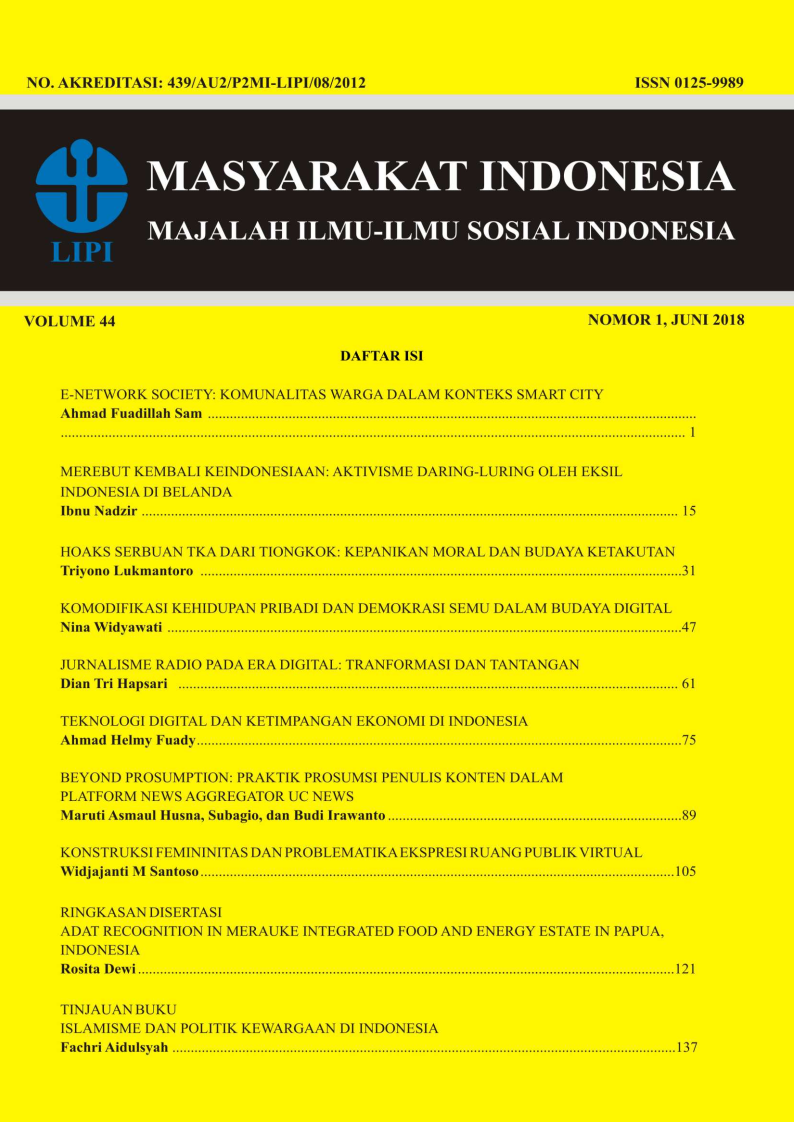
Jurnalisme Radio di Era Digital: Tranformasi dan Tantangan
DOI:
https://doi.org/10.14203/jmi.v44i1.760Keywords:
Radio, Teknologi, Media Baru, Jurnalisme, Media Tradisional, Opini Publik, Spiral of SilenceAbstract
During the periode of 2015, in Indonesia, a number of print newspapers decided to stop publich their printing media and switch to digital. This is also challenging for radio since it could be considered as traditional media such as the printing media. In this article, the authors explain how radio as a traditional mass-media is transformed into a new medium in the digital era. The outline of this paper discusses radio transformation as a new medium in terms of access model that uses the Internet and radio broadcast regulatory changes affect the democratic process in Indonesia. This article argues that throughout those changes, radio has not only adapted to the new technological demands while at the same time transform the media by facing the new technological challenger and access to their audience. However, despite the adaptability of radio towards the digital era, this new media era has brought up the seemingly silencing process of minority voice by the majority. This could be concurred through concept of spiral of slince. This article is a qualitative research that put attention to several processes of adaptation and transformation that radio has gone through since the era of Reformasi in Indonesia.
References
Ambardi, Kuskridho, 2014. Mapping Digital Media:Indonesia A report by The Open Society Foundations
Astuti, Santi Indra, 2017. Jurnalisme Radio Teori dan Praktik, Simbiosa Rekatama Media: Bandung.
Chaffee, Steven H. & Metzger Miriam J., 2001.The End of Mass Communication? Mass Communication and Society, 4:4, 365-379
Girard, Bruce. 2003. The One to Watch Radio, New ICTs and Interactivty. Rome : Food and Agriculture Organization of The United Nations.
Hopkins, Alexander E. 2015. Effects of the "Spiral of Silence" in Digital Media. Inquiries Journal/Student Pulse 7 (09) 2015, diakses melalui http://www.inquiriesjournal.com/a?id=1104
Jonathans, Errol, 2000. “Jurnalistik Radio,†dalam Rainer Adam et al. Politik dan Radio: Buku Pegangan bagi Jurnalis Radio, Jakarta: Friedrich Naumann Stiftung Littlejohn, Stephen W. & Foss, Karen A, 2009. Teori Komunikasi Theories of Human Communication, Jakarta: Salemba
Masduki, 2000. Jurnalistik Radio: Menata Profesionalisme Reporter dan Penyiar. Jakarta: Gramedia
Morissan, 2014. Teori Komunikasi Individu Hingga Massa, Kencana: Jakarta.
Mubarak, Moh. Husni, dan Henni T. Soelaeman, 2010. "Radio Elshinta: Melesat di Tengah Kepungan Pesaing". Majalah Swa, 05 Maret 2009, diakses melalui http://radioelshinta.blogspot.co.id/2010/01/artikel-tentang-radio-elshinta-di.html 7 Mei 2018 pukul 4:55pm
Noelle-Neumann, Elisabeth dan Thomas Petersen, 2004. “The Spiral of Silence and the Social Nature of Man,†dalam Lynda Lee Kaid (Ed.), Handbook of Political Communication Research, Mahwah, New Jersey: Lawrence Erlbaum Associates, Publishers
Roessing, Thomas, 2017. Spiral of Silence: General and Individual Media Tone. Dalam Patrick Rössler et al. The International Encyclopedia of Media Effects. Malden, MA: Willey Blackwell.
Romli, Asep Syamsul M, 2009. Dasar-Dasar Siaran Radio: Basic Announcing, Nuansa Cendekia: Bandung
Santoso, 2006. Waves of freedom : radio news agency KBR 68H. Jakarta: KBR 68H.
Vivian, John. 2006. The Media of Mass Communication (2006 Update). Boston: Pearson Education
Internet
http://marketeers.com/survey-markplus-insight-pengguna-internet-di-indonesia-55-jutamobile-internet-29-juta/ diakses pada 10/4/2018 pukul 16:15.
http://pusdatin.rri.co.id/file/docs/1/RRI%20Dari%20Masa%20Ke%20Masa.pdf di akses pada 13/4/18 pukul 4:26 pm
http://www.nielsen.com/id/en/press-room/2016/RADIO-MASIH-MEMILIKI-TEMPAT-DI-HATI-PENDENGARNYA.html di akses pada 10 /4/2018
Simatupang, Gopis. 2016. "RRI Luncurkan Radio Visual" diakses melalui http://wartakota.tribunnews.com/2016/03/28/rri-luncurkan-radio-visual
Downloads
Published
How to Cite
Issue
Section
License
Copyright (c) 2019 Author(s)

This work is licensed under a Creative Commons Attribution-ShareAlike 4.0 International License.