Global Trends and Evolution of Ecotechnology in Textile Wastewater Treatment: 21-Year Bibliometric Analysis
DOI:
https://doi.org/10.55981/limnotek.2025.13492Keywords:
Adsorption, bibliometric analysis, wetlands, nature-based solutions, textile effluent treatment, sustainabilityAbstract
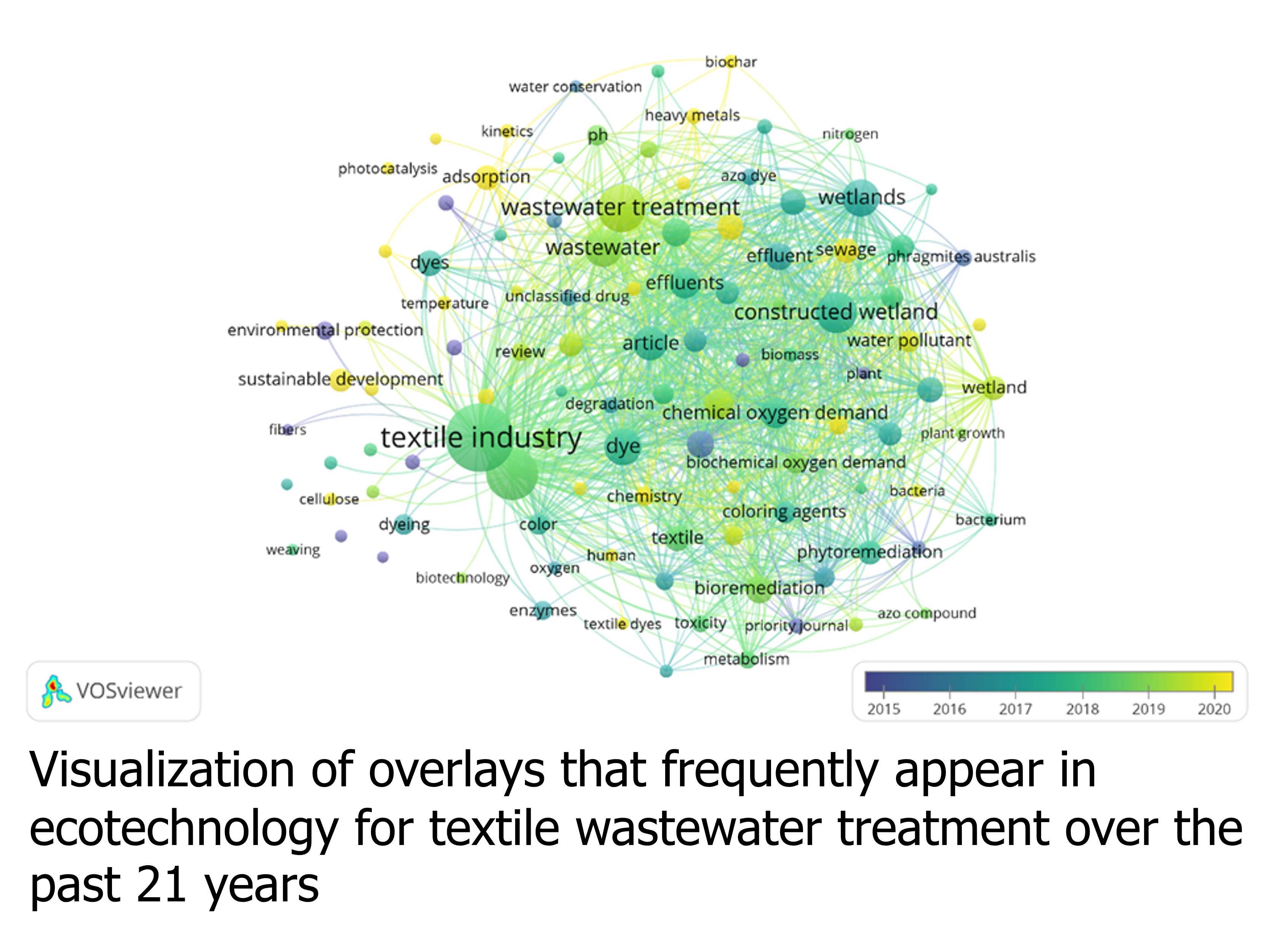
The textile industry supports the global economy, but it produces dye-rich wastewater that poses a threat to ecosystems and human health. Conventional treatment methods are expensive, energy-demanding, and often unsustainable. This study examines global research trends in the application of ecotechnology for textile wastewater treatment from 2004 to 2024. Data were collected from Scopus on August 9, 2025, and analyzed using the PRISMA, Excel, and VOSviewer tools. A total of 413 peer-reviewed English papers were reviewed based on the keywords “ecotechnology” and “textile wastewater treatment.” Research output has grown significantly since 2016, driven primarily by India and China. Core topics include constructed wetlands, adsorption, and phytoremediation, while recent studies highlight advanced materials, photocatalysis, nutrient recovery, and water conservation. These developments show a shift toward hybrid systems and circular economy models. Most papers appear in multidisciplinary journals, reflecting the broad and interconnected nature of the field. Yet, significant gaps remain in linking technology with social, policy, and behavioral aspects. Stronger collaboration across disciplines is needed to connect innovation, governance, and local engagement. Such efforts will help make ecotechnology a more sustainable and scalable solution for managing textile wastewater.
References
Aba RP, Sbahi S, Mugani R, Redouane EM, Hejjaj A, Azevedo J, Moreira CIT, Boo SF, Alexandrino DADM, Campos A, Vasconcelos V, Oudra B, Ouazzani N, Mandi L. 2024. Eco-friendly management of harmful cyanobacterial blooms in eutrophic lakes through vertical flow multi-soil-layering technology. Journal of Hazardous Materials 470:134281. DOI:10.1016/j.jhazmat.2024.134281
Abdullah KH, Azizan A. 2024. Ecoanxiety and mental health unveiled: a bibliometric analysis. International Journal of Public Health Science 13(2):783. DOI: 10.11591/ijphs.v13i2.23582
Ajibade FO, Ajala OA, Demissie H, Lasisi KH, Ajibade TF, Adelodun B, Kumar P, Nwogwu NA, Ojo AO, Olanrewaju OO, Adewumi JR. 2023. Utilization of constructed wetlands for dye removal: A concise review. 227–246. DOI:10.1016/bs.apmp.2022.11.004
Al Prol AE. 2019. Study of Environmental Concerns of Dyes and Recent Textile Effluents Treatment Technology: A Review. Asian Journal of Fisheries and Aquatic Research, 1–18. DOI: 10.9734/ajfar/2019/v3i230032
Angmo S, Kharayat Y, Shah S. 2024. Efficiency of Canna indica, Phragmites australis and Eichhornia crassipes in Remediation of Leachate Through a Vertical Flow Constructed Wetland. Current World Environment 19(2):592–607. DOI:10.12944/CWE.19.2.7
Arenas-Castro S, Gonçalves J, Alves P, Alcaraz-Segura D, Honrado JP. 2018. Assessing the multi-scale predictive ability of ecosystem functional attributes for species distribution modelling. PLOS ONE 13(6):1–31. DOI:10.1371/journal.pone.0199292
Ariel XQ, Chang V. 2020. Co-authorship network and the correlation with academic performance. Internet of Things 12:100307. DOI: 10.1016/j.iot.2020.100307
Baas J, Schotten M, Plume A, Côté G, Karimi R. 2020. Scopus as a curated, high-quality bibliometric data source for academic research in quantitative science studies. Quantitative Science Studies 1(1): 377–386. DOI: 10.1162/qss_a_00019
Bahara R, Nur AM, Syamsu K, Sunarti E, Jayanegara A, Tieman M. 2025. Global research trends on halal food SMEs: a bibliometric analysis. Journal of Islamic Marketing. DOI: 10.1108/JIMA-08-2024-0349
Bauermann BFC, Bussador AB, Bauermann H, Matrakas M. 2024. Connecting the green to the digital: Integrating Eco Cities and Smart Regions. Eco Cities 5(1):2755. DOI: 10.54517/ec.v5i1.2755
Behera M, Nayak J, Banerjee S, Chakrabortty S, Tripathy SK. 2021. A review on the treatment of textile industry waste effluents towards the development of efficient mitigation strategy: An integrated system design approach. Journal of Environmental Chemical Engineering, 9(4):105277. DOI: 10.1016/j.jece.2021.105277
Camano S, Behary N, Vroman P, Campagne C. 2014. Comparison of Bio and Eco-technologies with Chemical Methods for Pre-treatment of Flax Fibers: Impact on Fiber Properties. Journal of Engineered Fibers and Fabrics 9(4). DOI:10.1177/155892501400900407
Castillo-Suárez LA, Sierra-Sánchez AG, Linares-Hernández I, Martínez-Miranda V, Teutli-Sequeira EA. 2023. A critical review of textile industry wastewater: green technologies for the removal of indigo dyes. International Journal of Environmental Science and Technology 20(9):10553–10590. DOI:10.1007/s13762-023-04810-2
Costanza R. 2012. Ecosystem health and ecological engineering. Ecological Engineering 45:24–29. DOI:10.1016/j.ecoleng.2012.03.023
Daud NM, Abdullah SRS, Hasan HA, Ismail NI, Dhokhikah Y. 2022. Integrated physical-biological treatment system for batik industry wastewater: A review on process selection. Science of The Total Environment 819:152931. DOI:10.1016/J.SCITOTENV.2022.152931
Dell’Osbel N, Colares GS, Oliveira GA, Rodrigues LR, da Silva FP, Rodriguez AL, López DAR, Lutterbeck CA, Silveira EO, Kist LT, Machado ÊL. 2020. Hybrid constructed wetlands for the treatment of urban wastewaters: Increased nutrient removal and landscape potential. Ecological Engineering 158(July):106072. DOI:10.1016/j.ecoleng.2020.106072
Deng D, Lamssali M, Aryal N, Ofori‐Boadu A, Jha MK, Samuel RE. 2020. Textiles wastewater treatment technology: A review. Water Environment Research, 92(10):1805–1810. DOI:10.1002/wer.1437
Donthu N, Kumar S, Mukherjee D, Pandey N, Lim WM. 2021. How to conduct a bibliometric analysis: An overview and guidelines. Journal of Business Research 133:285–296. DOI: 10.1016/j.jbusres.2021.04.070
Effendi H, Margaretha JA, Krisanti M. 2018. Reducing ammonia and chromium concentration in batik wastewater by vetiver (Chrysopogon zizanioides L.) grown in floating wetland. Applied Ecology and Environmental Research, 16(3):2947–2956. DOI: 10.15666/aeer/1603_29472956
Fazal T, Razzaq A, Javed F, Hafeez A, Rashid N, Amjad US, Ur Rehman MS, Faisal A, Rehman F. 2020. Integrating adsorption and photocatalysis: A cost effective strategy for textile wastewater treatment using hybrid biochar-TiO2 composite. Journal of Hazardous Materials 390:121623. DOI:10.1016/j.jhazmat.2019.121623
Flores-Nieves MM, Soto-Zarazúa GM, Rico-García E, Zamora-Castro S, Macías-Bobadilla G, Hernández-López MS, Sánchez-Gutiérrez AE. 2022. Revaluation of Local Waste through an Ecotechnologies Strategic Plan: A Case Study with Digesters. Sustainability (Switzerland) 14(15). DOI:10.3390/su14159389
Geng D, Lai K, Zhu Q. 2021. Eco-innovation and its role for performance improvement among Chinese small and medium-sized manufacturing enterprises. International Journal of Production Economics 231:107869. DOI:10.1016/j.ijpe.2020.107869
Gomaa H, Emran MY, El-Gammal MA. 2023. Biodegradation of Azo Dye Pollutants Using Microorganisms. In Handbook of Biodegradable Materials 781–809. Springer International Publishing. DOI:10.1007/978-3-031-09710-2_33
Gustafsson S, Hermelin B, Smas L. 2019. Integrating environmental sustainability into strategic spatial planning: the importance of management. Journal of Environmental Planning and Management 62(8):1321–1338. DOI: 10.1080/09640568.2018.1495620
Halepoto H, Gong T, Memon H. 2022. Current status and research trends of textile wastewater treatments—A bibliometric-based study. Frontiers in Environmental Science 10. DOI:10.3389/fenvs.2022.1042256
Henny C, Rohaningsih D, Susanti E, Sumi F, Waluyo A. 2022. Evaluation of Heliconia psittacorum in a Horizontal Flow Constructed Wetland (HFCW) System for the Treatment of Textile Wastewater. IOP Conference Series: Earth and Environmental Science, 1062(1): 012026. DOI:10.1088/1755-1315/1062/1/012026
Holkar CR, Jadhav AJ, Pinjari DV, Mahamuni NM, Pandit AB. 2016. A critical review on textile wastewater treatments: Possible approaches. Journal of Environmental Management 182:351- 366. DOI:10.1016/j.jenvman.2016.07.090
Hussain Z, Arslan M, Malik MH, Mohsin M, Iqbal S, Afzal M. 2018. Treatment of the textile industry effluent in a pilot-scale vertical flow constructed wetland system augmented with bacterial endophytes. Science of The Total Environment 645: 966–973. DOI: 10.1016/j.scitotenv.2018.07.163
Hussain Z, Arslan M, Shabir G, Malik MH, Mohsin M, Iqbal S, Afzal M. 2019. Remediation of textile bleaching effluent by bacterial augmented horizontal flow and vertical flow constructed wetlands: A comparison at pilot scale. Science of The Total Environment 685: 370–379. DOI:10.1016/j.scitotenv.2019.05.414
Hussein A. 2023. Textile Wastewater Treated by Constructed Wetlands – A Critical Review. Journal of Ecological Engineering 24(5):256–275. DOI: 10.12911/22998993/161764
Islam MT, Al Mamun MA, Halim AFM, Peila R, Sanchez R. 2024. Current trends in textile wastewater treatment—bibliometric review. Environmental Science and Pollution Research 31(13):19166–19184. DOI: 10.1007/s11356-024-32454-3
Jebelli F, Hasheminejad H, Zarean MK. 2024. Efficient photocatalytic decolorization of textile wastewater using Fe-Mo LDH/ZnO nanocomposite: A sustainable approach for environmental remediation. Journal of Water Process Engineering 59:104981. DOI:10.1016/j.jwpe.2024.104981
Ji Z, Tang W, Pei Y. 2022. Constructed wetland substrates: A review on development, function mechanisms, and application in contaminants removal. Chemosphere 286:131564. DOI: 10.1016/j.chemosphere.2021.131564
Jorgensen SE. 2020. Application of Ecotechnology/Ecological Engineering in Environmental Management. In Ecotoxicology and Chemistry Applications in Environmental Management. DOI:10.1201/9781315371146-18
Junio CJ, Ontar PA, Rutaquio VJ, Manlapaz JM, Braga EB, Tugade C, Pescos CJ. 2024. Horizontal-flow constructed wetlands by phytoremediation using vetiver grass, common reed, and canna lily as tertiary wastewater treatment for the reduction of pollutant concentrations of ammonia, phosphates, and nitrates. IOP Conference Series: Earth and Environmental Science 1372(1):012045. DOI:10.1088/1755-1315/1372/1/012045
Kangas P. 2019. Ecological Engineering. In Ecology. Oxford University Press. DOI: 10.1093/obo/9780199830060-0217
Khan H, Kaur R. 2024. Advancing Sustainable Development and Technical Efficiency in India’s Textile Industry. 2024 15th International Conference on Computing Communication and Networking Technologies (ICCCNT) 1–8. DOI:10.1109/ICCCNT61001.2024.10724491
Khan SAR, Ponce P, Yu Z, Golpîra H, Mathew M. 2022. Environmental technology and wastewater treatment: Strategies to achieve environmental sustainability. Chemosphere, 286: 131532. DOI:10.1016/j.chemosphere.2021.131532
Khattab TA, Abdelrahman MS, Rehan M.2020. Textile dyeing industry: environmental impacts and remediation. Environmental Science and Pollution Research 27(4):3803–3818. DOI: 10.1007/s11356-019-07137-z
Klink A. 2017. A comparison of trace metal bioaccumulation and distribution in Typha latifolia and Phragmites australis: implication for phytoremediation. Environmental Science and Pollution Research 24(4): 3843–3852. DOI:10.1007/s11356-016-8135-6
Kumari M, Tripathi BD. 2015. Efficiency of Phragmites australis and Typha latifolia for heavy metal removal from wastewater. Ecotoxicology and Environmental Safety 112:80–86.DOI: 10.1016/j.ecoenv.2014.10.034
Li J, Hai Q. 2023. Evaluation of Economic Security and Environmental Protection Benefits from the Perspective of Sustainable Development and Technological Ecological Environment. Sustainability 15(7): 6072. DOI:10.3390/su15076072
Lyu Y, Liu Y, Guo Y, Tian J, Chen L. 2021. Managing water sustainability in textile industry through adaptive multiple stakeholder collaboration. Water Research 205:117655. DOI:10.1016/j.watres.2021.117655
Mitsch WJ, Mander Ü. 2017. Ecological engineering of sustainable landscapes. In Ecological Engineering 108. DOI: 10.1016/j.ecoleng.2017.08.021
Munonde TS, Madima N, Ratshiedana R, Nosizo NP, Mofokeng LE, Dima RS. 2025. Synergistic adsorption-photocatalytic remediation of methylene blue dye from textile industry wastewater over NiFe LDH supported on tyre-ash derived activated carbon. Applied Surface Science 679:161205. https://doi.org/10.1016/j.apsusc.2024.161205
Neto AA, Januário EFD, Bergamasco R, Vieira AMS. 2024. Comparative study of graphene oxide and copper oxide nanoparticle as surface modifiers in microfiltration membranes and adsorbents for efficient removal of textile dyes from contaminated water. Environmental Nanotechnology, Monitoring & Management, 22:100954. DOI:10.1016/j.enmm.2024.100954
Nuamah LA, Li Y, Pu Y, Nwankwegu AS, Haikuo Z, Norgbey E, Banahene P, Bofah-Buoh, R. 2020. Constructed wetlands, status, progress, and challenges. The need for critical operational reassessment for a cleaner productive ecosystem. Journal of Cleaner Production 269:122340. DOI:10.1016/j.jclepro.2020.122340
Odhaib WY, Jaeel AJ. 2023. A review of color and COD removal from textile effluent by coagulation and advanced oxidation processes. IOP Conference Series: Earth and Environmental Science 1232(1):012001. DOI:10.1088/1755-1315/1232/1/012001
Parihar P, Chand N, Suthar S. 2022. Treatment of High Nutrient-Loaded Wastewater in a Constructed Floating Wetland with Different Configurations: Role of Lantana Biochar Addition. Sustainability (Switzerland) 14(23). DOI:10.3390/su142316049
Pattnaik P, Dangayach GS, Bhardwaj AK. 2018. A review on the sustainability of textile industries wastewater with and without treatment methodologies. Reviews on Environmental Health 33(2):163–203. DOI:10.1515/reveh-2018-0013
Pratiwi R, Notodarmojo S, Helmy Q. 2018. Decolourization of remazol black-5 textile dyes using moving bed bio-film reactor. IOP Conference Series: Earth and Environmental Science 106:012089. DOI: 10.1088/1755-1315/106/1/012089
Rahmadyanti E, Wiyono A. 2020. Constructed Wetland with Rice Husk Substrate as Phytotechnology Treatment for Sustainable Batik Industry in Indonesia. Journal of Physics: Conference Series 1569(4): 042018. DOI: 10.1088/1742-6596/1569/4/042018
Rahman M, Hack-Polay D, Billah MM, Un Nabi, MN. 2020. Bio-based textile processing through the application of enzymes for environmental sustainability. International Journal of Technology Management & Sustainable Development 19(1): 87–106. DOI:10.1386/tmsd_00017_1
Ruiz-Sánchez R, Arencibia-Jorge R., Tagüeña J, Jiménez-Andrade JL, Carrillo-Calvet H. 2024. Exploring research on ecotechnology through artificial intelligence and bibliometric maps. Environmental Science and Ecotechnology 21:100386. DOI: 10.1016/j.ese.2023.100386
Saba B, Jabeen M, Khalid A, Aziz I, Christy AD. 2015. Effectiveness of Rice Agricultural Waste, Microbes and Wetland Plants in the Removal of Reactive Black-5 Azo Dye in Microcosm Constructed Wetlands. International Journal of Phytoremediation 17(11):1060–1067. DOI:10.1080/15226514.2014.1003787
Scarpellini S, Valero‐Gil J, Moneva JM, Andreaus, M. 2020. Environmental management capabilities for a “circular eco‐innovation.” Business Strategy and the Environment 29(5):1850–1864. DOI:10.1002/bse.2472
Scherbakova NG, Bredikhin SV. 2021. Co-authorship network structure analysis. Journal of Physics: Conference Series 2099(1): 012055. DOI:10.1088/1742-6596/2099/1/012055
Selvaraj D, Dhayabaran NK, Mahizhnan A. 2022. An insight on pollutant removal mechanisms in phycoremediation of textile wastewater. Environmental Science and Pollution Research 30(60):124714–124734. DOI: 10.1007/s11356-022-21307-6
Sethulekshmi S, Chakraborty S.2021. Textile wastewater treatment using horizontal flow constructed wetland and effect of length of flow in operation efficiency. Journal of Environmental Chemical Engineering 9(6):106379. DOI: 10.1016/j.jece.2021.106379
Sheoran D, Singh S. 2024. Examining the efficacy of constructed wetland coupled microbial fuel cell to treat textile wastewater using local wetlands plant species. Environmental Science and Pollution Research 31(58): 66136–66149. DOI:10.1007/s11356-024-3560-y
Silva JA. 2023. Wastewater Treatment and Reuse for Sustainable Water Resources Management: A Systematic Literature Review. Sustainability 15(14):10940. DOI: 10.3390/su151410940
Soana E, Vincenzi F, Gavioli A, Castaldelli G. 2025. Different Denitrification Capacity in Phragmites australis and Typha latifolia Sediments: Does the Availability of Surface Area for Biofilm Colonization Matter? Water 17(4):560. DOI:10.3390/w17040560
Sohaimi NS, Yusoff MN, Zulkifli Z, Ramli RA, Sohaimi MSN. 2023. How are Southeast Asia Countries Embracing Green Home Technology? International Journal of Academic Research in Business and Social Sciences 13(2). DOI:10.6007/IJARBSS/v13-i2/16364
Stoffers T, Collas FPL, Buijse AD, Geerling GW, Jans LH, van Kessel N, Verreth JAJ, Nagelkerke LAJ. 2021. 30 years of large river restoration: How long do restored floodplain channels remain suitable for targeted rheophilic fishes in the lower river Rhine? Science of The Total Environment 755:142931. DOI:10.1016/j.scitotenv.2020.142931
Sutapa IDA, Apip, Fakhrudin M, Yogaswara H. 2021. Implementation of ecohydrology to support sustainable water resources management in tropical region, Indonesia. Ecohydrology & Hydrobiology 21(3):501–515. DOI: 10.1016/j.ecohyd.2021.08.010
Urbina-Suarez NA, Angel-Ospina AC, Lopez-Barrera GL, Barajas-Solano AF, Machuca-Martínez F. 2024. S-curve and landscape maps for the analysis of trends on industrial textile wastewater treatment. Environmental Advances 15:100491. DOI: 10.1016/j.envadv.2024.100491
Vo TKQ, Vo TDH, Ntagia E, Amulya K, Nguyen NKQ, Tran PYN, Ninh NTT, Le SL, Le LT, Tran CS, Ha TL, Pham MDT, Bui XT, Lens PNL. 2023. Pilot and full scale applications of floating treatment wetlands for treating diffuse pollution. Science of The Total Environment 899:165595. DOI:10.1016/j.scitotenv.2023.165595
Widyarani, Wulan DR, Hamidah U, Komarulzaman A, Rosmalina RT, Sintawardani N. 2022. Domestic wastewater in Indonesia: generation, characteristics and treatment. Environmental Science and Pollution Research 29(22): 32397–32414. DOI:10.1007/s11356-022-19057-6
Wongkiew S, Aksorn S, Amnuaychaichana S, Polprasert C, Noophan P, Kanokkantapong V, Koottatep T, Surendra KC, Khanal SK. 2024. Bioponic systems with biochar: Insights into nutrient recovery, heavy metal reduction, and microbial interactions in digestate-based bioponics. Waste Management 178:267–279. DOI: 10.1016/j.wasman.2024.02.027
Zulti F, Prihatinningtyas E, Susanti E, Syafutra H. 2025. Scalable wastewater treatment: Performance of zeolite and bentonite in a fixed-bed reactor for textile effluents. Journal of Water Process Engineering, 71(October 2024): 107349. DOI: 10.1016/j.jwpe.2025.107349
Zulti F, Setiadewi N, Waluyo A, Susanti E. 2024. Removal Pollutants in Textile Wastewater Using Unmodified Rice Husk. E3S Web of Conferences 483. DOI:10.1051/e3sconf/202448302008
Downloads
Published
Issue
Section
License
Copyright (c) 2025 Fifia zulti, Dyah Iswantini, Anas Miftah Fauzi, Dewi Sondari

This work is licensed under a Creative Commons Attribution 4.0 International License.