Life‑History Responses of Daphnia to Catfish Kairomones: Does Ipomoea aquatica Function as an Effective Refuge?
DOI:
https://doi.org/10.55981/limnotek.2026.14136Keywords:
Daphnia sp, catfish kairomone, Ipomoea aquatica, limnetic ecosystemAbstract
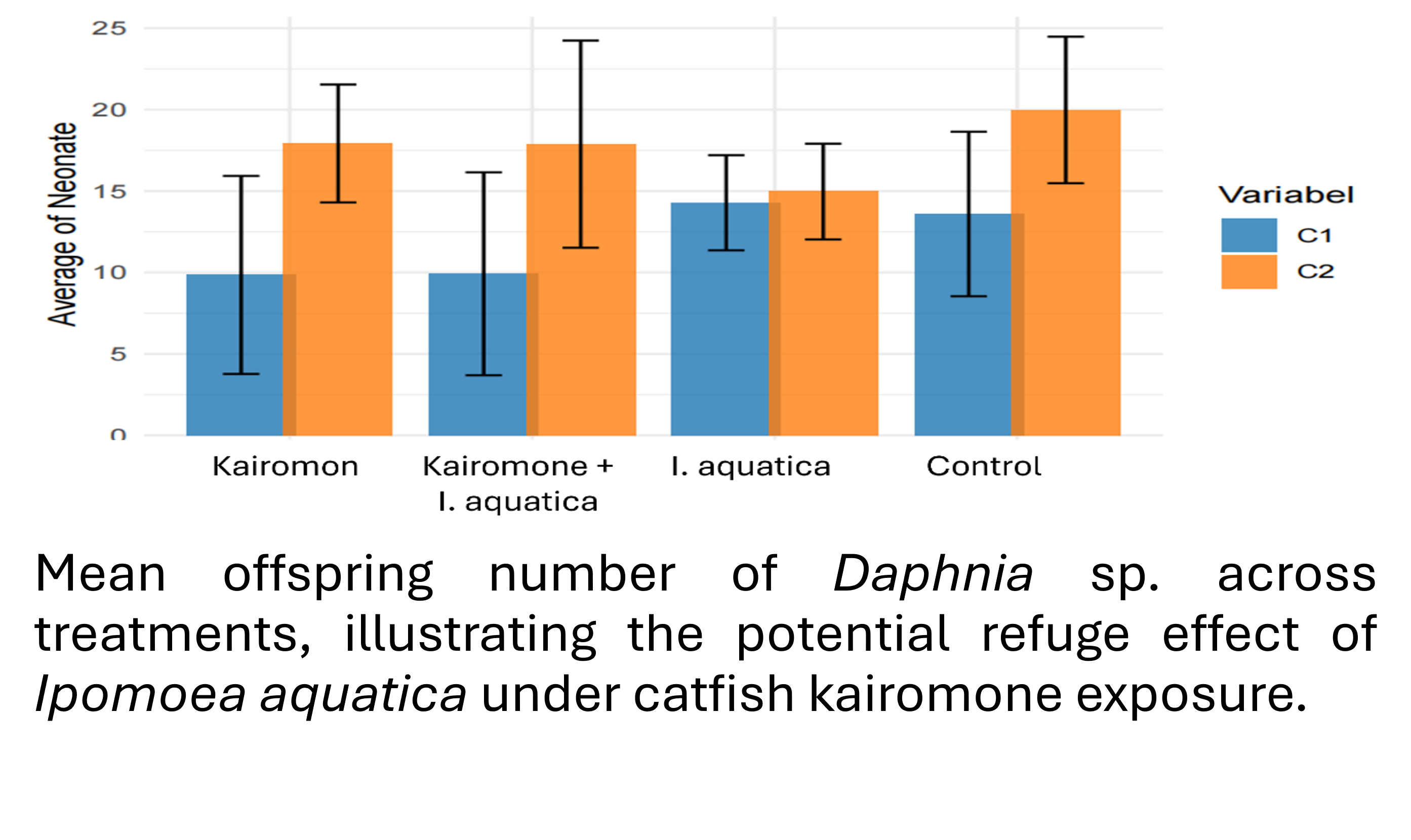
Zooplankton, particularly Daphnia sp., play a key role in aquatic food webs and exhibit strong life‑history plasticity in response to predation risk mediated by chemical cues (kairomones). Aquatic macrophytes such as water spinach (Ipomoea aquatica) are often assumed to provide refuge that may mitigate these effects. This study examined the influence of catfish (Clarias sp.) kairomones and the potential moderating role of I. aquatica on reproduction and survival of Daphnia sp. using an individual‑based bioassay with a randomized block design. Four treatments were applied: control, I. aquatica, kairomones, and kairomones + I. aquatica, observed in 15 days. Parameters measured included neonate number, age at first and second reproduction (AFR, ASR), Second Clutch/First Clutch ratio (C2/C1 ratio), and mortality. Kairomone exposure significantly reduced first‑clutch offspring production and delayed AFR, and induced compensatory reproduction in the second clutch, reflected by the highest C2/C1 ratios (K = 2.30; H = 2.11). Mortality was also highest in kairomone treatments (>42%). The presence of I. aquatica did not significantly mitigate kairomone effects and was associated with increased mortality relative to the control. These results indicate that chemical predator cues dominate over physical shelter in shaping Daphnia sp. life‑history strategies, with important implications for zooplankton dynamics in vegetated freshwater ecosystems.
References
Andersen, T., & Hessen, D.O. 2005. Ecology of Zooplankton in Freshwater Ecosystems. Springer.
Baludo, M. Y., Octorina, P., Beckerman, A., & Straile, D. 2024. Antipredator responses of three Daphnia species within the D. longispina species complex to two invertebrate predators. Ecology and Evolution, 14(1), e10841. https://doi.org/10.1002/ece3.10841
Burks, R. L. 2002. “Diel Horizontal Migration of Zooplankton: Costs and Benefits of Inhabiting the Littoral.” Freshwater Biology, vol. 47, no. 3hl m. 343–65. DOI.org (Crossref), https://doi.org/10.1046/j.1365-2427.2002.00824.x
De M, Roy C, Medda, Roy S, & Dey SR. 2019. Diverse role of Macrophytes in aquatic ecosystems: A brief review. International Journal of Experimental Research and Review, 19, 40–48. https://doi.org/10.52756/ijerr.2019.v19.005
Diel, P., Kiene, M., Martin- Creuzburg, D., & Laforsch, C. 2020. Knowing the enemy: Inducible defences in freshwater zooplankton. Diversity, 12, 147. https://doi.org/10.3390/d12040147
Diller, J. G. P., Hüftlein, F., Lücker, D., Feldhaar, H., & Laforsch, C.2023. Allelochemical run-off from the invasive terrestrial plant Impatiens glandulifera decreases defensibility in Daphnia. Scientific Reports, 13(1), 1207. https://doi.org/10.1038/s41598-023-27667-4
Dos Santos, N. G., Stephan, L. R., Otero, A., Iglesias, C., & Castilho-Noll, M. S. M. 2020. How free-floating macrophytes influence interactions between planktivorous fish and zooplankton in tropical environments? An in-lake mesocosm approach. Hydrobiologia, 847(5), 1357–1370. DOI: 10.1007/s10750-020-04194-1
El-Hady, H. A., & Khalifa, N. 2015. Phytoplankton biochemical contents and zooplankton composition in vegetated and non-vegetated regions in Bardawil Lagoon, North Sinai, Egypt. International Journal of Fisheries and Aquatic Studies. ISSN: 2347-5129 IJFAS 2015; 2(5): 46-54
Octorina P., Bohm A., Creuzburg DM., Straile D. 2022. Morphological defences and defence– cost trade- offs in Daphnia in response to two co- occurring invertebrate predators. Freshwater Biology. https://doi.org/10.1111/fwb.13888
Ogorelec, Ž., Wunsch, C., Kunzmann, A. J., Octorina, P., & Navarro, J. I. 2021. Large daphniids are keystone species that link fish predation and phytoplankton in trophic cascades. Fundamental and Applied Limnology, 194(4), 297–309. DOI: 10.1127/fal/2020/1344
Owsley, C. M., Neleigh, C. E., Vaughan, M. L., Castiglione, J. D., & Distel, C. A. 2017. Preliminary Report: Exotic armored catfish may reduce survival and growth of native amphibians. BIOS, 88(2), 86–91. https://doi.org/10.1893/BIOS-D-16-00005.1
Pietrzak, Barbara, et al. 2017. The Effect of Temperature and Kairomone on Daphnia Escape Ability: A Simple Bioassay. Hydrobiologia, vol. 798, no. 1. pp. 15–23. https://doi.org/10.1007/s10750-015-2539-z
Rabus, M., Söllradl, T., Clausen- Schaumann, H., & Laforsch, C. 2013. Uncovering ultrastructural defences in Daphnia magna— an interdisciplinary approach to assess the predator- induced fortification of the carapace. PLoS One, 8, e67856. https://doi.org/10.1111/j.1365-2435.2011.01840.x
Rajchard J. Kairomones - important substances in interspecific communication in vertebrates: a review. Veterinární medicína. 2013;58(11):561-566. doi: 10.17221/7137-VETMED
Stibor, H. 1992. Predator induced life-history shifts in a freshwater cladoceran. Oecologia, 92(2), 162–165. https://doi.org/10.1007/BF00317358
Thomaz, S.M. 2017. Macrophytes of aquatic ecosystems. Springer.
United States Environmental Protection Agency (USEPA). 1987. Procedure for Conducting Daphnia magna Toxicity Bioassay Prepare for The Office of Solid Waste. United States Environmental Protection Agency. Washington DC.
Van De Meutter, F.; Stoks, R.; De Meester, L. 2004. Behavioral linkage of pelagic prey and littoral predators: Microhabitat selection by Daphnia induced by damselfly larvae. Oikos, 107, 265–272.https://doi.org/10.1111/j.0030-1299.2004.13221.x
Wetzel RG. 2001. Limnology: Lake and River Ecosystems (3rd ed.). Academic Press.
Downloads
Published
Issue
Section
License
Copyright (c) 2026 Mochamad Haikal Haikal, Majariana Krisanti, Niken Tunjung Murti Pratiwi, Pelita Octorina

This work is licensed under a Creative Commons Attribution 4.0 International License.