Comparison of Chemical Oxygen Demand Removal Using Zeolite Adsorption and Floating Treatment Wetlands in Polluted River Water
DOI:
https://doi.org/10.55981/limnotek.2026.14185Keywords:
Zeolite, COD, Textile waste, Adsorption, FTW, Citarum RiverAbstract
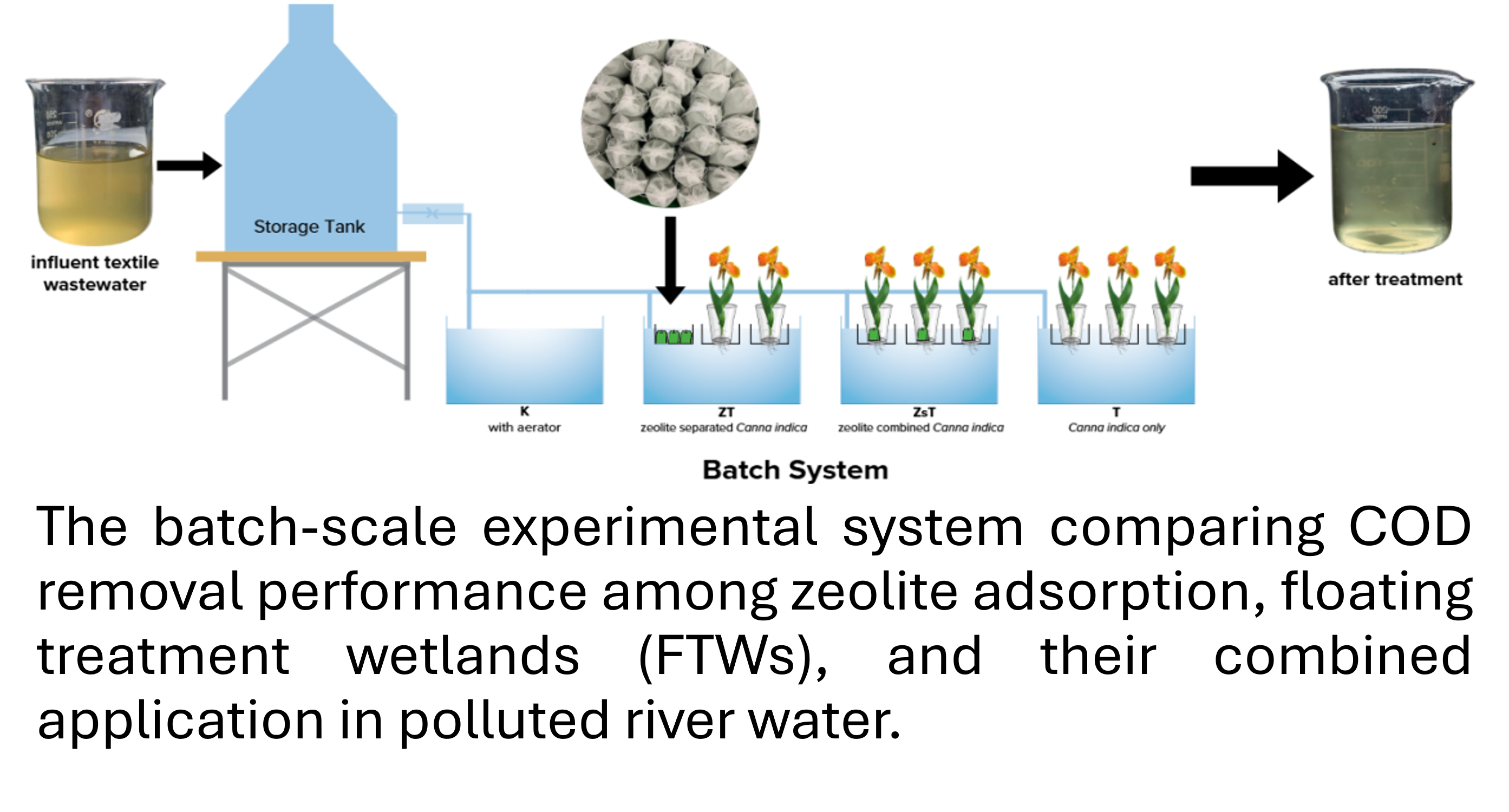
The Citarum River in Bandung, West Java, provides drinking water, irrigation, and industrial resources for the local community. However, the recent increase in textile industry activity has reduced water quality, with textile waste contributing significantly to organic pollution in tropical inland waters. Addressing these environmental challenges requires treatment technologies to protect public health and the integrity of the region's ecosystem. This study aims to evaluate the adsorption performance of natural zeolite using the tea bag method (laboratory scale) and investigate its integration with a floating treatment wetland (FTW) system planted with Canna indica (mini-pilot scale) to reduce chemical oxygen demand (COD) under tropical environmental conditions. Batch experiments were conducted using real textile wastewater with an initial COD concentration of approximately 752 mg/L to reflect actual pollution levels. The tea bag adsorption system showed a maximum COD reduction of 43%, while the integrated FTW system achieved a higher COD reduction of 48% after 24 days of operation. The enhanced performance of the FTW system relative to the tea bag system results from the combined effects of zeolite adsorption, microbial biodegradation, and improved oxygen transfer facilitated by the Canna indica root system. Experimental findings indicate that the integrated FTW system offers a sustainable, cost-effective, and nature-based approach for improving water quality in tropical inland waters affected by industrial pollution. Nevertheless, additional optimization is required to achieve compliance with regulatory discharge standards.
References
Abdissa D, Beyecha K. 2021. Sugarcane bagasse adsorption evaluation and application on BOD and COD removal from textile wastewater treatment. Water Conservation and Management 5: 30–34. DOI: 10.26480/wcm.01.2021.30.34
Ado BV, Dung PB, & Ichor T. 2025. Temperature and pH-Driven lipase dynamics of Penicillium spp. and Aspergillus niger for sustainable treatment of agro-industrial wastewater. South Asian Journal of Research in Microbiology 19: 76–92. DOI: 10.9734/sajrm/2025/v19i6444
Ahsanul BM, Nur FA, Prasetya, AN. 2024. Limbah tekstil berakibat pencemaran sungai di Desa Simbang Wetan Kecamatan Pekalongan Selatan Kota Pekalongan. Hexatech: Jurnal Ilmiah Teknik 3, 1. DOI: 10.55904/hexatech.v3i1.1266
Almadani, Mohammad. 2023. Adsorption process modeling to reduce COD by activated carbon for wastewater treatment. Chemosphere 339, 139691. DOI: 10.1016/j.chemosphere.2023.139691
Anh NT, Can LD, Nhan NT, Schmalz B, Luu T, Le. 2023. Influences of key factors on river water quality in urban and rural areas: A review. Case Studies in Chemical and Environmental Engineering 8, 100424. DOI: 10.1016/j.cscee.2023.100424
APHA. 2017. Standard Methods for the Examination of Water and Wastewater (23rd ed.). American Public Health Association.
Bhutiani R, Rai N, Sharma P, Rausa K, Ahamad F. 2019. Phytoremediation efficiency of water hyacinth (E. crassipes), canna (C. indica) and duckweed (L. minor) plants in treatment of sewage water. Environment Conservation Journal 20: 143–156. DOI: 10.36953/ECJ.2019.1008.1221
Castro CJ, Shyu HY, Xaba L, Bair R, Yeh DH. 2021. Performance and onsite regeneration of natural zeolite for ammonium removal in a field-scale non-sewered sanitation system. The Science of the Total Environment 776 (145938). DOI: 10.1016/j.scitotenv.2021.145938
Choong CE, Wong KT, Jang SB, Nah IW, Choi J, Ibrahim S, Yoon Y, Jang M. 2020. Fluoride removal by palm shell waste based powdered activated carbon vs. functionalized carbon with magnesium silicate: Implications for their application in water treatment. Chemosphere 239, 124765. DOI: 10.1016/j.chemosphere.2019.124765
Dehghani MH, Farhang M, Alimohammadi M, Afsharnia M, Mckay G. 2018. Adsorptive removal of fluoride from water by activated carbon derived from CaCl2-modified Crocus sativus leaves: Equilibrium adsorption isotherms, optimization, and influence of anions. Chemical Engineering Communications 205(7): 955–965. DOI: 10.1080/00986445.2018.1423969
Faulwetter JL, Burr MD, Cunningham AB, Stewart FM, Camper AK, Stein OR. 2011. Floating treatment wetlands for domestic wastewater treatment. Water Science and Technology: A Journal of the International Association on Water Pollution Research 64(10). DOI: 10.2166/wst.2011.576
Fito J, Said H, Feleke S, Worku A. 2019. Fluoride removal from aqueous solution onto activated carbon of Catha edulis through the adsorption treatment technology. Environmental Systems Research 8(1): 25. DOI: 10.1186/s40068-019-0153-1
Frank VB, Regnery J, Chan KE, Ramey DF, Spear JR, Cath TY. 2017. Co-treatment of residential and oil and gas production wastewater with a hybrid sequencing batch reactor-membrane bioreactor process. Journal of Water Process Engineering 17: 82–94. DOI: 10.1016/j.jwpe.2017.03.003
Fraser LH, Carty SM, Steer D. 2004. A test of four plant species to reduce total nitrogen and total phosphorus from soil leachate in subsurface wetland microcosms. Bioresource Technology 94: 185–192. DOI: 10.1016/j.biortech.2003.11.023
Hammer MJ, Mark J Hammer Jr. 2014. Water and Wastewater Technology. In Pearson Education Limited. DOI: www.perasoned.co.uk
Haydar S, Bari A, Student G. 2011. Characterization and study of correlations among major pollution parameters in textile wastewater. Mehran University Research Journal of Engineering & Technology 30 (4).
Hdidou M, Ncibi MC, Labille J, El Hajjaji S, Dhiba D, Chehbouni A, Roche N. 2022. Potential use of constructed wetland systems for rural sanitation and wastewater reuse in agriculture in the Moroccan context. DOI: 10.3390/en15010156
Ho QN, Hidaka T, Rahman MA, Yoshida N. 2024. Application of natural zeolite adsorption in cooperation with photosynthesis for the post-treatment of microbial fuel cells. RSC Adv 14: 26484–26493. DOI: 10.1039/D4RA04672B
Jamwal P, Raj AV, Raveendran L, Shirin S, Connelly S, Yeluripati J, Richards S, Rao L, Helliwell R, Tamburini M. 2021. Evaluating the performance of horizontal sub-surface flow constructed wetlands: A case study from southern India. Ecological Engineering 162, 106170. DOI: 10.1016/j.ecoleng.2021.106170
Khairuddin, Yamin M, Syukur A. 2019. Pelatihan tentang penggunaan ikan sebagai indikator dalam menentukan kualitas air sungai di Ampenan Tengah Mataram. Jurnal Pengabdian Magister Pendidikan IPA 2: 25–29. DOI: 10.29303/jpmpi.v1i2.244
Khandare RV, Kabra AN, Kadam AA, Govindwar SP. 2013. Treatment of dye containing wastewaters by a developed lab scale phytoreactor and enhancement of its efficacy by bacterial augmentation. International Biodeterioration & Biodegradation 78: 89–97. DOI: 10.1016/j.ibiod.2013.01.003
Li L, Yang Y, Tam NFY, Yang L, Mei XQ, Yang FJ. 2013. Growth characteristics of six wetland plants and their influences on domestic wastewater treatment efficiency. Ecological Engineering 60: 382–392. DOI: 10.1016/j.ecoleng.2013.09.044
Liang Y, Zhu H, Bañuelos G, Yan B, Shutes B, Cheng X, Chen X. 2017. Removal of nutrients in saline wastewater using constructed wetlands: plant species, influent loads and salinity levels as influencing factors. Chemosphere 187: 52–61. DOI: 10.1016/j.chemosphere.2017.08.087
Mahmoud E, Hammad W, Hakami O. 2020. Effect of water treatment residuals and cement kiln dust on COD adsorption and heavy metals from textile wastewater. Desalination and Water Treatment 205: 336–342. DOI: 10.5004/dwt.2020.26404
Malakar C, Chakraborty T, Roy S. 2023. Characterization and optimization of bacterial biofilm in secondary wastewater treatment. International Journal of Pharmaceutical Sciences Review and Research 81(1). DOI: 10.47583/ijpsrr.2023.v81i01.014
Molle P, Lienard A, Boutin C, Merlin G, Iwema A. 2005. How to treat raw sewage with constructed wetlands: an overview of the French systems. Water Science and Technology: A Journal of the International Association on Water Pollution Research 51: 11–21. DOI: pubmed.ncbi.nlm.nih.gov/16042238/
Monteagudo-Hernández G, Hernández-Castelán DA, Zamora-Lobato T, Sandoval-Herazo M, Hernández-Orduña MG, Sandoval Herazo LC. 2024. Evaluation of the pollutant removal efficiency of swine wastewater through two configurations of hybrid wetlands with tropical ornamental plants. Results in Engineering 24, 102864. DOI: 10.1016/j.rineng.2024.102864
Murti AHR, Novembrianto R, Rosariawari F, Ali M. 2021. The effect of pH values on suspended microorganisms growth in tofu wastewater treatment. NST Proceedings. DOI: 10.11594/nstp.2021.1429
Niazi L, Lashanizadegan A, Sharififard H. 2018. Chestnut oak shells activated carbon: Preparation, characterization and application for Cr (VI) removal from dilute aqueous solutions. Journal of Cleaner Production 185: 554–561. DOI: 10.1016/j.jclepro.2018.03.026
Ojstrsek A, Fakin D. 2011. Colour and TOC reduction using biofilter packed with natural zeolite for the treatment of textile wastewaters. Desalination and Water Treatment 33: 147–155. DOI: 10.5004/dwt.2011.2623
Oktaviyani D, Pratiwi NTM, Krisanti M, Susanti E. 2023. Floating treatment wetlands using Vetiveria zizanioides and Heliconia psittacorum in aquaculture wastewater treatment. IOP Conference Series: Earth and Environmental Science 1201(1), 12074. DOI: 10.1088/1755-1315/1201/1/012074
Oliveira GA, Colares GS, Lutterbeck CA, Dell’Osbel N, Machado EL, Rodrigues LR. 2021. Floating treatment wetlands in domestic wastewater treatment as a decentralized sanitation alternative. The Science of the Total Environment 773. DOI: 10.1016/j.scitotenv.2021.145609
Ramesh G, Goel M, Das A. 2017. A study on comparison of horizontal and vertical flow wetland system in treating domestic wastewater. International Journal of Civil Engineering and Technology 8: 1302–1310.
Rehman K, Ijaz A, Arslan M, Afzal M. 2019. Floating treatment wetlands as biological buoyant filters for wastewater reclamation. International Journal of Phytoremediation 21(13). DOI: 10.1080/15226514.2019.1633253
Rizzo L, Malato S, Antakyali D, Beretsou VG, Đolić MB, Gernjak W, Heath E, Ivancev-Tumbas I, Karaolia P, Lado Ribeiro AR, Mascolo G, McArdell CS, Schaar H, Silva AMT, Fatta-Kassinos D. 2019. Consolidated vs new advanced treatment methods for the removal of contaminants of emerging concern from urban wastewater. Science of The Total Environment 655: 986–1008. DOI: 10.1016/j.scitotenv.2018.11.265
Rohim MF, Samudro G, Sumiyati S. 2015. Pengaruh konsentrasi chemical oxygen demand (COD) dan pH terhadap kinerja dual chamber microbial fuel cells (Dcmcs). Jurnal Teknik Lingkungan 4: 1–10. DOI: 10.17605/OSF.IO/2CQH9
Sandoval L, Zamora-Castro SA, Vidal-Álvarez M, Marín-Muñiz JL. 2019. Role of wetland plants and use of ornamental flowering plants in constructed wetlands for wastewater treatment: a review. MDPI AG. DOI: 10.3390/app9040685
Sharma G, Priya, Brighu U. 2014. Performance analysis of vertical up-flow constructed wetlands for secondary treated effluent. APCBEE Procedia 10: 110–114. DOI: 10.1016/j.apcbee.2014.10.026
Skouteris G, Rodriguez-Garcia G, Reinecke SF, Hampel U. 2020. The use of pure oxygen for aeration in aerobic wastewater treatment: A review of its potential and limitations. Bioresource Technology 312, 123595. DOI: 10.1016/j.biortech.2020.123595
Spangler JT, Sample DJ, Fox LJ, Owen JS, White SA. 2019. Floating treatment wetland aided nutrient removal from agricultural runoff using two wetland species. Ecological Engineering 127: 468–479. DOI: 10.1016/j.ecoleng.2018.12.017
Stefanakis AI, Tsihrintzis VA. 2012. Effects of loading, resting period, temperature, porous media, vegetation and aeration on performance of pilot-scale vertical flow constructed wetlands. Chemical Engineering Journal 181: 16–430. DOI: 10.1016/j.cej.2011.11.108
Sumantri A, Rahmani RZ. 2020. Analisis pencemaran kromium (VI) berdasarkan kadar chemical oxygen demand (COD) pada hulu sungai Citarum di Kecamatan Majalaya Kabupaten Bandung Provinsi Jawa Barat 2018. Jurnal Kesehatan Lingkungan Indonesia 19: 144–151. DOI: 10.14710/jkli.19.2.144-151
Suyata, Irmanto. 2008. Penurunan BOD dan COD limbah cair industri tekstil di Kabupaten Pekalongan dengan metode multi soil layering. Molekul 3: 98–106. DOI: 10.20884/1.jm.2008.3.2.54
Tejeda A, Valencia-Botín AJ, Zurita F. 2022. Resistance evaluation of Canna indica, Cyperus papyrus, Iris sibirica, and Typha latifolia to phytotoxic characteristics of diluted tequila vinasses in wetland microcosms. International Journal of Phytoremediation 25: 1259–1268. DOI: 10.1080/15226514.2022.2145266
Titchou FE, Akbour RA, Assabbane A, Hamdani M. 2020. Removal of cationic dye from aqueous solution using Moroccan pozzolana as adsorbent: Isotherms, kinetic studies, and application on real textile wastewater treatment. Groundwater for Sustainable Development 11, 100405. DOI: 10.1016/j.gsd.2020.100405
Trein CM, Zumalacarregui JAG, Moraes M, von Sperling M. 2019. Reduction of area and influence of the deposit layer in the first stage of a full-scale French system of vertical flow constructed wetlands in a tropical area. Water Science and Technology: A Journal of the International Association on Water Pollution Research 80: 347–356. DOI: 10.2166/wst.2019.278
Trifando RY, Sutanto HB, Prihatmo G. 2022. The reducing of organic loading and phosphate (PO4) in domestic wastewater treatment by constructed wetland system using Canna indica and Cyperus. BIOLINK (Jurnal Biologi Lingkungan Industri Kesehatan) 9: 95–105. DOI: 10.31289/biolink.v9i1.6837
Wang J, Kong F, Li Y, Wang W, Wu H, Wang S. 2021. Enhancement of wastewater treatment under low temperature using novel electrochemical active biofilms constructed wetland. DOI: 10.2139/ssrn.3945382
Yang C, Zhang X, Tang Y, Jiang Y, Xie S, Zhang Y, Qin Y. 2022. Selection and optimization of the substrate in constructed wetland: A review. Journal of Water Process Engineering 49, 103140. DOI: 10.1016/j.jwpe.2022.103140
Yang Q, Chen ZH, Zhao JG, Gu BH. 2007. Contaminant removal of domestic wastewater by constructed wetlands: Effects of plant species. Journal of Integrative Plant Biology 49: 437–446. DOI: 10.1111/j.1744-7909.2007.00389.x
Yugi Prasetyo P, Manu Rohmiyati S, Andayani N, Budi Pustika A, Widyayanti S, Widodo S. 2024. Pengaruh Pemberian Zeolit terhadap Kualitas Beberapa Varietas Padi (Oryza sativa L.). Agroforetech, 2.
Zhang J, Wu H, Hu Z, Liang S, Fan J. 2014. Examination of oxygen release from plants in constructed wetlands in different stages of wetland plant life cycle. Environmental Science and Pollution Research 21: 9709–9716. DOI: 10.1007/s11356-014-2905-9
Zhang Q, Qin S, Yuan C, Chen W. 2023. A novel biofilm reactor startup with HN-AD bacteria inoculation for high ammonia-salt wastewater treatment: performance, microbial characteristics and salt-tolerant mechanism. DOI: 10.2139/ssrn.4576087
Zhang T, Yu Y, Lu Y, Tang H, Chen, K, Shi J, Ren Z, Wu S, Xia D, Zheng Y. 2026. Bridging biodegradable metals and biodegradable polymers: a comprehensive review of biodegradable metal–organic frameworks for biomedical application. In Progress in Materials Science. Elsevier Ltd. DOI: 10.1016/j.pmatsci.2025.101526
Zhang Z, Rengel Z, Meney K. 2007. Removal of nutrients from secondary-treated municipal wastewater in wetland microcosms using ornamental plant species. International Journal of Environment and Waste Management 1: 363–375. DOI: 10.1504/IJEWM.2007.015689
Zhu H, Zhou Q, Yan B, Liang Y, Yu X, Gerchman Y, Cheng X. 2017. Influence of vegetation type and temperature on the performance of constructed wetlands for nutrient removal. Water Science and Technology 77: 829–837. DOI: 10.2166/wst.2017.556
Zulti F, Prihatinningtyas E, Susanti E, Syafutra H. 2025. Scalable wastewater treatment: performance of zeolite and bentonite in a fixed-bed reactor for textile effluents. Journal of Water Process Engineering 71, 107349. DOI: 10.1016/j.jwpe.2025.107349
Downloads
Published
Issue
Section
License
Copyright (c) 2026 Fifia zulti, Chrisantha , Rifka

This work is licensed under a Creative Commons Attribution 4.0 International License.