Assessing Data Quality in Real-Time River Water Quality Monitoring using Multi-Parameter Indicators: A Case Study of Ciliwung and Cisadane, Indonesia
DOI:
https://doi.org/10.55981/limnotek.2026.14216Keywords:
River water quality monitoring, Internet of Things (IoT), Online data quality evaluation, Data quality assessment, Data governance, Stability indexAbstract
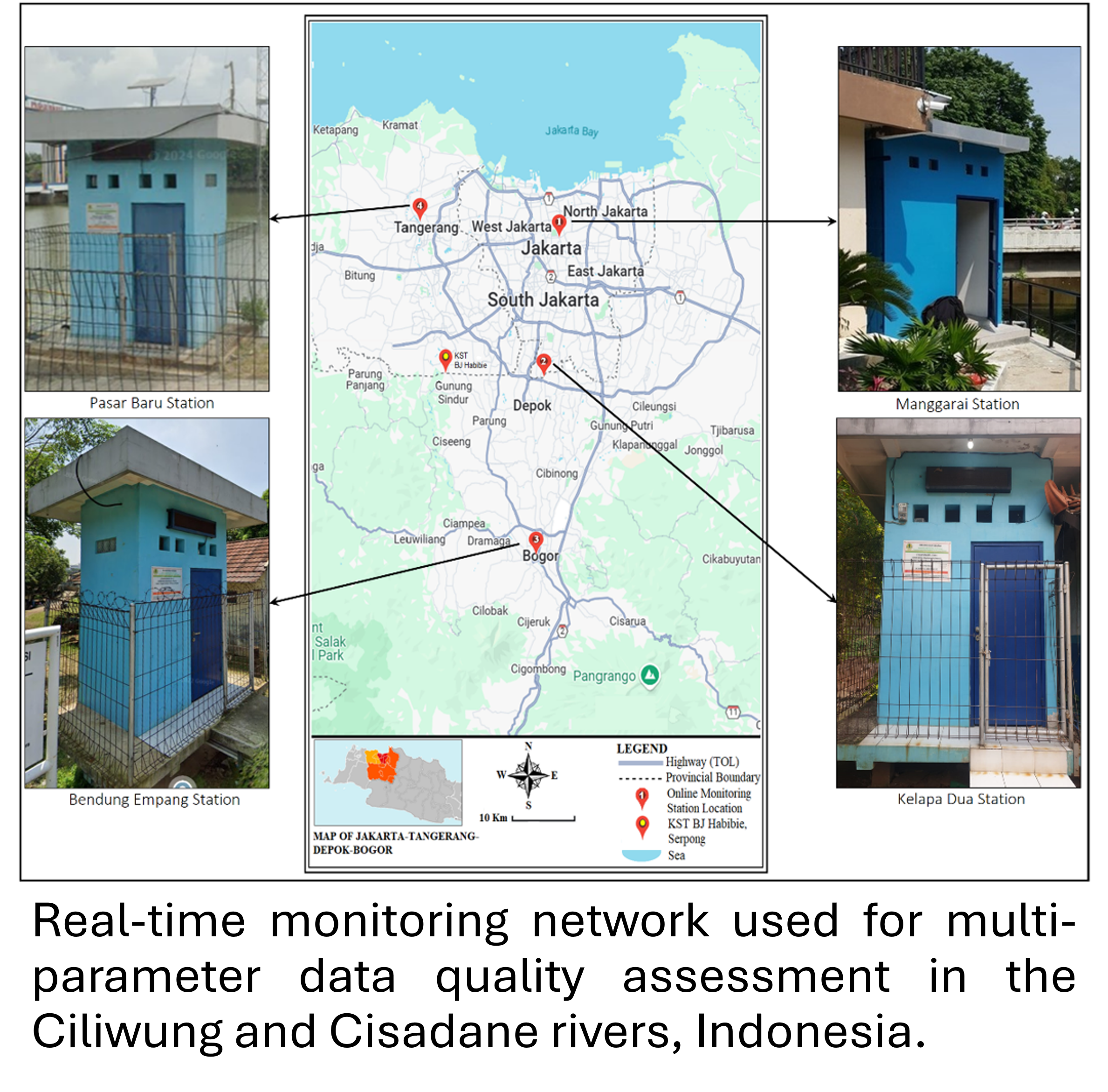
Water pollution has become a complex environmental challenge in rapidly urbanizing Southeast Asia. Indonesia has deployed over 347 online river water quality monitoring stations (ORWQM) in several watersheds to provide real-time data for pollution control and informed ecological decision-making. However, problems have arisen with some of the longstanding stations, including equipment degradation, data loss, sensor malfunctions, and inconsistencies, raising concerns about the reliability of these datasets. This study aims to address these issues by using a hybrid Total Data Quality Management (TDQM), Online Data Quality Evaluation Model (ODQEM) framework to evaluate and improve the data quality at four stations (Manggarai, Kelapa Dua, Pasar Baru, and Empang Dam) representing the upstream and downstream areas of the Ciliwung and Cisadane Rivers. The workflow consists of four steps: (i) defining the relevant data quality dimensions; (ii) measuring data quality using completeness index, range validity, accuracy, uniqueness, and stability index; (iii) analyzing cross-parameter and cross-station patterns to identify potential failure modes and governance gaps; and (iv) translating findings into targeted calibration, cleaning, and maintenance actions. The results show strong structural integrity; completeness indicators reach 100%, and uniqueness exceeds 99.9%, indicating robust acquisition and temporal consistency. However, functional reliability varies widely across parameters and station locations. Completeness indicators for non-zero values show systematic zero values for the DO probe (1.02%) and nitrate (0.19%) at Empang Dam Station; TDS (9.57%) at Pasar Baru Station; ammonia (60.02%) at Kelapa Dua Station. Overall stability is high for physical probes (temperature, pH), but low for chemical/ion probes at some stations (salinity 1.47%–6.62%; TDS 5.49%–10.92%; ammonia 30.20%–71.40%). Ion sensors also show higher risks, including low validity or accuracy for nitrate at Kelapa Dua Station (61.67%). These findings indicate that the dataset appears complete and valid, but still contains substantial functional uncertainty due to several zero-value parameters and unstable sensor behavior. Because the evaluation is limited to four stations, these findings should be interpreted as an in-depth case study rather than a complete representation of the ORWQM network in Indonesia. The proposed TDQM–ODQEM Data Governance Model offers a replicable method for improving online and real-time environmental monitoring, helping bridge the gap between technological performance and policy design in sustainable river management.
References
Adu-Manu, K. S., Katsriku, F. A., Abdulai, J. D., & Engmann, F. (2020). Smart River Monitoring Using Wireless Sensor Networks. Wireless Communications and Mobile Computing, 2020. https://doi.org/10.1155/2020/8897126
Batini, C., Cappiello, C., Francalanci, C., & Maurino, A. (2009). Methodologies for data quality assessment and improvement. ACM Computing Surveys, 41(3). https://doi.org/10.1145/1541880.1541883
Batini, C., & Scannapieco, M. (2016). Data and Information Quality. Springer International Publishing. https://doi.org/10.1007/978-3-319-24106-7
Behmel, S., Damour, M., Ludwig, R., & Rodríguez, M. J. (2016). Water quality monitoring strategies—A review and future perspectives. Science of the Total Environment, 571, 1312–1329. http://dx.doi.org/10.1016/j.scitotenv.2016.06.235
Bowo, W. A., Ma’mun, S., Suhanto, A., Hidayanto, A. N., Naisuty, M., & Habsari, I. C. (2019). Data Quality Assessment: A Case Study of PT JAS Using TDQM Framework. https://doi.org/doi:10.1109/ICIC47613.2019.8985896.
Bushnell, M., Toll, R., & Worthington, H. (2015). Manual for real-time quality control of dissolved oxygen observations: a guide to quality control and quality assurance for dissolved oxygen observations in coastal oceans. https://doi.org/10.7289/V5ZW1J4J
Bushnell, M., & Worthington, H. (2016). Manual for real-time quality control of in-situ temperature and salinity data: a guide to quality control and quality assurance for in-situ temperature and salinity observations. https://doi.org/10.7289/V5V40SD4
BPPT (2015). Final Report: Installation of Online System Monitoring Devices at Ciliwung (2 Points) and Citarum (1 Point). Technology Service Center / BPPT Engineering, Agency for the Assessment and Application of Technology, Jakarta.
Cahyono, S. H., Sucahyo, Y. G., Raya, J. S., & Pusat, J. (2020). Pengukuran Kualitas Data Menggunakan Framework Total Data Quality Management (TDQM): Studi Kasus Sistem Informasi Beasiswa Universitas Indonesia. Jurnal Ilmu Pengetahuan Dan Teknologi Komunikasi, 22(2), 193–206. https://doi.org/10.33164/iptekkom.22.2.2020.193-206
Chapman, D. V. (1996). Water quality assessments: a guide to the use of biota, sediments and water in environmental monitoring (No. 17872). E & FN Spon. https://iris.who.int/bitstream/handle/10665/41850/0419216006_eng.pdf
Daniel, A., Laës-Huon, A., Barus, C., Beaton, A. D., Blandfort, D., Guigues, N., ... & Achterberg, E. P. (2020). Toward a harmonization for using in situ nutrient sensors in the marine environment. Frontiers in Marine Science, 6, 773. https://doi.org/10.3389/fmars.2019.00773
Ehrlinger, L., & Wöß, W. (2022). A Survey of Data Quality Measurement and Monitoring Tools. In Frontiers in Big Data (Vol. 5). Frontiers Media S.A. https://doi.org/10.3389/fdata.2022.850611
IEC. (2024). ISO/IEC 30141:2024. Internet of things (IoT) – Reference architecture. https://standards.iteh.ai/catalog/standards/iso/d571f944-575e-49b2-a919-39a721ff7209/iso-iec-30141-2024
Karkouch, A., Mousannif, H., Al Moatassime, H., & Noel, T. (2016). Data quality in internet of things: A state-of-the-art survey. In Journal of Network and Computer Applications (Vol. 73, pp. 57–81). Academic Press. https://doi.org/10.1016/j.jnca.2016.08.002
Kaur, R., Chana, I., & Bhattacharya, J. (2018). Data deduplication techniques for efficient cloud storage management: a systematic review. Journal of Supercomputing, 74(5), 2035–2085. https://doi.org/10.1007/s11227-017-2210-8
KLHK. (2024). Laporan Kinerja Direktorat Pengendalian Pencemaran Air. https://www.scribd.com/document/891351611/Ditjen-PPKL-2024-L-Rev1-compressed
Klein, A. and Lehner, W. (2009). Representing data quality in sensor data streaming environments. ACMJ. Data Inform. Quality 1, 2, Article 10 (September 2009), 28 pages. DOI =10.1145/1577840.1577845.
Li, X. T., Zhai, J., Zheng, G. F., & Yuan, C. F. (2018). Quality assessment for open government data in China. In Proceedings of the 2018 10th International Conference on Information Management and Engineering (pp. 110–114). https://doi.org/10.1145/3285957.3285962
Lin, L., Yang, H. & Xu, X. (2022). Effects of Water Pollution on Human Health and Disease Heterogeneity: A Review. Front. Environ. Sci. 10:880246. https://doi.org/10.3389/fenvs.2022.880246
Lucas, L. V., Brown, C. J., Robertson, D. M., Baker, N. T., Johnson, Z. C., Green, C. T., Cho, S. J., Erickson, M. L., Gellis, A. C., Jasmann, J. R., Knowles, N., Prein, A. F., & Stackelberg, P. E. (2025). Gaps in Water Quality Modeling of Hydrologic Systems. Water, 17(8), 1200. https://doi.org/10.3390/w17081200
Luna Juncal, M. J., Skinner, T., Bertone, E., & Stewart, R. A. (2020). Development of a real-time, mobile nitrate monitoring station for high-frequency data collection. Sustainability, 12(14), 5780. https://doi.org/10.3390/su12145780
Mahmud, M. P., Ejeian, F., Azadi, S., Myers, M., Pejcic, B., Abbassi, R., ... & Asadnia, M. (2020). Recent progress in sensing nitrate, nitrite, phosphate, and ammonium in aquatic environment. Chemosphere, 259, 127492.https://doi.org/10.1016/j.chemosphere.2020.127492
Mansouri, T., Reza, M., Moghadam, S., & Zareravasan, A. (2023). IoT Data Quality Issues and Potential Solutions: A Literature Review. The Computer Journal, 66(3), 615–625. DOI: 10.1093/comjnl/bxab183
Meyer, A. M., Klein, C., Fünfrocken, E., Kautenburger, R., & Beck, H. P. (2019). Real-time monitoring of water quality to identify pollution pathways in small and middle scale rivers. Science of the Total Environment, 651, 2323–2333. https://doi.org/10.1016/j.scitotenv.2018.10.069
Mohamed, A., Nik, A., Kadir, A., Lin, M.-, Rahman, S. A., & Arshad, N. H. (2009). Data completeness analysis in the Malaysian Educational Management Information System. In International Journal of Education and Development using Information and Communication Technology (Vol. 5, Issue 2). https://www.learntechlib.org/p/188080/
Pezoulas, V. C., Kourou, K. D., Kalatzis, F., Exarchos, T. P., Venetsanopoulou, A., Zampeli, E., Gandolfo, S., Skopouli, F., De Vita, S., Tzioufas, A. G., & Fotiadis, D. I. (2019). Medical data quality assessment: On the development of an automated framework for medical data curation. Computers in Biology and Medicine, 107, 270–283. https://doi.org/10.1016/j.compbiomed.2019.03.001
Pipino, L. L., Lee, Y. W., Wang, R. Y., & Yang, R. Y. (2002). Data Quality Assessment (Communications of the ACM, Vol. 45, Issue 4 pages 211-218). https://doi.org/10.1145/505248.506010
Qartod.(2018). Manual for Real-Time Quality Control of Stream Flow Observations, U.S. Integrated Ocean Observing System (IOOS). DOI : https://doi.org/10.25923/gszc-ha43
Qin, Y., Sheng, Q. Z., Falkner, N. J. G., Dustdar, S., Wang, H., & Vasilakos, A. V. (2016). When things matter: A survey on data-centric internet of things. Journal of Network and Computer Applications, 64, 137–153. https://doi.org/10.1016/j.jnca.2015.12.016
Ramirez, G., Fuentes, O., & Tweedie, C. E. (2011, March). Assessing data quality in a sensor network for environmental monitoring. In 2011 Annual Meeting of the North American Fuzzy Information Processing Society (pp. 1-6). IEEE. DOI: 10.1109/NAFIPS.2011.5752010
Redman, T. C. (2005). Measuring data accuracy a framework and review. https://www.researchgate.net/publication/292332376_Measuring_data_accuracy_A_framework_and_review
Rinn, P., Boruta, F., Czermak, P., & Ebrahimi, M. (2025). Fouling Control of Ion-Selective Electrodes (ISEs) in Aquatic and Aquacultural Environments: A Comprehensive Review. Sensors, 25(24), 7515. https://doi.org/10.3390/s25247515
Saboe, D. (2022). Monitoring Key Water Quality Parameters in Water Resources Systems Using Bioactive Electrodes (Doctoral dissertation, Arizona State University). https://www.proquest.com/openview/c74b150c093c032a1ca5408edfc69f45/1?pqorigsite=gscholar&cbl=18750&diss=y
Samuelsson, O., Björk, A., Zambrano, J., & Carlsson, B. (2018). Fault signatures and bias progression in dissolved oxygen sensors. Water Science and Technology, 78(5), 1034–1044. https://doi.org/10.2166/wst.2018.350
Soares, A. L. C., Pinto, C. C., & Oliveira, S. C. (2020). Impacts of anthropogenic activities and calculation of the relative risk of violating surface water quality standards established by environmental legislation: a case study from the Piracicaba and Paraopeba river basins, Brazil. Environmental Science and Pollution Research, 27(12), 14085–14099. https://doi.org/10.1007/s11356-020-07647-1
Sulthonuddin, I., Hartono, D. M., Abidin Said, C. A., & Utomo, S. W. (2019). River Water Pollution Indication in the Cimanuk River Downstream, Indramayu District. IOP Conference Series: Earth and Environmental Science, 239(1). https://doi.org/10.1088/1755-1315/239/1/012010
Snyder, L., Potter, J. D., & McDowell, W. H. (2018). An evaluation of nitrate, fDOM, and turbidity sensors in New Hampshire streams. Water Resources Research, 54(3), 2466–2479. https://doi.org/10.1002/2017WR020678Digital Object Identifier Talagala,
Teh, H. Y., Kempa-Liehr, A. W., & Wang, K. I. K. (2020). Sensor data quality: a systematic review. In Journal of Big Data (Vol. 7, Issue 1). Springer Science and Business Media Deutschland GmbH. https://doi.org/10.1186/s40537-020-0285-1
Tena, D., Penarrocha-Alós, I., Sanchis, R., & Moliner-Heredia, R. (2020). Ammonium Sensor Fault Detection in Wastewater Treatment Plants. In ICINCO (pp. 681-688). DOI: 10.5220/0009875406810688
U.S. EPA (2018). Online Water Quality Monitoring in Distribution Systems. https://share.google/SzANXckRwU2f6KrDq
Wang, R. Y. (1998). A Product Perspective on Total Data. In COMMUNICATIONS OF THE ACM (Vol. 41, Issue 2). https://doi.org/10.1145/269012.269022
Wang Richard Y & Strong Diane M. (1996). Beyond accuracy: What data quality means to data consumers. Journal of Management Information Systems, 12(4), 5–34. https://doi.org/10.1080/07421222.1996.11518099
Wei, Y., Jiao, Y., An, D., Li, D., Li, W., & Wei, Q. (2019). Review of dissolved oxygen detection technology: From laboratory analysis to online intelligent detection. In Sensors (Switzerland) (Vol. 19, Issue 18). MDPI AG. https://doi.org/10.3390/s19183995
Wijayanti, W., Hidayanto, A. N., Wilantika, N., Adawati, I. R., & Yudhoatmojo, S. B. (2018). Data Quality Assessment on Higher Education: A Case Study of Institute of Statistics. DOI: 10.1109/ISRITI.2018.8864476
Yang, P., Li, Z., Yu, Y., Shi, J., & Sun, M. (2021). Studies on fault diagnosis of dissolved oxygen sensor based on GA-SVM. Mathematical Biosciences and Engineering, 18(1), 386–399. doi: 10.3934/mbe.2021021
Zhang, L., Jeong, D., & Lee, S. (2021). Data quality management in the internet of things. In Sensors (Vol. 21, Issue 17). MDPI AG. https://doi.org/10.3390/s21175834
Zhang, Y., & Thorburn, P. J. (2022). Handling missing data in near real-time environmental monitoring: A system and a review of selected methods. Future Generation Computer Systems, 128, 63–72. https://doi.org/10.1016/j.future.2021.09.033
Zhang, X., Ma, L., Zhu, Y., Lou, W., Xie, B., Sheng, L., ... & Gu, Q. (2022). Temporal stability analysis for the evaluation of spatial and temporal patterns of surface water quality. Water Resources Management, 36(4), 1413–1429. https://doi.org/10.1007/s11269-022-03090-8
Downloads
Published
Issue
Section
License
Copyright (c) 2026 Satmoko Yudo, Dwi Nowo Martono, Dwita Sutjiningsih, Budi Kurniawan

This work is licensed under a Creative Commons Attribution 4.0 International License.