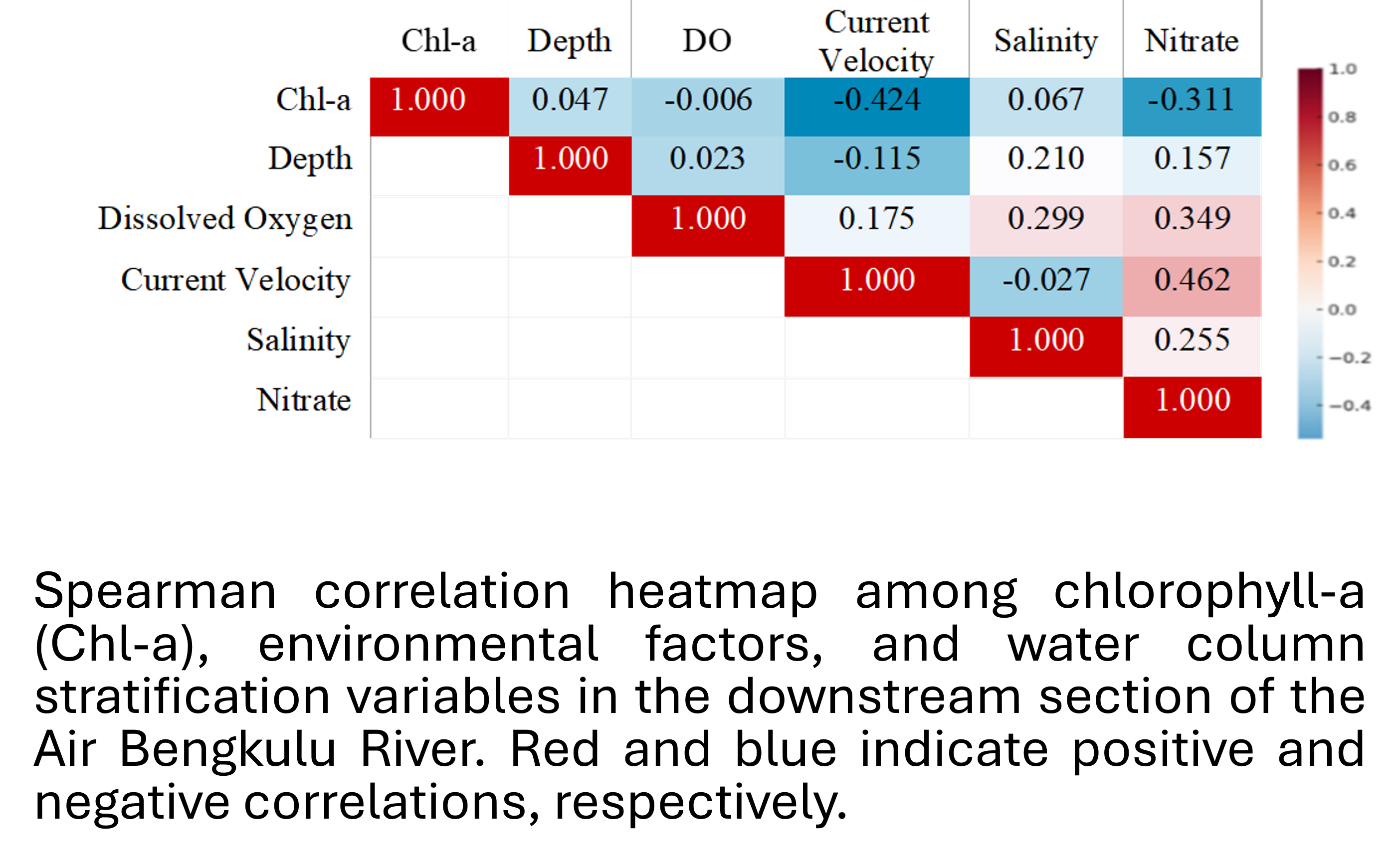
Vertical Distribution of Chl-a in Relation to Environmental Factors and Water Column Stratification in the Downstream Section of the Air Bengkulu River
DOI:
https://doi.org/10.55981/limnotek.2026.15445Keywords:
Chl-a, Ecosystem productivity, Tropical estuary, Photosynthetic rate, Phytoplankton biomassAbstract
The Bengkulu Watershed, which spans two administrative districts, plays a crucial role in supporting ecological and socio-economic functions in Bengkulu Province, Indonesia. Its main river, the Air Bengkulu, has experienced environmental pressures from land conversion, coal mining activities, domestic waste discharge, and industrial effluents, which may alter downstream water quality and disrupt estuarine ecological processes, including primary productivity. Historically, the adjacent coastal area was utilized by local fishers as a fishing ground in the early 2000s, but this function has since declined. However, studies on the ecological implications of these pressures on phytoplankton production in the Air Bengkulu estuary remain limited. This study aimed to assess phytoplankton productivity using Chl-a concentration as a proxy and examine its relationship with key environmental parameters. Fieldwork was conducted during the peak dry season from June to August 2025, with two sampling sessions per event in the morning and afternoon under spring tide conditions. Observations were carried out at three stations on three sampling events with measurements taken at three depth levels. Salinity, current velocity, dissolved oxygen, and nitrate concentration were measured at all depths, while temperature, pH, and water transparency were limited to surface levels. Chlorophyll-a (Chl-a) concentration was analyzed using spectrophotometric methods and its relationship with environmental parameters was evaluated using correlation analysis and quantile regression. The results showed that Chl-a concentrations were consistently very low across stations, ranging from 0.025 to 0.139 µg/L, indicating ultra-microtrophic to oligotrophic conditions. Among the measured parameters, nitrate concentration and current velocity exhibited the strongest relationships with Chl-a, suggesting their role as primary limiting factors, while other parameters showed comparatively weaker influences. These findings indicate that low nutrient availability and hydrodynamic conditions constrain phytoplankton biomass development and primary productivity in the Air Bengkulu River estuary, potentially limiting its capacity to sustainably support the food web.
References
BMKG. 2025. Data curah hujan harian wilayah Bengkulu (Juni–Agustus 2025). Badan Meteorologi, Klimatologi, dan Geofisika. Accessed 26 April 2026, https://dataonline.bmkg.go.id/data-harian
Balai Penelitian Tanah. 2005. Petunjuk Teknis Analisis Kimia Tanah, Tanaman, Air dan Pupuk. in Bahasa
Belladona M. 2017. Analisis Tingkat Pencemaran Sungai Akibat Limbah Industri Karet di Kabupaten Bengkulu Tengah. Jurnal Universitas Muhammadiyah Jakarta. in Bahasa
BMKG Provinsi Bengkulu. 2025. Buku Prediksi Musim Kemarau 2025/06 Provinsi Bengkulu. in Bahasa
BPDAS Ketahun. 2024. Laporan Monitoring dan Evaluasi Daerah Aliran Sungai Bengkulu tahun 2024. in Bahasa
Cereja R, Brotas V, Cruz JPC, Rodrigues M, Brito AC. 2021. Tidal and Physicochemical Effects on Phytoplankton Community Variability at Tagus Estuary (Portugal). Frontiers in Marine Science 8:1-21 https://doi.org/10.3389/fmars.2021.675699
Cloern JE, Foster SQ, Kleckner AE. 2014. Phytoplankton primary production in the world’s estuarine-coastal ecosystems. Biogeosciences 11(9):2477–2501. https://doi.org/10.5194/bg-11-2477-2014 in Bahasa
Dahuri R. 2003. Keanekaragaman Hayati Laut; Aset Pembangunan Berkelanjutan Indonesia. PT Gramedia Pustaka Utama. in Bahasa
Damar A, Colijn F, Hesse KJ, Kurniawan F. 2020. Coastal phytoplankton pigments composition in three tropical estuaries of Indonesia. Journal of Marine Science and Engineering 8(5). https://doi.org/10.3390/JMSE8050311
Dinas Lingkungan Hidup Kota Bengkulu. 2023. Laporan Pemantauan Kualitas Sungai dan Danau Tahun 2023. in Bahasa
Domingues RB, Barbosa AB. 2023. Evaluating Underwater Light Availability for Phytoplankton: Mean Light Intensity in the Mixed Layer versus Attenuation Coefficient. Water (Switzerland) 15(16). https://doi.org/10.3390/w15162966
Effendi, H. 2003. Telaah Kualitas Air Bagi Pengelolaan Sumber Daya Alam dan Lingkungan. Kanisius. in Bahasa
EPA. 1997. Method 446.0 - In Vitro Determination of Chlorophylls a, b, c1+c2 and Pheopigments in Marine and Freshwater Algae by Visible Spectrophotometry. EPA: Cincinnati, OH
EPA. 2000. Guidance for Data Quality Assessment: Practical Methods for Data Analysis: EPA QA/G9: QA00 Update: July 2000. EPA: Washington DC
EPA. 2023. Indicators: Phytoplankton. Accessed 9 June 2026, https://www.epa.gov/national-aquatic-resource-surveys/indicators-phytoplankton
Gall M, Pinkerton M. 2024. Phytoplankton/chlorophyll a in estuary/coastal water (trophic state). In D. Lohrer et al. (Eds.), Information Stocktakes of Fifty-Five Environmental Attributes across Air, Soil, Terrestrial, Freshwater, Estuaries and Coastal Waters Domains. (NIWA Report No. 2024216HN; Project MFE24203). Ministry for the Environment, New Zealand.
Gall M, Zeldis J, Safi K, Wood S, Pinkerto, M. 2023. Vertical stratification of phytoplankton biomass in a deep estuary site: implications for satellite-based net primary productivity. Frontiers in Marine Science, 10. https://doi.org/10.3389/fmars.2023.1250322
Gonçalves-Araujo R, Markager S. 2020. Light in the Dark: Retrieving Underwater Irradiance in Shallow Eutrophic Waters From AC-S Measurements. Frontiers in Marine Science, 7. https://doi.org/10.3389/fmars.2020.00343
González-Ramírez J, Parés-Sierra A, Cepeda-Morales J. 2023. Chlorophyll response to wind and terrestrial nitrate in the western and southern continental shelves of the Gulf of Mexico. Frontiers in Marine Science 10. https://doi.org/10.3389/fmars.2023.1034638
Hasibuan, G, Johan Y, Brata B. 2020. Kajian Kedudukan Garis Pantai Untuk Penetapan Sempadan Pantai Kota Bengkulu. Naturalis – Jurnal Penelitian Pengelolaan Sumberdaya Alam dan Lingkungan 9(2): 119–131. in Bahasa
Jeffrey SW, Humphrey GF. 1975. New spectrophotometric equations for determining chlorophylls a, b, c₁ and c₂ in higher plants, algae and natural phytoplankton. Biochemie Und Physiologie Der Pflanzen: 191–194.
Junior, OC. 2025. Estuary: A systems perspective. Estuarine Management and Technologies 2: 43–70. https://doi.org/10.3897/emt.2.158168
Kirk JTO. 2011. Light and photosynthesis in aquatic ecosystems. Cambridge University Press.
Lancelot C, Muylaert K. 2011. Trends in Estuarine Phytoplankton Ecology. In E. Wolanski and McLusky. D (Eds.), Treatise on Estuarine and Coastal Science, 5–15. Academic Press. https://doi.org/10.1016/b978-0-12-374711-2.00703-8
Lionard M, Muylaert K, Van Gansbeke D, Vyverman W. 2005. Influence of changes in salinity and light intensity on growth of phytoplankton communities from the Schelde river and estuary (Belgium/The Netherlands). Hydrobiologia 540(1–3): 105–115. https://doi.org/10.1007/s10750-004-7123-x
Lupiola J, Bárcena J, García-Alba J, García A. 2025. Characteristics and driving mechanisms of mixing and stratification in Suances estuary using the potential energy anomaly budget equation. Frontiers in Marine Science 12. https://doi.org/10.3389/fmars.2025.1531684
Mallin M, Paerl HW, Rudek J, Bates P. 1993. Regulation of estuarine primary production by watershed rainfall and river flow. Marine Ecology Progress Series 93: 199–203.
Nasution A, Widyorini N, Purwanti F. 2019. Analisis Hubungan Kelimpahan Fitoplankton dengan Kandungan Nitrat dan Fosfat di Perairan Morosari, Demak. Journal of Maquares 8(2): 78. https://ejournal3.undip.ac.id/index.php/maquares/article/view/24230/0 in Bahasa
Neun S, Hintz NH, Schröder M, Striebel M. 2022. Phytoplankton Response to Different Light Colors and Fluctuation Frequencies. Frontiers in Marine Science, 9. https://doi.org/10.3389/fmars.2022.824624
Nontji, A. (2008). Plankton Laut. Lembaga Ilmu Pengetahuan Indonesia Press. in Bahasa
Orizar IDS, Repetti SI, Lewandowska AM, Dolan J. 2024. Phytoplankton stoichiometry along the salinity gradient under limited nutrient and light supply. Journal of Plankton Research 46(4): 387–397. https://doi.org/10.1093/plankt/fbae031
Pareke J, Putra D. 2014. Model penyelesaian konflik kewenangan dalam hal timbulnya dampak dumping limbah batu bara: studi kasus pada Pemerintah Kota Bengkulu dengan Pemerintah Kabupaten Bengkulu Tengah. Padjadjaran Jurnal Ilmu Hukum 1(2): 301–321. in Bahasa
Purnaini R, Purwono S. 2018. Pengaruh Pasang Surut Terhadap Sebaran Salinitas Sungai Kapuas Kecil. In Jurnal Teknologi Lingkungan Lahan Basah 01(2): 21-29. in Bahasa
Rasyid A, Purnama D, Kusuma A. 2018. Pemanfaatan Fitoplankton Sebagai Bioindikator Kualitas Air Di Perairan Muara Sungai Hitam Kabupaten Bengkulu Tengah Provinsi Bengkulu. Jurnal Enggano 3(1): 39–51. in Bahasa
Reseck, J, Lepera, M (ed). 1988. Marine Biology 2nd edition. Prentice-Hall, Inc.
Rey F, Aminot A. 2002. Standard procedure for the determination of chlorophyll a by spectroscopic methods. ICES Techniques in Marine Environmental Sciences. Bergen, Norway. https://www.researchgate.net/publication/242385183
Steidle L, Vennell R. 2023. Phytoplankton Retention Mechanisms in Estuaries: A Case Study of the Elbe Estuary. EGUsphere. https://doi.org/10.5194/egusphere-2023-2231
Stumpner EB, Bergamaschi BA, Kraus TEC, Parker AE, Wilkerson FP, Downing BD, Dugdale RC, Murrell MC, Carpenter KD, Orlando JL, Kendall C. 2020. Spatial variability of phytoplankton in a shallow tidal freshwater system reveals complex controls on abundance and community structure. Science of the Total Environment 700. https://doi.org/10.1016/j.scitotenv.2019.134392
Tendean M. 2017. Phenomena Stratification of Sea Water Volume and the River Flowing Mass of Beach Estuary. International Journal of Applied Science and Technology 7(2): 46-53. in Bahasa
Thrush S, Townsend M, Hewitt J, Davies K, Lohrer A, Lundquist C, Cartner K. 2014. The Many Uses and Values ff Estuarine Ecosystems. In J. Dymond (Ed.), Ecosystem Services in New Zealand – Condition and Trends. Manaaki Whenua Press.
Torres-Valdes S, Purdie D. 2006. Nitrogen removal by phytoplankton uptake through a temperate non-turbid estuary. Estuarine, Coastal and Shelf Science 70(3): 473–486.
Utami E, Mahardika RG, Anggraeni, Rosalina D. 2021. Chlorophyll a concentration of Phytoplankton in Estuary Mangrove Kurau, Bangka Tengah, Indonesia. IOP Conference Series: Earth and Environmental Science 926(1). https://doi.org/10.1088/1755-1315/926/1/012032
Wang S, Zhou F, Chen F, Zhu Q, Meng Y. 2024. Spatial and seasonal variations of chlorophyll a in Zhanjiang Bay, China, and controlling factors. Frontiers in Marine Science 11. https://doi.org/10.3389/fmars.2024.1329864
WetlandInfo. 2023. Stratification. Accessed 25 April 2026, https://wetlandinfo.detsi.qld.gov.au/wetlands/ecology/processes-systems/stratification
Wijayanto R, Adeko R, Gazali M. 2025. Water quality monitoring and water quality status of the Bengkulu River. Journal of Nursing and Public Health 13: 410–409.
Xia J, Hu H, Gao X, Kan J, Gao Y, Li J. 2024. Phytoplankton Diversity, Spatial Patterns, and Photosynthetic Characteristics Under Environmental Gradients and Anthropogenic Influence in the Pearl River Estuary. Biology 2024 13, 550. https://doi.org/10.3390/biology13070550
Ye Y, Tian Y, Zhou Q, Chen Y, Wang Y, Xing B, Jia C, Xiang P, He X. (2025). Dynamics of phytoplankton in estuaries and changes in environmental driving factors: a study of Lianzhou Bay in Guangxi, China. Frontiers in Marine Science 12:1603340. https://doi.org/10.3389/fmars.2025.1603340
Zakem EJ, Al-Haj A, Church MJ, Van Dijken GL, Dutkiewicz S, Foster SQ, Fulweiler RW, Mills MM, Follows MJ. 2018. Ecological control of nitrite in the upper ocean. Nature Communications 9(1206). https://doi.org/10.1038/s41467-018-03553-w
Zhang H, Ruihong C, Li F, Chen L. 2015. Effect of flow rate on environmental variables and phytoplankton dynamics: results from field enclosures. Chinese Journal of Oceanology and Limnology 33: 430–438.
Zhong Y, Chien H. 2024. Stratification Effects on Estuarine Mixing: Comparative Analysis of the Danshui Estuary and a Thermal Discharge Outlet. Journal of Marine Science and Engineering 12(2353). https://doi.org/10.3390/jmse12122353
Downloads
Published
Issue
Section
License
Copyright (c) 2026 Ms. Kusdini, Prof. Sigit Sudjatmiko, Dr. Yar Johan, Dr. Deddy Bakhtiar, Ms. Ela H Windari

This work is licensed under a Creative Commons Attribution 4.0 International License.