Mercury Dynamics in Mining-Adjacent Ecosystems: Risk Assessment of Lake Lais, Central Kalimantan, Indonesia
DOI:
https://doi.org/10.55981/limnotek.2025.8184Keywords:
Index Geoaccumulation (I-Geo), Mercury Contamination, Risk Ecology (RI), Risk of Quotient (RQ), Gold MiningAbstract
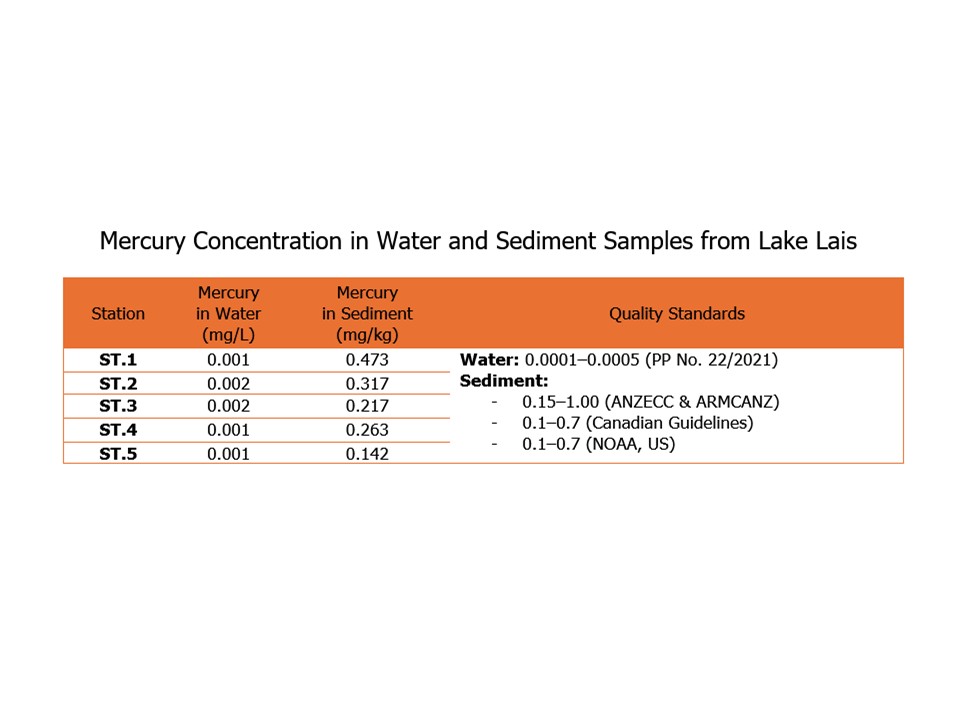
Mercury is a hazardous chemical that significantly impacts both the environment and human health. In Central Kalimantan, gold mining activities contribute to mercury contamination, particularly in aquatic ecosystems. Lake Lais, an oxbow lake along the Kahayan River, is potentially affected by mercury from upstream mining activities. This study aims to assess mercury contamination in Lake Lais water and sediment, and evaluate the ecological risks associated with mercury pollution. In September 2024, water and sediment samples were collected from five sites in Lais Lake. Water samples were collected from the surface using polypropylene bottles with added nitric acid to preserve mercury content. Sediment samples were taken using an Ekman grab and analyzed for mercury using Atomic Absorption Spectrophotometry (AAS) at Balai Standarisasi Pelayanan Jasa Industri in Banjarbaru, South Kalimantan. The results showed that water mercury concentrations ranged from 0.00 to 0.002 mg/l, which is within the limits set by the Indonesian government (PP No. 22/2021). However, sediment mercury levels ranged from 0.14 to 0.47 mg/kg, which can negatively impact the ecosystem based on international standards. Lais Lake was classified as having mild to moderate mercury contamination, with an ecological risk ranging from moderate to very strong. The Risk Quotient (RQ) exceeded 1, indicating high ecological risk. These findings highlight the need for regular monitoring and stricter regulation of mercury use in mining. Future research should focus on long-term impacts and seasonal variations in mercury levels to better assess ecological risks.
References
Abdullah, M. I. C., Sah, A. S., R., M., and Haris, H. 2020. Geoaccumulation Index and Enrichment Factor of Arsenic in Surface Sediment of Bukit Merah Reservoir, Malaysia. Tropical Life Science Research, 31(3).
Ananga, E., Bernard Walter Lawson, B. W., Aduboffour, V. K. A., Meshack Teid, and Antwie, A. B. 2023. Mercury and lead pollution in rivers in Ghana: geo-accumulation index, contamination factor, and water quality index. Water Practice & Technology, Vol. 18 No. 5, 1273. doi: 10.2166/wpt.2023.070.
Astuti, R.D.P, Mallongi, A., Rauf, A.U. 2021. Risk identification of Hg and Pb in soil: a case study from Pangkep Regency, Indonesia. Soil Science Annual, 72(1): 1-12.
Elvince R & Kembarawati. 2021. Kajian Kualitas Air Danau Hanjalutung Kegiatan Perikanan di Kelurahan Petuk Katimpun, Kota Palangka Raya, Kalimantan Tengah. Jurnal Teknologi Lingkungan Lahan Basah, Vol. 09, No. 1, 029-041.
Elvince R, Inoue T, Darung U Ardianor, Kawakami T, Nagafuchi O, Tsushima K. 2008. Mercury Contamination in Lake Tilap, Central Kalimantan, Indonesia. Journal Of Ecotechnology Research, 13(4), 291-294.
Guentzel, J. L., Portilla, E., Keith, K. M., Keith, E. O. 2007. Mercury transport and bioaccumulation in riverbank communities of the Alvarado Lagoon System, Veracruz State, Mexico. Science of the Total Environment, 388: 316–324.
Guo, W., Liu, X, Liu, Z, Li, G. 2010. Pollution and Potential Ecological Risk Evaluation of Heavy Metals in the Sediments around Dongjiang Harbor, Tianjin. Procedia Environmental Sciences, 2: 729–736.
Handayani, C.O, Sukarjo, Zu’amah, H, Dewi, T. 2024. Penilaian Status dan Risiko Ekologi Cemaran Logam Berat di Lahan Pertanian Kota Malang, Provinsi Jawa Timur. Jurnal Ilmu Lingkungan, 22(1): 60-68.
Haryati, A., Prartono, T. & Hindarti, D. 2022. Konsentrasi Merkuri (Hg) Di Sedimen Perairan Cirebon, Jawa Barat Pada Musim Peralihan Timur. J. Ilmu Dan Teknologi Kelautan Tropis, 14(3): 321-335. Doi: https://doi.org/10.29244/jitkt.v14i3.33788.
Huang, W.Y, Huang, S.W, Li, Y.L, Huang, S.P, Lin, C, Ngo, H.H., Bui, X. T. 2023. Reduced pollution level and ecological risk of mercury-polluted sediment in an alkali-chlorine factory’s brine water storage pond after corrective actions: A case study in Southern Taiwan. Environmental Technology & Innovation, 29: 1-11.
Indrajaya, F, Virgiyanti, L. 2019. Analisa Kandungan Merkuri (Hg) Di Wilayah Penambangan Emas Danau Payawan Desa Tumbang Panggo Kecamatan Tasik Payawan Kabupaten Katingan. PROMINE, 7(2), 59–64.
Kho, F., Koppel, D.J., von Hellfeld, R, Astley Hastings, A., Gissi, F., Cresswell, T., Higgins, S. 2022. Current understanding of the ecological risk of mercury from subsea oil and gas infrastructure to marine ecosystems. Journal of Hazardous Materials, 438.
Mao, L., Ren, W., Liu, X., He, M., Zhang, B., Lin, C., Ouyang, W. 2023. Mercury contamination in the water and sediments of a typical inland river – Lake basin in China: Occurrence, sources, migration and risk assessment. Journal of Hazardous Materials, 446. https://doi.org/10.1016/j.jhazmat.2023.130724.
Marsyalita, F., Rahardja, S. B. & Cahyoko, Y. 2012. Analisis Kandungan Merkuri (Hg) Pada Air, Sedimen, Ikan Keting (Arius caelatus), Dan Ikan Mujair (Oreochromis mossambicus) Di Kali Jagir Surabaya. Jurnal Ilmiah Perikanan dan Kelautan, 4(2): 113-118.
Maulana, A., Harianti, M., Prasetyo, T.B, Herviyanti. 2023. Index of contamination/pollution factor, geo-accumulation and ecological risk in ex-gold mining soil contaminated with mercury. Journal of Degraded and Mining Lands Management, 10(4): 4791-4799.
Mulyaningsih, T.R, and Suprapti, S. 2015. Penaksiran Kontaminasi Logam Berat Dan Kualitas Sedimen Sungai Cimadur, Banten. Jurnal Iptek Nuklir, 18(1): 11 - 21.
Nakazawa, K., Nagafuchi O., Kawakami, T., Inoue, T., Elvince, R., Kanefuji, K., Nur, I., Napitupulu, M., Basir, M., Kinoshita, H. & Shinozuka, K. 2021. Human Health Risk Assessment of Atmospheric Mercury Inhalation Around Three Artisanal Small-scale Gold Mining Areas in Indonesia. Environmental Science: Atmospheres, 1: 423-433.
Nakazawa, K., Nagafuchi, O, Kawakami, T, Inoue, T., Yokota, K., Serikawa, Y, Cyio, B, Elvince, R. 2016. Human health risk assessment of mercury vapor around artisanal small-scale gold mining area, Palu city, Central Sulawesi, Indonesia. Ecotoxicology and Environmental Safety, 124: 155-162.
Niode, S. N., Hasim, H., & Kasim, F. 2021. Tingkat Kontaminasi Logam Berat Merkuri (Hg) di Perairan Danau Limboto. Jurnal Ilmiah Perikanan dan Kelautan, 9(3), 58–63. https://ejurnal.ung.ac.id/index.php/nike/article/view/7799.
Nugraha, M. A., Pamungkas, A., Syari, I. A., Sari, S. P., Umroh, Hudatwi, M., Utami, E., Akhrianti, I., & Priyambada, A. 2022. Penilaian Pencemaran Logam Berat Cd, Pb, Cu dan Zn Pada Sedimen Permukaan Perairan Matras, Sungailiat, Bangka. Jurnal Kelautan Tropis, 24(1): 70-78.
Nugrayani, D, Hidayati, N.V, Muslih, Cahyo, T.N., Putri, A.A, Putri, N.A, Ummah, A.N, Santoso, F.S. 2023. Potensi Resiko Ekologis Logam Berat (Cd, Cr, Fe) Pada Sedimen Anak Sungai Pelus Sekitar Home Industry Batik Kauman Sokaraja, Banyumas. Journal Perikanan, 13(3), 796-805.
Panggabean, S. S. P., Rodhiyah, Z., Ilfan, F., & Ihsan, M. 2022. Indeks Beban Pencemar Sebagai Penentu Tingkat Pencemaran Pada Lahan Bekas Pertambangan Emas Tanpa Izin. INSOLOGI: Jurnal Sains dan Teknologi, 1(5), 565-573.
Portezuela, M., García, M., & González, J. 2019. Derivation of sediment mercury quality standards for the protection of benthic invertebrates. Environmental Pollution, 255, 113-120. https://doi.org/10.1016/j.envpol.2019.113120
Republik Indonesia. (2021). Peraturan Pemerintah Republik Indonesia Nomor 22 Tahun 2021 tentang Penyelenggaraan Perlindungan dan Pengelolaan Lingkungan Hidup. https://peraturan.bpk.go.id/Details/161852/pp-no-22-tahun-2021
Sukarjo, Zulaehah, I., Harsanti, E. S., & Ardiwinata, A. N. 2021. Penilaian Spasial Potensi Risiko Ekologis Logam Berat di Lapisan Olah Tanah Sawah DAS Serayu Hilir, Jawa Tengah. Jurnal Tanah dan Iklim, 45(1), 69-77.
US EPA. 2024. Mercury Emissions: The Global Context. https://www.epa.gov/international-cooperation/mercury-emissions-global-context.
US EPA. 2024. Climate Change Indicators: Lake Temperature. https://www.epa.gov/climate-indicators/climate-change-indicators-lake-temperature.
US EPA. 2024. Ecological Risk Assessment. https://www.epa.gov/risk/ecological-risk-assessment.
US EPA. 2024. Electrical Conductivity and Resistivity. https://www.epa.gov/environmental-geophysics/electrical-conductivity-and-resistivity#:~:text=Electrical%20conductivity%20(%CF%83)%20is%20a,meter%20(mS%2Fm).
US EPA. 2024. Indicators: Sediment Mercury. https://www.epa.gov/national-aquatic-resource-surveys/indicators-sediment-mercury#:~:text=Why%20is%20sediment%20mercury%20important%3F&text=Mercury%20is%20a%20common%20pollutant,and%20animals%20that%20eat%20fish.
US EPA. 2024. pH. https://www.epa.gov/caddis/ph.
Downloads
Published
Issue
Section
License
Copyright (c) 2025 Rosana Elvince, Budhi Ardhani

This work is licensed under a Creative Commons Attribution 4.0 International License.