The Dual Role of Vetiver Root Extract on Heterotrophic Bacterial Growth in Lake Riparian Zones: Implications for Lake Riparian Zone Water Quality
DOI:
https://doi.org/10.55981/limnotek.2025.8984Keywords:
bacterial growth, heterotrophic bacteria, riparian zone, root extract, vetiver plantsAbstract
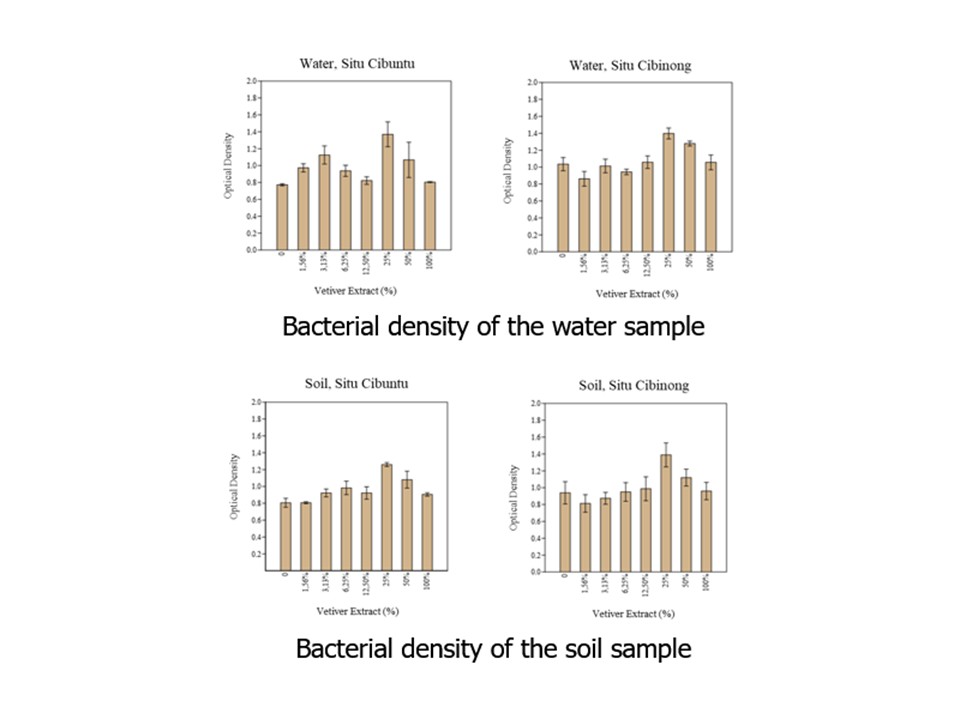
Plant–microbe interactions are fundamental to maintaining ecological balance in aquatic systems. In riparian zones, fluctuating lake water levels create standing water conditions that facilitate exchanges between riparian vegetation and aquatic microbes, particularly heterotrophic bacteria. This study examined the influence of Vetiveria zizanioides (Vetiver) root extract on heterotrophic bacterial growth in riparian ecosystems. Vetiver, widely utilized for erosion control and sediment stabilization, was selected as the experimental species. Soil and water samples from two small lakes in Cibinong, Bogor, West Java (Situ Cibuntu and Situ Cibinong), served as sources of bacterial isolates. Vetiver root extract was prepared via aqueous extraction and applied at varying concentrations in 50% tryptone glucose yeast (TGY) liquid medium. Bacterial growth responses were assessed through optical density measurements, alongside environmental parameter evaluations. Results demonstrated that Vetiver root extract modulated bacterial growth in a concentration-dependent manner: a 25% extract concentration significantly promoted heterotrophic bacterial growth, suggesting a role in enhancing nutrient cycling, whereas higher concentrations exhibited inhibitory effects, implying potential applications for microbial population management. These findings highlight the dual role of vetiver root extract in either stimulating or suppressing microbial activity within riparian ecosystems. This research provides a scientific foundation for developing nature-based solution (NBS) to promote lake ecosystem stability and environmental sustainability. Further research is needed regarding the assessment of the long-term effects of Vetiver root extract application on soil health, water quality, plant-microbe interactions, and overall ecosystem sustainability
References
Amalia R, Tasya A, and Ramadhani D. 2021. Kandungan Nitrit dan Nitrat pada Kualitas Air Permukaan. Prosiding Seminar Nasional Biologi 1(1): 679–688.
APHA. 2005. Standard Method for the Examination of Water and Wastewater, 21st ed. Washington DC: American Public Health Association/American Water Works Association/Water Environment Federation.
Arrijani, Makahinda T, Kurniahtunnisa, Aini M, Fitrianingrum AM, and Agustina TP. 2024. Multipurpose riparian zone design – enhancing conservation and pollution control for a sustainable Lake Tondano. Eco. Eng. & Environ. Tech 25(12): 290–304. https://doi.org/10.12912/27197050/194815
Askhary R. 2016. Kajian Karakteristik Kualitas Air dan Kemampuan Pulih Perairan pada Situ Cibinong, Kabupaten Bogor. Universitas Trisakti.
Bolan N, Park J, Robinson B, Naidu R, and Huh K. 2011. Phytostabilization: A green approach to contaminant containment. Advances in Agronomy 112: 145–204.
Boyd C. 1979. Water Quality in Warm Water Fish Ponds. Auburn AL (US): Auburn University.
Broeckling CD, Broz AK, Bergelson J, Manter DK, and Vivanco JM. 2008. Root exudates regulate soil fungal community composition and diversity. Appl Environ Microbiol 74(3): 738–744.
Cesco S. 2012. Plant-borne flavonoids released into the rhizosphere: Impact on soil bio-activities related to plant nutrition – A review. Biol Fertil Soils 48(2): 123–149.
Hamdiyati Y. 2011. Pertumbuhan dan Pengendalian Mikroorganisme II. Bandung: Universitas Pendidikan Indonesia.
Horne A and Goldman C. 1994. Limnology, 2nd ed. New York (US): McGraw Hill Book Co.
Ibrahim A, Aisyah S, Akhdiana I, Lukman, Rahmadya A, and Mayasari N. 2021. Evaluation of the physicochemical properties of Cibuntu Pond, Bogor Regency, West Java. J Nat Resour Environ Manage 11(4): 513–523. https://doi.org/10.29244/jpsl.11.4.513-523
Jannah H and Safnowandi. 2018. Identifikasi jenis tumbuhan obat tradisional di kawasan hutan Olat Cabe Desa Batu Bangka Kecamatan Moyo Hilir Kabupaten Sumbawa Besar. Bioscientist: Jurnal Ilmiah Biologi 6(2): 145–172.
Larosa SF, Kusdiyantini E, Raharjo B, and Sarjiya A. 2013. Kemampuan isolat bakteri penghasil indole acetic acid (IAA) dari tanah gambut Sampit Kalimantan Tengah. J Biol 2(3): 41–54.
Leatemia SPO, Wanggai EC, and Talakua S. 2016. Kelimpahan dan keanekaragaman makroavertabrata air pada kerapatan vegetasi riparian yang berbeda di Sungai Aimasi Kabupaten Manokwari. J Fish Dev 3(1): 25–38.
Narayanasamydamodaran S, Kumar N, and Zuo J. 2025. Profiling and metabolic analysis of microorganisms in bioretention cells vegetated with vetiver and cattail species treating nitrogen and phosphorous. Int J Phytoremediation 27(6): 861–873. https://doi.org/10.1080/15226514.2025.2452942
Notowinarto and Agustina F. 2015. Populasi bakteri heterotrof di perairan Pulau Bulang Batam. J Pendidik Biol Indones 1(3): 334–342.
Pitrianingsih C, Suminto, and Sarjito. 2014. Pengaruh bakteri kandidat probiotik terhadap perubahan kandungan nutrien C, N, P dan K media kultur lele dumbo (Clarias gariepinus). J Aqua Manage Tech 3(4): 247–256.
Radiastuti N. 2009. Pengujian antibakteri dari minyak atsiri bunga cengkeh, kulit kayu manis dan rimpang jahe terhadap Bacillus subtilis, Streptococcus aureus, dan P. aeruginosa. Berk Penel. Hayati Edisi Khusus 3C: 3–51.
Rahmawati, Chadijah, and A Ilyas. 2013. Analisa penurunan kadar COD dan BOD limbah cair laboratorium biokimia UIN Makassar menggunakan fly ash (abu terbang) batubara. Al-Kimia 1(1): 64–75.
Sadi NH. 2013. Keanekaragaman fungsional bakterioplankton di Situ Cibuntu dan Situ Cilalay Cibinong Bogor. In. Pertemuan Ilmiah Tahunan Masyarakat Limnologi Indonesia 2013: 136–148.
Seniati, Marbiah, and A Irham. 2019. Measurement standard of population density of Vibrio harveyi using methods of plate count (TPC) and spectrophotometer. J Agrokompleks 19(2): 12–19.
Sulastri, Akhdiana I, and Khaerunissa N. 2020. Phytoplankton and water quality of three small lakes in Cibinong, West Java, Indonesia. In IOP Conf Ser: Earth Environ Sci. Institute of Physics Publishing.
Triyani and Hafsan. 2021. Mengungkap Misteri Interaksi Antara Mikroba dan Tanaman. Makassar: Alauddin University Press.
UNEP-IETC/ILEC. 2001. Lakes and Reservoirs: Similarities, Differences and Importance, vol 1. Shiga, Japan: UNEP-IETC/ILEC.
Waryanti A, Sudarno, and Sutrisno E. 2013. Studies on the effect of addition of coconut fiber on the making of liquid fertilizer the wastewater derived from cleaning fishes against quality nutrients macro (CNPK). J Tek Lingkungan 2(4): 1–7.
Waters CM and Bassler BL. 2005. Quorum sensing: Cell-to-cell communication in bacteria. Annu Rev Cell Dev Biol 21: 319–346. https://doi.org/10.1146/annurev-cellbio-111822-120242
Widyati E. 2017. Memahami komunikasi tumbuhan-tanah dalam areal rhizosfir untuk optimasi pengelolaan lahan. J Sumberdaya Lahan 11(1): 33–42.
Zhang M, O’Connor PJ, Zhang, Ye X. 2021. Linking soil nutrient cycling and microbial community with vegetation cover in riparian zone. Geoderma 384: 114801. https://doi.org/10.1016/j.geoderma.2020.114801
Zhang X, Bilyera N, Fan L, Duddek P, Ahmed MA, Carminati A, Kaestner A, Dippold MA, Spielvogel S, and Razavi BS. 2023. The spatial distribution of rhizosphere microbial activities under drought: water availability is more important than root-hair-controlled exudation. New Phytologist 237: 780–792. https://doi.org/10.1111/nph.18409
Zhuang X, Gao J, Ma A, Fu S, and Zhuang G. 2013. Bioactive molecules in soil ecosystems: Masters of the underground. Int J Mol Sci 14(5): 8841–8868. https://doi.org/10.3390/ijms14058841
Zulti F, Satya A, and Sulawesty F. 2012. Distribusi spasial karakteristik fisika Situ Cibuntu, Jawa Barat. Limnotek 19(1): 29–36.
Downloads
Published
Issue
Section
License
Copyright (c) 2025 Nina Hermayani Sadi, Ni Made Diah Puspita Dewi, I Wayan Suirta

This work is licensed under a Creative Commons Attribution 4.0 International License.