Data-driven Optimization Of Runway Occupancy Time Landing: A Case Study On Runway 06 at Soekarno-hatta International Airport
DOI:
https://doi.org/10.55981/ijoa.2025.14372Keywords:
runway occupancy, threshold speed, ADS-B, stochastic simulation, blueskyAbstract
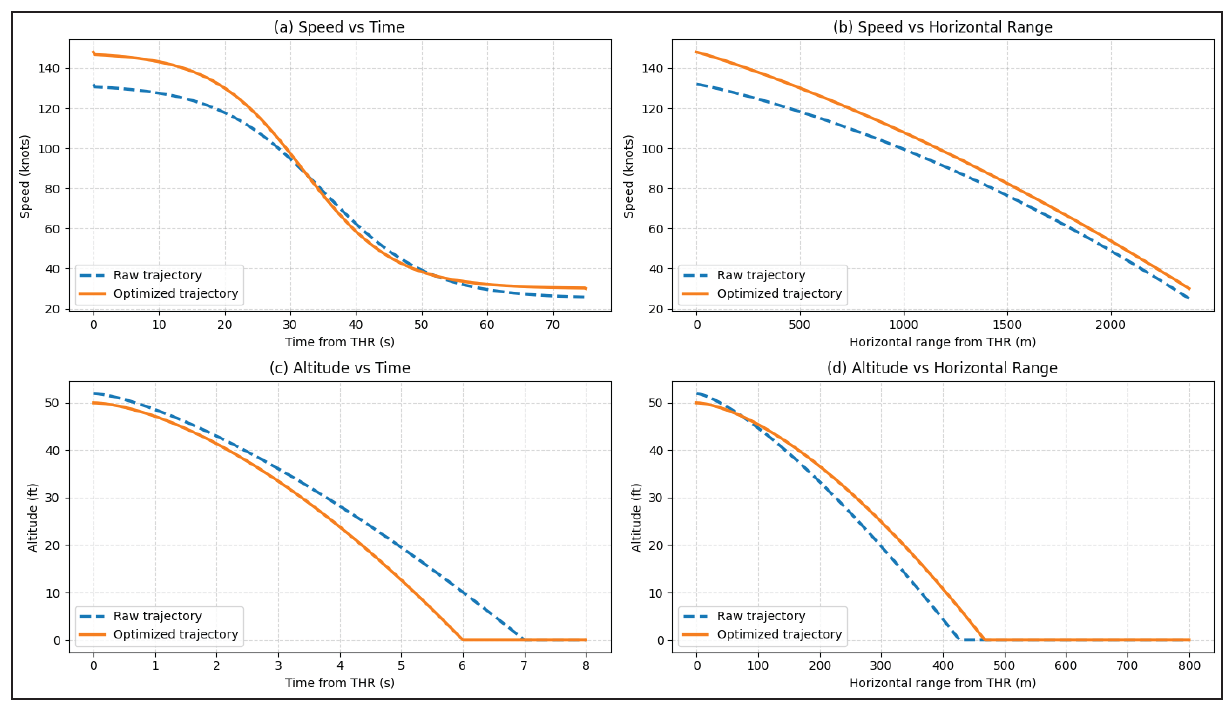
This study investigates how aircraft speed and altitude at threshold crossing influence Runway Occupancy Time Landing (ROTL) on Runway 06 at Soekarno–Hatta International Airport. A dataset of 2,000 ADS-B landing trajectories from Flightradar24 was analyzed to quantify empirical relationships between threshold parameters and ROTL. The 5% lowest ROTL flights showed substantially higher threshold speeds than the 5% highest ROTL flights, while threshold altitude remained nearly constant, indicating that speed is the dominant operational driver of runway occupancy. A regression-based scoring method was used to identify a representative efficient reference flight, which then served as the baseline for stochastic simulation in the BlueSky ATM Simulator. Threshold speed and altitude were sampled from normal distributions calibrated to the efficient group, and 300 simulated landings were generated. The simulation reproduced efficient operations with a mean ROTL of 51.77 s and a narrow 95% confidence interval of 51.69–51.85 s. The results support a practical recommendation to standardize threshold speed and deceleration profiles as a low-cost strategy to reduce ROTL without infrastructure modification.
References
Airbus. (2025). Airbus global market forecast 2025–2044. https://www.airbus.com/en/products-services/commercial-aircraft/global-market-forecast
AirNav Indonesia. (2015). Manual perhitungan kapasitas runway (Edisi ke-2, Dokumen No. 001/MAN-PKRN/DSPA-2/12/2015). Direktorat Keselamatan, Keamanan & Standarisasi, Perum LPPNPI.
AirNav Indonesia. (2024). Laporan Tahunan 2024. AirNav Indonesia.
AirNav Indonesia. (2025). Prosedur Operasi Standar Pelayanan Lalu Lintas Penerbangan Aerodrome Control Service (TWR) (SOP.009/G/01/LPPNPI/OPS.12/I/2025, Edisi 9). Cabang JATSC.
Chen, Z., Xiang, H., Han, B., Shen, Y., Zhou, T., & Zhang, F. (2024). Research on runway capacity evaluation of general aviation airport based on runway expansion system. Symmetry, 16(11), 1555. https://doi.org/10.3390/sym16111555
Chou, T.-Y. (2013). Weighted linear combination ranking technique for multi-criteria decision analysis. The Journal of Global Business Management, 9(1), 61–67. https://doi.org/10.4102/sajems.v16i5.639
EUROCONTROL. (2023). Optimised runway occupancy time spacing for arrivals (ROCAT solution). SESAR Joint Undertaking.
Federal Aviation Administration. (2024). Airport design (Advisory Circular AC 150/5300-13B, Change 1). U.S. Department of Transportation.
Galagedera, M., & Samarasekara, K. (2021). Evaluation of the impact of runway characteristics on veer and occupancy time. Journal of Air Transport Management, 95, 102109. https://doi.org/10.1016/j.trip.2021.100480
Gao, H., Xie, Y., Yuan, C., He, X., & Niu, T. (2023). Prediction of aircraft arrival runway occupancy time based on machine learning. International Journal of Computational Intelligence Systems, 16(150). https://doi.org/10.1007/s44196-023-00333-3
International Civil Aviation Organization. (2005). Aerodrome design manual: Part 2. Taxiways, aprons and holding bays (Doc 9157, 4th ed.). ICAO.
International Civil Aviation Organization. (2020a). Doc 8168: Procedures for air navigation services — Aircraft operations. Volume II: Construction of visual and instrument flight procedures (7th ed.). ICAO.
International Civil Aviation Organization. (2020b). Manual on simultaneous operations on parallel or near-parallel instrument runways (SOIR) (Doc 9643, 2nd ed.). ICAO.
Juniawan, A. F., & Putriekapuja, R. A. (2023). Runway occupancy time landing analysis of runway 06/24 at Soekarno-Hatta International Airport. International Journal of Progressive Sciences and Technologies, 39(2), 352–356. http://dx.doi.org/10.52155/ijpsat.v39.2.5490
Kumar, V., Sherry, L., & Kicinger, R. (2010). Runway occupancy time extraction and analysis using surface track data. Transportation Research Record, 2300, 45–55.
Lim, Z. J. (2020). Causal effects of landing parameters on runway occupancy time. Nanyang Technological University. https://ieeexplore.ieee.org/document/9308243
Maltinti, F., Flore, M., Pigozzi, F., & Coni, M. (2024). Optimizing airport runway capacity and sustainability through the introduction of rapid exit taxiways: A case study. Sustainability, 16(13), 5359. https://doi.org/10.3390/su16135359
Meijers, N. P. (2019). Empirical analysis of runway occupancy with applications to airport capacity (Master’s thesis). Massachusetts Institute of Technology. https://dspace.mit.edu/handle/1721.1/128034
Montgomery, D. C., & Runger, G. C. (2018). Applied statistics and probability for engineers (7th ed.). Wiley.
Nguyen, T. D., et al. (2022). Model generalization in arrival runway occupancy time prediction by feature equivalences. arXiv preprint. https://arxiv.org/pdf/2201.11654
Pavlin, S., Zuzic, M., & Pavicic, S. (2006). Runway occupancy time as element of runway capacity. Promet – Traffic & Transportation, 18(4), 293–299.
Republik Indonesia. (2009). Undang-Undang Republik Indonesia Nomor 1 Tahun 2009 tentang Penerbangan. Sekretariat Negara.
Rosmayanti, R., Abimanyu, Y., Sonhaji, I., & Faridan, A. (2024). Evaluation of compliance with the runway occupancy time standard at Soekarno-Hatta International Airport. Langit Biru: Jurnal Ilmiah Aviasi, 17(2), 49–61. https://doi.org/10.54147/langitbiru.v17i2.1042
Schornagel, F. C. (2022). Improving climb and descent profiles in BlueSky using ATC performance models (Master’s thesis). Rotterdam.
TangerangNews. (2025, January 7). Bandara Soekarno-Hatta layani 54,8 juta penumpang sepanjang 2024. https://www.tangerangnews.com/bandara/read/52269
U.S. Department of Transportation, Federal Aviation Administration. (2023). Pilot’s handbook of aeronautical knowledge (FAA-H-8083-25C). Flight Standards Service.
Downloads
Published
How to Cite
Issue
Section
License
Copyright (c) 2026 Prakoso Satrio Wibowo, Javensius Sembiring, Toto Indriyanto

This work is licensed under a Creative Commons Attribution-ShareAlike 4.0 International License.