Characterization of Do-It-Yourself (DIY) Ultra Compact ITERA Robotic Telescope (UTOPIA-Scope) Mounting
DOI:
https://doi.org/10.55981/ijoa.2025.4098Keywords:
3D printer, DIY telescope, instrument characterization, robotic telescope, UTOPIA-ScopeAbstract
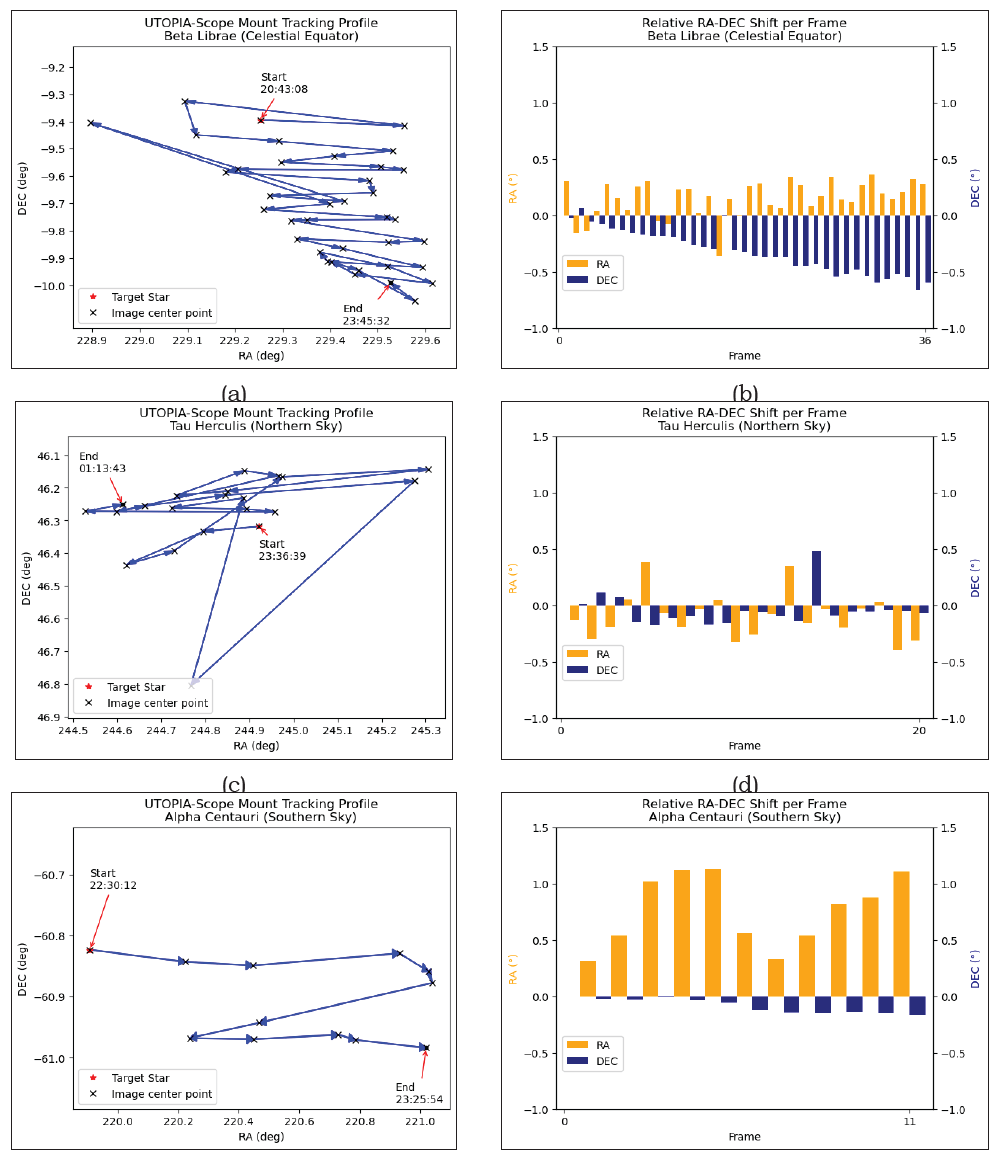
Low-cost and locally fabricated robotic telescope systems are increasingly important for education, amateur astronomy, and basic scientific observation. This paper presents the characterization of the UTOPIA-Scope, a do-it-yourself (DIY) alt-azimuth robotic telescope mount developed using extruded aluminum structures and 3D-printed strain-wave gears. The performance of the mount was evaluated through pointing and tracking tests using an alt-azimuth grid and selected equatorial stars. Image center coordinates were obtained using plate-solving techniques and analyzed with descriptive statistical methods. The results show average pointing errors of 1.600° ± 0.123° in azimuth, 0.415° ± 0.048° in altitude, and 0.451° ± 0.106° in equatorial pointing, corresponding to approximately 96′, 25′, and 27′, respectively. Tracking tests indicate drift rates of 22–36 arcsec per minute, depending on the observed sky region. These results provide a quantitative baseline for the performance of the UTOPIA-Scope mount and serve as a reference for further mechanical and control-system improvements toward future scientific applications.
References
Bely, P.-Y. (2003, January). The Design and Construction of Large Optical Telescopes. Springer
International Publishing. doi:10.1007/b97612
Berg, S. (n.d.). Introduction - Nighttime Imaging ‘N’ Astronomy. Introduction - Nighttime Imaging
‘N’ Astronomy. Retrieved May 14, 2023, from https://nighttime-imaging.eu/docs/
master/site/#about-nina
Cassar, G., Costes, V., & Escarrat, L. (2017, November). Optical design of a compact telescope
for the next generation Earth observation system. 41-41. doi:10.1117/12.2309055
Castro-Tirado, A. J. (2010, January). Robotic Autonomous Observatories: A Historical Perspective.
(L. Hanlon, Ed.) Advances in Astronomy, 2010. doi:10.1155/2010/570489
Dimple, S, K. T., Omar, A., & Misra, K. (2023, January). Characterization of a deep-depletion 4K
x 4K CCD Detector System designed for ADFOSC. arXiv (Cornell University). doi:10.48550/
arxiv.2301.08746
Han, K. (n.d.). ASTAP, Astrometric Stacking Program. ASTAP, Astrometric Stacking Program.
Retrieved May 14, 2023, from https://www.hnsky.org/astap.htm#index
Lynch, K. M., Marchuk, N., & Elwin, M. L. (2016). Gearing and Motor Sizing. Embedded
Computing and Mechatronics with the PIC32, 427-437. doi:10.1016/b978-0-12-420165-
1.00026-3
Price-Whelan, A. M., Lim, P. L., Earl, N., Starkman, N., Bradley, L., Shupe, D. L., . . . Zonca,
A. (2022, August). The Astropy Project: Sustaining and Growing a Community-oriented
125
Indonesian Journal of Aerospace Vol. 32 No. 2 December 2025 : pp 117–126 (Barends et al.)
Open-source Project and the Latest Major Release (v5.0) of the Core Package*. The
Astrophysical Journal, 935, 167. doi:10.3847/1538-4357/ac7c74
Quesada, R. M., Domínguez, A. M., Martinell, O. C., Ruiz, J. S., & Fernández, D. (2022,
January). 3D printed telescopes: an interesting tool for teaching Astronomy, Science and
Technology. UPCommons institutional repository (Universitat Politècnica de Catalunya).
doi:10.5821/conference-9788419184405.104
Roulet, M., Atkins, C., Hugot, E., Lemared, S., Lombardo, S., & Ferrari, M. (2018, May). 3D
printing for astronomical mirrors. arXiv (Cornell University). doi:10.1117/12.2306836
Skoog, D. A. (2014). Fundamentals of analytical chemistry (9 ed.). Brooks /Cole, Cengage
Learning.
Thingiverse.com. (n.d.). 3D printed harmonic drive by ymtlab. 3D printed harmonic drive by
ymtlab. Retrieved February 27, 2023, from https://www.thingiverse.com/thing:4505585
Wiki Onstep. (n.d.). Onstep. Onstep. Retrieved February 27, 2022, from https://onstep.groups.
io/g/main/wiki
Downloads
Published
How to Cite
Issue
Section
License
Copyright (c) 1970 Renza Alvionzo Barends, Hendra Agus Prastyo, Achmad Zainur Rozzykin, Alka Budi Wahidin, Ridlo Wahyudi Wibowo, Aditya Abdilah Yusuf, Adhitya Oktaviandra

This work is licensed under a Creative Commons Attribution-ShareAlike 4.0 International License.