
Evaluasi Sebaran Longitudinal Sifat Fisika Dan Mekanika Dendrocalamus Asper Dan Gigantochoa Apus Menggunakan Mixed-Effect Modeling
Article Sidebar
Main Article Content
Abstract
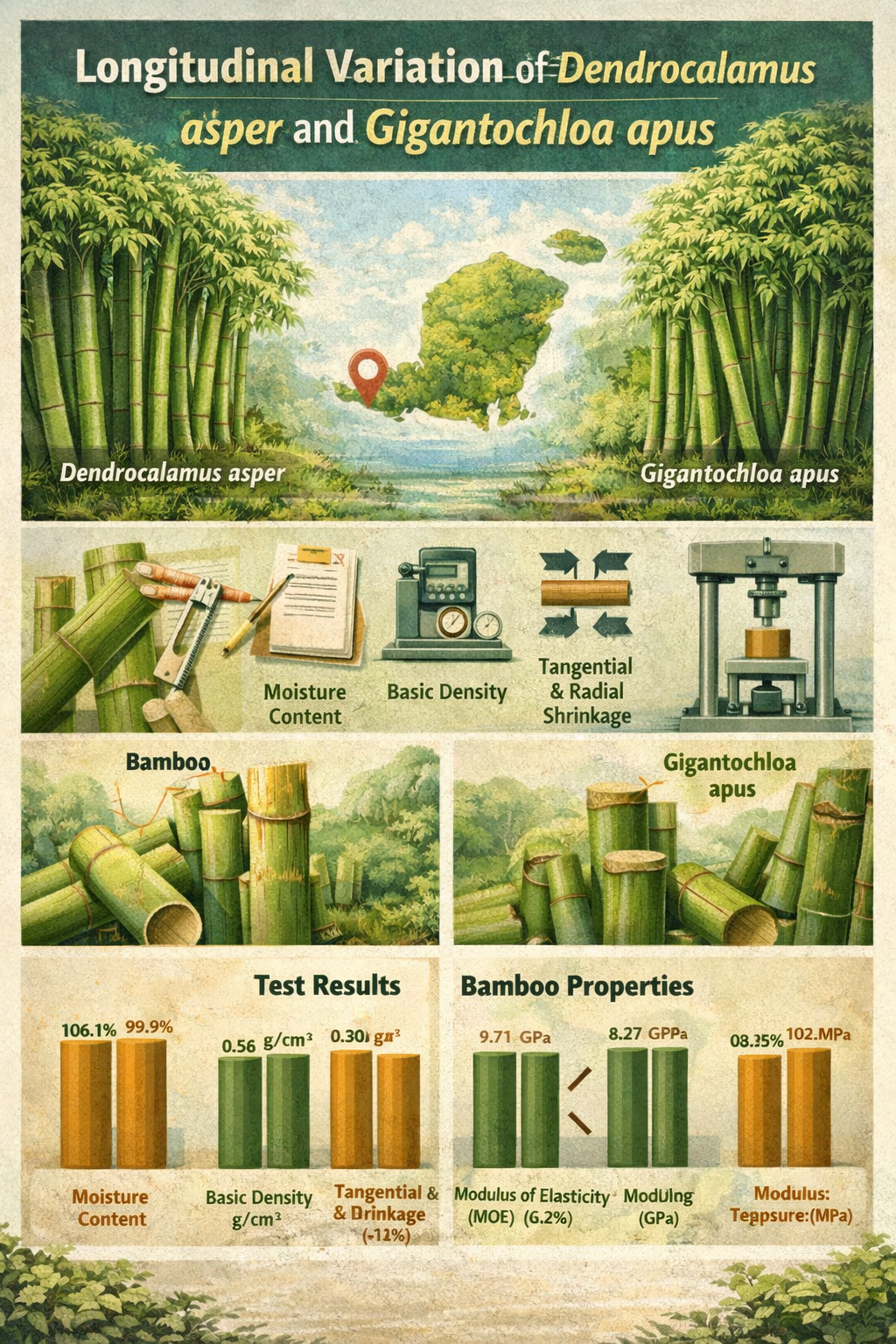
Bamboo is an environmentally friendly construction material because it is renewable, lightweight, and possesses good mechanical strength. However, due to the lack of basic knowledge about the properties of bamboo culms, only a few species are commonly utililized. This study aims to investigate the longitudinal variation of physical and mechanical properties of Dendrocalamus asper and Gigantochloa apus that grow naturally on Lombok Island. Sampling was carried out by selecting 10 bamboo culms, aged 3-4 years old, from different clumps at each location. The tests conducted include moisture content, basic density, tangential and radial shrinkage, modulus of elasticity (MOE), and modulus of rupture (MOR). Statistical analysis was performed using R software, incorporating linear and non-linear mixed-effects models to evaluate longitudinal variations and the influence of individual and location on the distribution of bamboo properties. The results showed that the values for green moisture content, basic density, tangential and radial shrinkage at 1% moisture content change, MOE, and MOR for G. apus were 99.97%, 0.60 g/cm³, 0.29%, 0.35%, 8.27 GPa, and 108.80 MPa, respectively. Meanwhile, the values for D. apser were 108.13%, 0.58 g/cm³, 0.34%, 0.42%, 9.71 GPa, and 102.47 MPa, respectively. The longitudinal variation of moisture content in G. apus followed a linear pattern, while a logarithmic equation best described the variation in moisture content of D. asper, basic density, MOE, and MOR for both bamboo species. Additionally, the longitudinal variation in tangential and radial shrinkage for both species remained constant, following a linear equation with a y-intercept.
Article Details

This work is licensed under a Creative Commons Attribution-ShareAlike 4.0 International License.
References
Abdullah, A. H. D., Karlina, N., Rahmatiya, W., Mudaim, S., & Fajrin, A. R. (2017). Physical and mechanical properties of five Indonesian bamboos. IOP Conference Series: Earth and Environmental Science. IOP Publishing. (hal. 012014).
Ahmad, M., & Kamke, F. A. (2005). Analysis of Calcutta bamboo for structural composite materials: physical and mechanical properties. Wood Science and Technology, 39, 448-459.
Aguinsatan, R. G., Razal, R. A., Carandang, M. G., & Peralta, E. K. (2019). Site influence on the Morphological, physical and mechanical properties of giant bamboo (Dendrocalamus asper) in Bukidnon Province, Mindanao, Philippines. Journal of Tropical Forest Science, 31(1), 99-107.
Akinlabi, E. T., Anane-Fenin, K., Akwada, D. R., Akinlabi, E. T., Anane-Fenin, K., & Akwada, D. R. (2017). Bamboo taxonomy and distribution across the globe. Bamboo: the multipurpose plant, 1-37.
Anokye, R., Kalong, R. M., Bakar, E. S., Ratnasingam, J., Jawaid, M., & Awang, K. (2014). Variations in moisture content affect the shrinkage of Gigantochloa scortechinii and Bambusa vulgaris at different heights of the bamboo culm. BioResources, 9(4), 7484-7493.
Anwar, U. M. K., Zaidon, A., Hamdan, H., & Tamizi, M. M. (2005). Physical and mechanical properties of Gigantochloa scortechinii bamboo splits and strips. Journal of Tropical Forest Science, 1-12.
Awalluddin, D., Ariffin, M. A. M., Osman, M. H., Hussin, M. W., Ismail, M. A., Lee, H. S., & Lim, N. H. A. S. (2017). Mechanical properties of different bamboo species. In MATEC web of conferences. EDP Sciences. (hal. 01024).
Banik, R. L. (2015). Morphology and growth. In Bamboo: The plant and its uses . Cham: Springer International Publishing.
Burnham, K. P., & Anderson, D. R. (2004). Multimodel inference: understanding AIC and BIC in model selection. Sociological methods & research, 33(2), 261-304.
Ekawati, D., Karlinasari, L., & Soekmadi, R. (2022). Drivers, barriers, and strategies in the community-based supply of bamboo for industrial-scale bamboo utilization in Ngada regency, east Nusa Tenggara, Indonesia. Sustainability, 14(10), 5970.
Hartono, R., Iswanto, A. H., Priadi, T., Herawati, E., Farizky, F., Sutiawan, J., & Sumardi, I. (2022). Physical, chemical, and mechanical properties of six bamboo from Sumatera Island Indonesia and its potential applications for composite materials. Polymers, 14(22), 4868.
Idrus, I. (2024). Inovasi Rumah Smart Berkelanjutan dengan Material Bambu: Pengembangan dan Penerapan Teknologi pada Hunian Modern. Jurnal Pengabdian Masyarakat Konstruksi (MAJJAMA), 2(2), 71-86.
Iswanto, A. H., Madyaratri, E. W., Hutabarat, N. S., Zunaedi, E. R., Darwis, A., Hidayat, W., ... & Hua, L. S. (2022). Chemical, physical, and mechanical properties of Belangke bamboo (Gigantochloa pruriens) and its application as a reinforcing material in particleboard manufacturing. Polymers, 14(15), 3111.
Kamruzzaman, M., Saha, S. K., Bose, A. K., & Islam, M. N. (2008). Effects of age and height on physical and mechanical properties of bamboo. Journal of Tropical Forest Science, 211-217.
Kamthai, S., & Puthson, P. (2005). The physical properties, fiber Morphology and chemical compositions of sweet bamboo (Dendrocalamus asper Backer). Agriculture and Natural Resources, 39(4), 581-587.
Liese, W., & Tang, T. K. H. (2015). Properties of the bamboo culm. In Bamboo: the plant and its uses. Cham: Springer International Publishing.
Manandhar, R., Kim, J. H., & Kim, J. T. (2019). Environmental, social and economic sustainability of bamboo and bamboo-based construction materials in buildings. Journal of Asian Architecture and Building Engineering, 18(2), 49-59.
Marsoem, S. N., Setiaji, F., Kim, N. H., Sulistyo, J., Irawati, D., Nugroho, W. D., & Pertiwi, Y. A. B. (2015). Fiber Morphology and physical characteristics of Gigantochloa atter at three different ages and heights of culms for better utilization. Journal of the Korean Wood Science and Technology, 43(2), 145-155.
Nordahlia AS, Uyup MKA, Husain H, Mohmod AL, Awalludin MF. 2019. Anatomical, physical, and mechanical properties of thirteen Malaysian bamboo species. BioResources 14: 3925- 3943.
Pertiwi, Y., Nufus, M., Agustina, A., Rahmadwiati, R., Wicaksono, R., & Nayasilana, I. (2021). Studi keanekaragaman, biomassa dan carbon stock bambu di taman hutan raya k.g.p.a.a. mangkunagoro i. Jurnal Belantara, 4(2), 140-152.
Pinheiro, J., & Bates, D. (2000). Mixed-effects models in S and S-PLUS. Springer science & business media.
Priyanto, Abdulah L (2014) Model capacity building for efficient and sustainable utilization of bamboo resources in Indonesia. ITTO PD 600/11 Rev. 1 (I), Technical Report Act 2.1, Forestry Research and Development Agency, Ministry of Forestry, Bogor, hal. 15.
Rini, D. S., Wulandari, F. T., & Aji, I. M. L. (2017). Studi Jenis Dan Sebaran Bambu Di Kawasan Hutan Dengan Tujuan Khusus (KHDTK) Senaru. Jurnal Sangkareang Mataram, 3(4), 37-41.
Rini, D. S., Ishiguri, F., Nezu, I., Aji, I. M. L., Irawati, D., Ohshima, J., & Yokota, S. (2022). Longitudinal and geographic variations in the green moisture content and basic density of bamboo culm in three species naturally grown in Lombok Island, Indonesia. Tropics, 30(4), 83-93.
Rini, D. S., Ishiguri, F., Nezu, I., Ngadianto, A., Irawati, D., Otani, N., ... & Yokota, S. (2023). Geographic and longitudinal variations of anatomical characteristics and mechanical properties in three bamboo species naturally grown in Lombok Island, Indonesia. Scientific Reports, 13(1), 2265.
Ribeiro, R. A. S., Ribeiro, M. G. S., & Miranda, I. P. (2017). Bending strength and nondestructive evaluation of structural bamboo. Construction and Building Materials, 146, 38-42.
Sharma, B., Gatóo, A., & Ramage, M. H. (2015). Effect of processing methods on the mechanical properties of engineered bamboo. Construction and Building Materials, 83, 95-101.
Suriani, E. (2017). Bambu sebagai alternatif penerapan material ekologis: potensi dan tantangannya. EMARA: Indonesian Journal of Architecture, 3(1), 33-42.
Tan, T., Rahbar, N., Allameh, S. M., Kwofie, S., Dissmore, D., Ghavami, K., & Soboyejo, W. O. (2011). Mechanical properties of functionally graded hierarchical bamboo structures. Acta biomaterialia, 7(10), 3796-3803.
Vetter, R. E., Sá Ribeiro, R. A., Sá Ribeiro, M. G., & Miranda, I. P. (2015). Studies on drying of imperial bamboo. European Journal of Wood and Wood Products, 73, 411-414.
Wang, H., An, X., Li, W., Wang, H., & Yu, Y. (2014). Variation of mechanical properties of single bamboo fibers (Dendrocalamus latiflorus Munro) with respect to age and location in culms. Holzforschung, 68(3),291–297.
Wijayani, I., Sasongko, D., & Rusli, A. (2025). Estimation of potential carbon economic value of bamboo in community forest area in rumpin-dalam hamlet, rumpin village, bogor district. Journal of Sylva Indonesiana, 8(2), 92-99.
Widjaja, E. A. (2000). Bamboo diversity and its future prospect in Indonesia. In Proceedings of The Third International Wood Science Symposium (hal. 235-240).


