FLORIS TRADISIONAL LEBARAN DI LERENG MERBABU: PERSPEKTIF PASCAKOLONIAL
DOI:
https://doi.org/10.55981/tambo.2025.13392Keywords:
flower bucket, traditional florist, ancestral heritage, postcolonialAbstract
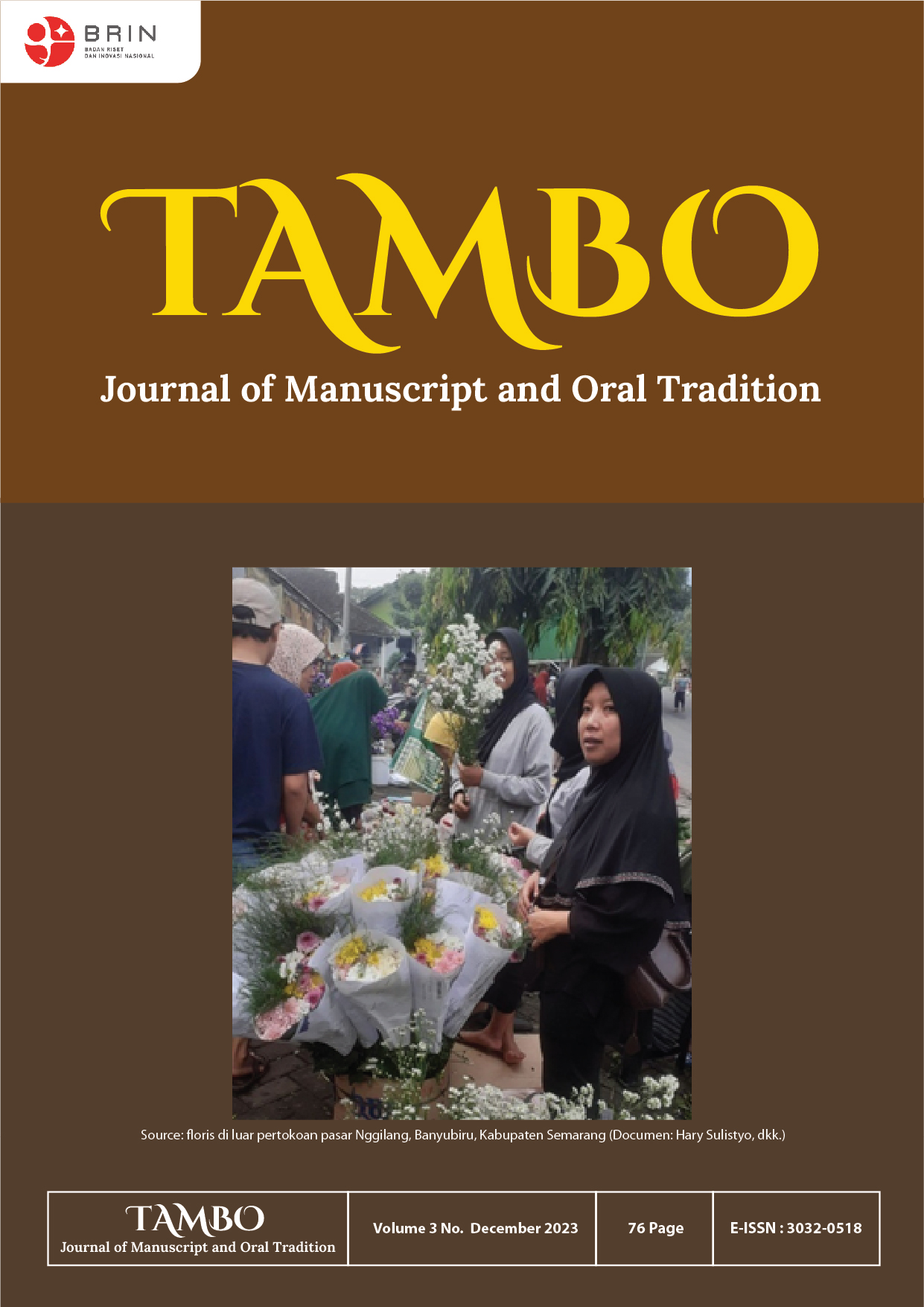
Merbabu area, Central Java, which are influenced by the cultural heritage of the Dutch community who lived in the area during the colonial era. Geographically, Mount Merbabu encompasses Boyolali Regency to the east, Salatiga City to the north, Magelang and Temanggung Regencies to the west, and Semarang Regency to the northwest. The tradition of florists and flower buckets during Eid al-Fitr represents cultural ambiguity as a characteristic of post-colonial society, because on the one hand it is a legacy of colonialism, but on the other hand, it has become a hereditary tradition for the local community and seems to be purely an ancestral heritage. The objectives of this study are: 1). To describe the tradition of florists and flower buckets in the celebration of Eid al-Fitr for the community in the Mount Merbabu area of Central Java in the context of oral tradition; 2). To describe the tradition and its correlation to post-colonial conditions as a legacy of Western society in the area during the colonial era which gave rise to ambiguity for the local community. The theory used in this study is the oral and postcolonial tradition of Hommi K. Bhabha which discusses mimicry and mockery. This research method is descriptive qualitative with data collection through documentation and interviews. The results of the study show: 1). The community in the Mount Merbabu area of Central Java presents the flower bucket tradition at the Eid al-Fitr celebration in every house supported by the presence of traditional florists based on traditions carried out by their ancestors; 2). Based on the results of the study, the tradition is based on the legacy of Western society who lived in the area during the colonial era and the local community does not know or question that this is a postcolonial form and seems to assume that this condition is purely an ancestral heritage.
References
Agusta, R. (2019). I SAKALA DIHYANG: RELASI PRASASTI AKHIR MAJAPAHIT DAN NASKAH-NASKAH MERAPI-MERBABU. Jumantara: Jurnal Manuskrip Nusantara, 9(2). https://doi.org/10.37014/jumantara.v9i2.243
Ashari, A., & Widodo, E. (2019). HIDROGEOMORFOLOGI DAN POTENSI MATAAIR LERENG BARATDAYA GUNUNG MERBABU. Majalah Geografi Indonesia, 33(1). https://doi.org/10.22146/mgi.35570
Ayu Sutarto. (2006). Nilai-Nilai Tradisi Lisan dan Kehidupan Berbangsa dan Bernegara. Festival Dan Workshop Tradisi Lisan Nusantara.
Banda, Maria Matildis dan Pidada, I. B. J. S. (2022). Tradisi Lisan, Kearifan Lokal, dan Latar Daerah dalam Karya Sastra. Penerbit Kosa Kata Kita.
Banda, M. M. (2015). Tradisi Lisan Sa Ngaza dalam Ritual Adat dan Ritual Keagamaan Etnik Ngadha di Flores. Universitas Udayana.
Bhabha, H. K. (1994). The Location of Culture. Routledge.
Endraswara, S. (2009). Metodologi Penelitian Folklor Konsep, Teori, dan Aplikasi. Media Pressindo.
Faruk. (2012). Metodologi Penelitian Sastra: Sebuah Penjelajahan Awal. Pustaka Pelajar.
Harjanti, M. I. (2016). Tingkat Pelestarian Kawasan Bersejarah Benteng Willem I Ambarawa. RUANG.
Hoed, H. B. P. (2008). Komunikasi Lisan sebagai Dasar Tradisi Lisan dalam Metodologi Kajian Tradisi Lisan. ,. Yayasan Obor & ATL.
James Danandjaja. (1994). Folklore sebagai Bahan Penelitian Antropologi Psikologi (Pengukuhan Guru Besar).
Mignolo, W. D. (2002). The geopolitics of knowledge and the colonial difference. South Atlantic Quarterly, 101(1). https://doi.org/10.1215/00382876-101-1-57
Moleong, L. J. (1990). Metodologi Penelitian Kualitatif. Remaja Rosdakarya.
Nur Arini, B. C., & Amalia, H. (2023). NILAI BUDI PEKERTI DAN FUNGSI LEGENDA RAWA PENING. Widyaparwa, 51(1). https://doi.org/10.26499/wdprw.v51i1.524
Ong, W. J. (2013). Kelisanan dan Keberaksaraan. Gading Publishing.
Pipit Mugi Handayani. (2020). MENIMBANG KEKAYAAN “LEGENDA BARUKLINTING” SEBAGAI BAHAN AJAR PADA PEMBELAJARAN SEKOLAH DASAR DI KABUPATEN SEMARANG. Media Informasi Penelitian Kabupaten Semarang, 3(1). https://doi.org/10.55606/sinov.v3i1.73
Salamah, S., Nazilah, H. M., Agistina, F. I., & Zakiyah, M. (2024). Setaman flower lexicons in the Nyekar rite: Anthropolinguistics of Javanese society. LITERA, 23(1). https://doi.org/10.21831/ltr.v23i1.70972
Spradley, J. P. (2006). Metode Etnografi. Tiara Wacana.
Sulistyowati, S. (2019). Tradisi Lisan Yogyakarta: Narasi dan Dokumentasi. Bakti Budaya, 2(1). https://doi.org/10.22146/bb.45032
Sumarno, S., Anjani, A., & Agusta, R. (2020). Kultus Hanuman: Pembawa Hujan dalam Naskah Merapi-Merbabu. Patra Widya: Seri Penerbitan Penelitian Sejarah Dan Budaya., 21(3). https://doi.org/10.52829/pw.315
Tol, R. dan P. (n.d.). Tradisi Lisan Nusantara: Oral Traditions from the Indonesian Archipelago, A Three Directional Approach. Dalam Warta ATL No. I/01-Maret 1995, 12–16.
Trisna Kumala Satya Dewi. (2009). Transformasi Mitos Dewi Sri dalam Masyarakat Jawa. Universitas Indonesia.
Trisna Kumala Satya Dewi. (2010). Tradisi Lisan sebagai Penguat Kultural dan Karakter Bangsa. Proceeding Konggres Pancasila III. Harapan, Peluang, Dan Tantangan Pembudayaan Nilai-Nilai Pancasila., 48–55.
Wulandari, S. S. (2022). Revitalization as a Regulatory Strategy in Rawa Pening Lake Management (Case Study in Dusun Sido Makmur, Sumber Rejo, Semarang Regency). Endogami: Jurnal Ilmiah Kajian Antropologi, 6(1).
Yus Rusyana. (2006). Peranan Tradisi Lisan dalam Ketahanan Budaya. Festival Dan Workshop Tradisi Lisan Nusantara
Additional Files
Published
How to Cite
Issue
Section
License
Copyright (c) 2025 Tambo: Journal of Manuscript and Oral Tradition

This work is licensed under a Creative Commons Attribution-NonCommercial-ShareAlike 4.0 International License.