
Kualitas Ekstrak Akasia dari Berbagai Lokasi di Indonesia dan Efek Penambahan Aditif pada Daya Rekatnya
Article Sidebar
Main Article Content
Abstract
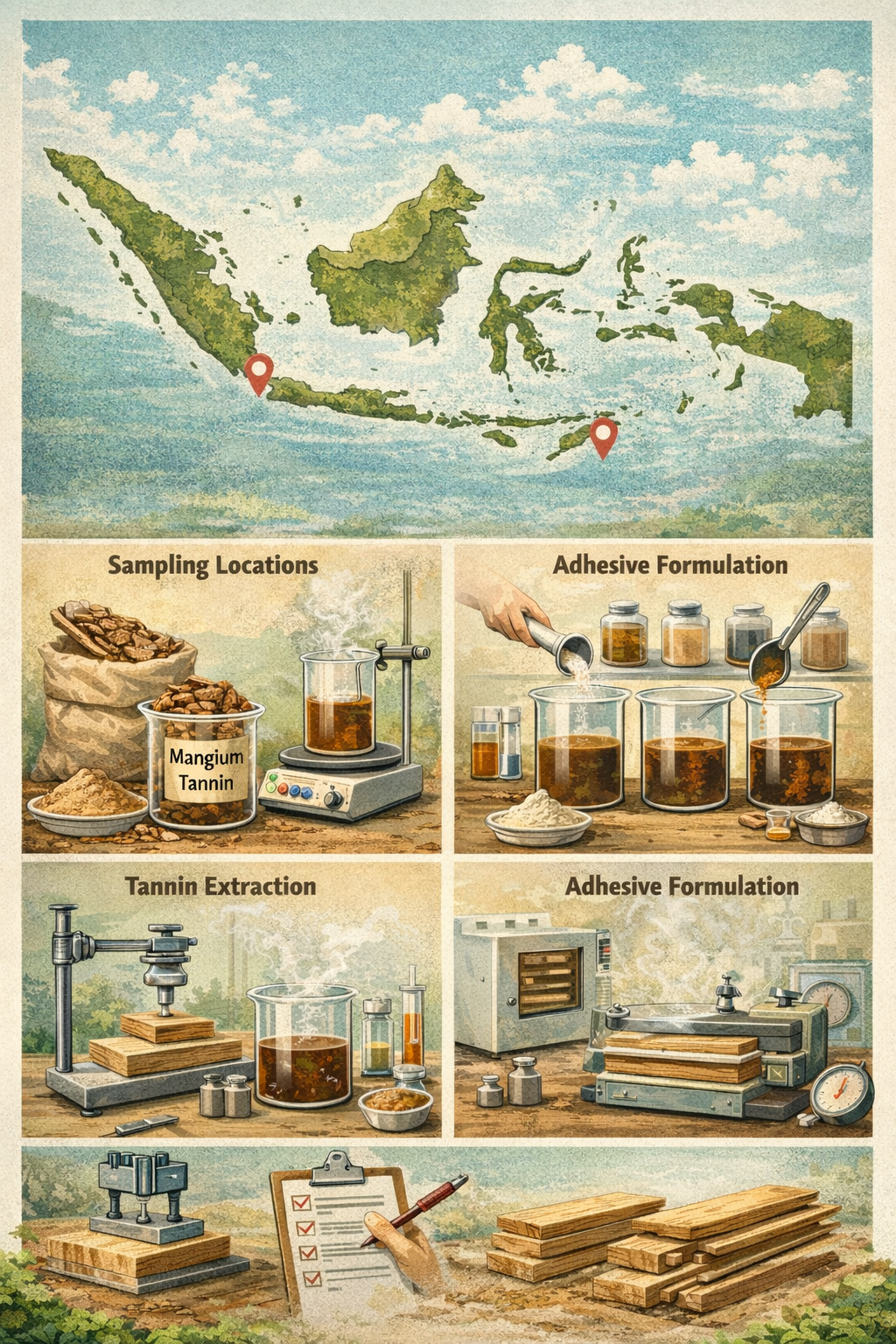
The tannin characteristic of plants is often influenced by their planting location. The characteristic of tannin potentially affects the quality of tannin-based adhesive. The addition of extender and hardener also influences the quality of tannin adhesive. In this study, we investigated the characteristics of Acacia mangium tannin extract produced from bark obtained from various locations in Indonesia, as well as the bonding quality of tannin adhesive with the addition of an extender and hardener. The objective of this research was to understand the difference in mangium tannin characteristics from different locations and the effect of extender and hardener addition on the bonding strength of acacia tannin adhesive. The Acacia mangium wood barks were obtained from Parung Panjang, Probolinggo, Pontianak, and Muara Enim. The amounts of extender and hardener added were 0%, 2.5%, 5%, 7.5%, 10%, and 0%, 0.5%, 1%, 1.5%, 2%, respectively. The evaluation of mangium tannin bark extract was conducted using the solid content and stiasny number tests. The bonding strength of the tannin adhesive was evaluated through shear strength and wood failure tests of sengon laminated wood. The two-ply sengon laminated wood was fabricated under the following conditions: a glue spread rate of 170 g/m², a cold-press time of 24 hours, and a pressure of 12 kg/cm². Mangium tannin bark extract from Parung Panjang has the best characteristics for adhesive production, i.e., 5.70% solid content and 200.63% stiasny number. The extender and hardener amounts of 7.5% and 1.5%, respectively, produced optimum properties for dry shear strength and wood failure, which meet the JAS No. 234 requirement, i.e., 112.31 kg/cm² and 98–100%, respectively.
Article Details

This work is licensed under a Creative Commons Attribution-ShareAlike 4.0 International License.
References
Adnan, N. A., Md Tahir, P., Husain, H., Lee, S. H., Anwar Uyup, M. K., Mat Arip, M. N., & Ashaari, Z. (2021). Effect of ACQ treatment on surface quality and bonding performance of four Malaysian hardwoods and cross laminated timber (CLT). European Journal of Wood and Wood Products, 79(2), 285–299. https://doi.org/10.1007/s00107-020-01609-7
Aini, E. N., Widyorini, R., Prayitno, T. A., & Setyayunita, T. (2020). Characteristics of bamboo particleboard bonded with citric acid-starch using three-step press cycle method. Key Engineering Materials, 840 KEM, 543–550. https://doi.org/10.4028/www.scientific.net/kem.840.543
Alara, O. R., Abdurahman, N. H., & Ukaegbu, C. I. (2021). Extraction of phenolic compounds: A review. Current Research in Food Science, 4, 200–214. https://doi.org/10.1016/j.crfs.2021.03.011
Anshori, S., & Supriyadi, B. (2001). Potency and management of logging residue of first rotation Acacia mangium in Musi Hutan Persada Ltd.co. Proceedings of Seminar “Environment Conservation Through Efficiency Utilization of Forest Biomass,” 155–160. https://doi.org/10.20886/jphh.2009.27.4.303-313
Astu, I. P. J., Achmadi, S. S., & Santoso, A. (2005). Ekstrak Kulit Mangium sebagai Bahan Perekat Tanin Resorsinol Formaldehida untuk Pembuatan Papan Partikel [Master Thesis]. IPB University.
Atanassova, M., & Christova-Bagdassarian, V. (2009). Determination of tannins content by titrimetric method for comparison of different plant species. Journal of the University Chemical Technology and Metallurgy, 44(4), 413–415.
Awaliyan, H. M. R, Rosamah, E., & Sukaton, E. (2017). Karakteristik tanin dari ekstrak kulit kayu Leda (Eucalyptus deglupta Blume.). Ulin: Jurnal Hutan Tropis, 1(1), 16-28. http://dx.doi.org/10.32522/ujht.v1i1.859
Barry, K. M., Irianto, R. S. B., Santoso, E., Turjaman, M., Widyati, E., Sitepu, I., & Mohammed, C. L. (2004). Incidence of heartrot in harvest-age Acacia mangium in Indonesia, using a rapid survey method. Forest Ecology and Management, 190(2–3), 273–280. https://doi.org/10.1016/j.foreco.2003.10.017
Basheer, S. M., Chellappan, S., & Sabu, A. (2022). Enzymes in fruit and vegetable processing. Dalam M. Kuddus & C. N. Aguilar (Eds.), Value-Addition in Food Products and Processing Through Enzyme Technology (pp. 101–110). Academic Press. https://doi.org/10.1016/B978-0-323-89929-1.00014-7
Bono, A., Krishnaiah, D., Rajin, M., & Siambun, N. J. (2006). Variation of reaction stages and mole composition effect on melamine-urea-formaldehyde (MUF) resin properties. Studies in Surface Science and Catalysis, 159, 713–716. https://doi.org/10.1016/s0167-2991(06)81696-4
BPS [Badan Pusat Statistik]. (2020). Statistik Produksi Kehutanan Indonesia 2019. Badan Pusat Statistik Indonesia.
BPS [Badan Pusat Statistik]. (2021). Statistik Produksi Kehutanan 2020. Badan Pusat Statistik Indonesia.
BPS [Badan Pusat Statistik]. (2022). Statistik Produksi Kehutanan 2021. Badan Pusat Statistik Indonesia.
BPS [Badan Pusat Statistik]. (2023). Statistik Produksi Kehutanan 2022. Badan Pusat Statistik Indonesia.
BSN [Badan Standarisasi Nasional]. (1998). SNI 06-4566-1998 : Urea Formaldehida untuk Pengerjaan Kayu.
Bussotti, F., Gravano, E., Grossoni, P., & Tani, C. (1998). Occurrence of tannins in leaves of beech trees (Fagus sylvatica) along an ecological gradient, detected by histochemical and ultrastructural analyses. New Phytologist, 138(3), 469–479. https://doi.org/10.1046/j.1469-8137.1998.00121.x
da Silva Araujo, E., Lorenço, M. S., Zidanes, U. L., Sousa, T. B., da Silva Mota, G., de Nazaré de Oliveira Reis, V., Gomes da Silva, M., & Mori, F. A. (2021). Quantification of the bark Myrcia eximia DC tannins from the amazon rainforest andits application in the formulation of natural adhesives for wood. Journal of Cleaner Production, 280. https://doi.org/10.1016/j.jclepro.2020.124324
Dababi, I., Gimello, O., Elaloui, E., & Brosse, N. (2020). Water extraction of tannins from aleppo pine bark and sumac root for the production of green wood adhesives. Molecules (Basel, Switzerland), 25(21). https://doi.org/10.3390/molecules25215041
Derkyi, N. S. A., Sekyere, D., Darkwa, N. A., & Yartey, J. G. (2008). Effect of cassava flour as urea-formaldehyde adhesive extender. Ghana Journal of Forestry, 23 & 24, 25–34.
Eckelman, C. A. (2015). Brief survey of wood adhesives. Forestry & Natural Resources, 10.
Fendy, T. P., & Haryanto, H. (2021). Pengaruh waktu maserasi dan konsentrasi pelarut pada proses perendaman daun ketapang (Terminalia catappa Linn) terhadap pewarnaan kain. Simposium Nasional RAPI XX – 2021 FT UMS, 251–255.
Gong, Y., Wu, G., & Ren, H. (2016). Block shear strength and delamination of cross-laminated timber fabricated with japanese larch. BioResources, 11(4), 10240–10250. https://doi.org/10.15376/biores.11.4.10240-10250
Granssiri, A. W., Konaï, N., Nzie, W., Pizzi, A., Danwe, R., Amirou, S., Ntamack, G. E., Segovia, C., & Kueny, R. (2020). Adhesiveness performances of Monopetalanthus durandii tannin. Journal of Nanotechnology and Smart Materials, 6(1), 1–14. https://doi.org/10.17303/jnsm.2020.6.101
Hajriani, S., Yunianti, A. D., Suhasman, S., & Lestari, A. S. R. D. (2021). Karakteristik ekstrak tanin kulit kayu pinus (Pinus merkusii Jungh et de Vriese). Jurnal Penelitian Kehutanan Wallacea, 10(1), 93–102. www.jurnal.balithutmakassar.org
Hardie, M., Akhmad, N., Mohammed, C., Mendham, D., Corkrey, R., Gafur, A., Siregar, S., Hardie, M., Akhmad, N., Mohammed, C., Mendham, D., Hardie, M., Akhmad, N., Mohammed, C., Mendham, D., Corkrey, R., & Gafur, A. (2018). Role of site in the mortality and production of Acacia mangium plantations in Indonesia. Southern Forests, 80(1), 1–14. https://doi.org/10.2989/20702620.2016.1274857
Hogger, E. M., van Herwijnen, H. W. G., Moser, J., Kantner, W., & Konnerth, J. (2020). Systematic assessment of wheat extenders in condensation resins for plywood production: Part I - physico-chemical adhesive properties. Journal of Adhesion, 97(15), 1404–1422. https://doi.org/10.1080/00218464.2020.1776123
Hoong, Y. B., Paridah, M. T., Luqman, C. A., Koh, M. P., & Loh, Y. F. (2009). Fortification of sulfited tannin from the bark of Acacia mangium with phenol-formaldehyde for use as plywood adhesive. Industrial Crops and Products, 30(3), 416–421. https://doi.org/10.1016/j.indcrop.2009.07.012
Irianty, R. S., & Yenti, S. R. (2014). Pengaruh perbandingan pelarut etanol-air terhadap kadar tanin pada sokletasi daun gambir (Uncaria gambir Roxb). Sagu, 13(1), 1–7.
Iriany, I., Pandiagan, F., & Eka, C. (2017). Ekstraksi tanin dari kulit kayu akasia dengan menggunakan microwave : pengaruh daya microwave, waktu ekstraksi dan jenis pelarut. Jurnal Teknik Kimia, 6(3), 52–57.
JAS [Japanese Standard Association] (2007). Japanese Agricultural Standard 234 : Glued Laminated Timber.
Jimenez, J. P., Acda, M. N., Razal, R. A., Abasolo, W. P., Hernandez, H. P., & Elepaño, A. R. (2020). Effect of tobacco stalk additive particle size on the bond strength and formaldehyde emission of urea formaldehyde bonded plywood. Philippine Journal of Science, 149(2), 363–372.
Kemppainen, K., Siika-aho, M., Pattathil, S., Giovando, S., & Kruus, K. (2014). Spruce bark as an industrial source of condensed tannins and non-cellulosic sugars. Industrial Crops and Products, 52, 158–168. https://doi.org/10.1016/j.indcrop.2013.10.009
Kraus, T. E. C., Dahlgren, R. A., & Zasoski, R. J. (2003). Tannins in nutrient dynamics of forest ecosystems - a review. Plant and Soil, 256(1), 41–66. https://doi.org/10.1023/A:1026206511084
Lallo, S., Lewerissa, A. C., Rafi’i, A., Usmar, U., Ismail, I., & Tayeb, R. (2022). Pengaruh ketinggian tempat tumbuh terhadap aktivitas antioksidan dan sitotoksik ekstrak rimpang lengkuas (Alpinia galanga L.). Majalah Farmasi Dan Farmakologi, 23(3), 118–123. https://doi.org/10.20956/mff.v23i3.9406
Lee, J. S., Lee, E. sil, & Han, J. (2020). Enhancement of the water-resistance properties of an edible film prepared from mung bean starch via the incorporation of sunflower seed oil. Scientific Reports, 10(1), 1–15. https://doi.org/10.1038/s41598-020-70651-5
Liu, B., Zhou, Y., Essawy, H., Chen, Q., Liang, J., Zhou, X., Zhang, J., & Du, G. (2022). Formaldehyde free tannin-based adhesive with epoxy as hardener for plywood. Maderas: Ciencia y Tecnologia, 24(24), 1–18. https://doi.org/10.4067/S0718-221X2022000100433
Low, J. H., Rahman, W. A. W. A., & Jamaluddin, J. (2015). The influence of extraction parameters on spent coffee grounds as a renewable tannin resource. Journal of Cleaner Production, 101(April 2015), 222–228. https://doi.org/10.1016/j.jclepro.2015.03.094
Lu, Y., & Shi, Q. (1995). Larch tannin adhesive for particleboard. Holz Als Roh- Und Werkstoff, 53(1), 17–19. https://doi.org/10.1007/BF02716377
Luo, X., Bai, R., Zhen, D., Yang, Z., Huang, D., Mao, H., Li, X., Zou, H., Xiang, Y., Liu, K., Wen, Z., & Fu, C. (2019). Response surface optimization of the enzyme-based ultrasound-assisted extraction of acorn tannins and their corrosion inhibition properties. Industrial Crops and Products, 129(June 2018), 405–413. https://doi.org/10.1016/j.indcrop.2018.12.029
Malisch, C. S., Salminen, J. P., Kölliker, R., Engström, M. T., Suter, D., Studer, B., & Lüscher, A. (2016). Drought effects on proanthocyanidins in sainfoin (Onobrychis viciifolia Scop.) are dependent on the plant’s ontogenetic stage. Journal of Agricultural and Food Chemistry, 64(49), 9307–9316. https://doi.org/10.1021/acs.jafc.6b02342
Monisa, F. S., Bintang, M., Safithri, M., & Falah, S. (2016). Potensi ekstrak tanin daun dan kulit batang surian sebagai penghambat α -glukosidase. Jurnal Ilmu Teknologi Kayu Tropis, 14(2), 156–164.
Nurhasybi, N., Sudrajat, D. J., & Diatna, K. (2009). Identification of Acacia mangium provenances for solid-wood forest plantations. Indonesian Journal of Forestry Research, 6(1), 1–16. https://doi.org/10.20886/ijfr.2009.6.1.1-16
Pareyt, B., & Delcour, J. A. (2008). The role of wheat flour constituents, sugar, and fat in low moisture cereal based products: a review on sugar-snap cookies. Critical Reviews in Food Science and Nutrition, 48(9), 824–839. https://doi.org/10.1080/10408390701719223
Pari, G., Hastoeti, P., & Lestari, S. B. (1992). Quality and properties of tannin extractive from Acacia mangium bark. Jurnal Penelitian Hasil Hutan, 10(4), 113–121.
Pizzi, A. (2021). Tannins medical/pharmacological and related applications: a critical review. Sustainable Chemistry and Pharmacy, 22(July), 100481. https://doi.org/10.1016/j.scp.2021.100481
Rachmawati, O., Sugita, P., & Santoso, A. (2018). Sintesis perekat tanin resorsinol formaldehida dari ekstrak kulit pohon mangium untuk peningkatan kualitas batang sawit. Jurnal Penelitian Hasil Hutan 36(1), 33–46. https://doi.org/10.20886/jphh.2018.36.1.33-46
Ryanata, E., Palupi, S., & Azminah, A. (2015). Penentuan jenis tanin dan penetapan kadar tanin dari kulit buah pisang masak (Musa paradisiaca L.) secara spektrofotometri dan permanganometri. Jurnal Ilmiah Mahasiswa Universitas Surabaya, 4(1), 1–16.
Sánchez-Martín, J., Beltrán-Heredia, J., & Solera-Hernández, C. (2010). Surface water and wastewater treatment using a new tannin-based coagulant. Pilot plant trials. Journal of Environmental Management, 91(10), 2051–2058. https://doi.org/10.1016/j.jenvman.2010.05.013
Santoso, A., Aini, E. N., & Prastiwi, D. A. (2022). Bonding characteristic of gambir tannin-based adhesive on tusam wood (Pinus merkusii) in various ages: effects of gambir leaves condition and extender addition. Journal of Indonesian Wood Research Society, 13(1), 12–24.
Santoso, A., Hadi, Y. S., & Juliati, R. (2010). Pengaruh kadar ekstender dan waktu kempa terhadap sifat fisis mekanis LBV dengan perekat phenol formaldehida. Jurnal Penelitian Hasil Hutan, 28(4), 380–393.
Santoso, A., Sulastiningsih, I. M., Pari, G., & Jasni, J. (2016). Pemanfaatan ekstrak kayu merbau untuk perekat produk laminasi bambu. Jurnal Penelitian Hasil Hutan, 34(2), 89–100. https://doi.org/10.20886/jphh.2016.34.2.89-100
Sharma, K. P. (2019). Tannin degradation by phytopathogen’s tannase: a plant’s defense perspective. Biocatalysis and Agricultural Biotechnology, 21(September), 101342. https://doi.org/10.1016/j.bcab.2019.101342
Sinaga, P. S. (2021). Kualitas perekatan kayu laminasi rengas (Gluta renghas L.) menggunakan perekat urea formaldehid. Wana Lestari, 4(1), 126–133.
Sukmawi, R., Sulaeman, R., & Sribudiani, E. (2020). Pemanfaatan limbah kulit kayu Acacia mangium sebagai bahan baku papan partikel menggunakan perekat damar. Jurnal Ilmu-Ilmu Kehutanan, 4(1), 1–9. https://doi.org/10.1016/j.solener.2019.02.027%0Ahttps://www.golder.com/insights/block-caving-a-viable-alternative/%0A???
Tahir, P. M., Halip, J. A., & Lee, S. H. (2019). Tannin-based bioresin as adhesives. Dalam H. Ariffin, S. M. Sapuan, & M. A. Hassan (Eds.), Lignocellulose for Future Bioeconomy (pp. 109–133). Elsevier. https://doi.org/10.1016/B978-0-12-816354-2.00007-4
Tharayil, N., Suseela, V., Triebwasser, D. J., Preston, C. M., Gerard, P. D., & Dukes, J. S. (2011). Changes in the structural composition and reactivity of Acer rubrum leaf litter tannins exposed to warming and altered precipitation: climatic stress-induced tannins are more reactive. New Phytologist, 191(1), 132–145. https://doi.org/10.1111/j.1469-8137.2011.03667.x
Vázquez, G., González-Alvarez, J., Santos, J., Freire, M. S., & Antorrena, G. (2009). Evaluation of potential applications for chestnut (Castanea sativa) shell and eucalyptus (Eucalyptus globulus) bark extracts. Industrial Crops and Products, 29(2–3), 364–370. https://doi.org/10.1016/j.indcrop.2008.07.004
Vieira, M. C., Lelis, R. C. C., da Silva, B. C., & Oliveira, G. de L. (2011). Tannin extraction from the bark of Pinus oocarpa var. oocarpa with sodium carbonate and sodium bisulfite. Floresta e Ambiente, 18(1), 1–8. https://doi.org/10.4322/floram.2011.017
Widyorini, R., Umemura, K., Kusumaningtyas, A. R., & Prayitno, T. A. (2017). Effect of starch addition on properties of citric acid-bonded particleboard made from bamboo. BioResources, 12(4), 8068–8077. https://doi.org/10.15376/biores.12.4.8068-8077
Yusmaniar, Kurniadewi, F., & Nur Oktavia, A. (2023). The effect of concentration extender on the making of lignin phenol-formaldehyde from coconut fibre as an environmentally friendly adhesive. Journal of Physics: Conference Series 2498, 2498(1), 1–7. https://doi.org/10.1088/1742-6596/2498/1/012047
Yusoff, M. N. M., Chew, L. T., Ali, A. R. M., & Nasir, N. M. (1989). The adhesive properties of bark extract of Acacia mangium. Journal of Tropical Forest Science 2(2), 104–109.
Zheng, G., Lin, Y., & Yazaki, Y. (1991). Extractives yields, stiasny values and polyflavanoid contents in barks from six acacia species in Australia. Australian Forestry, 54(3), 154–156. https://doi.org/10.1080/00049158.1991.10674572
Zhou, X., & Du, G. (2020). Applications of tannin resin adhesives in the wood industry. Dalam A. Aires (Ed.), Tannins - Structural Properties, Biological Properties and Current Knowledge (pp. 1–19). IntechOpen. https://doi.org/10.5772/intechopen.86424


