
Identifikasi Senyawa Kimia Penyusun Minyak Atsiri Syzygium (Identification Of Chemical Compound From Syzygium Essential Oil)
Article Sidebar
Main Article Content
Abstract
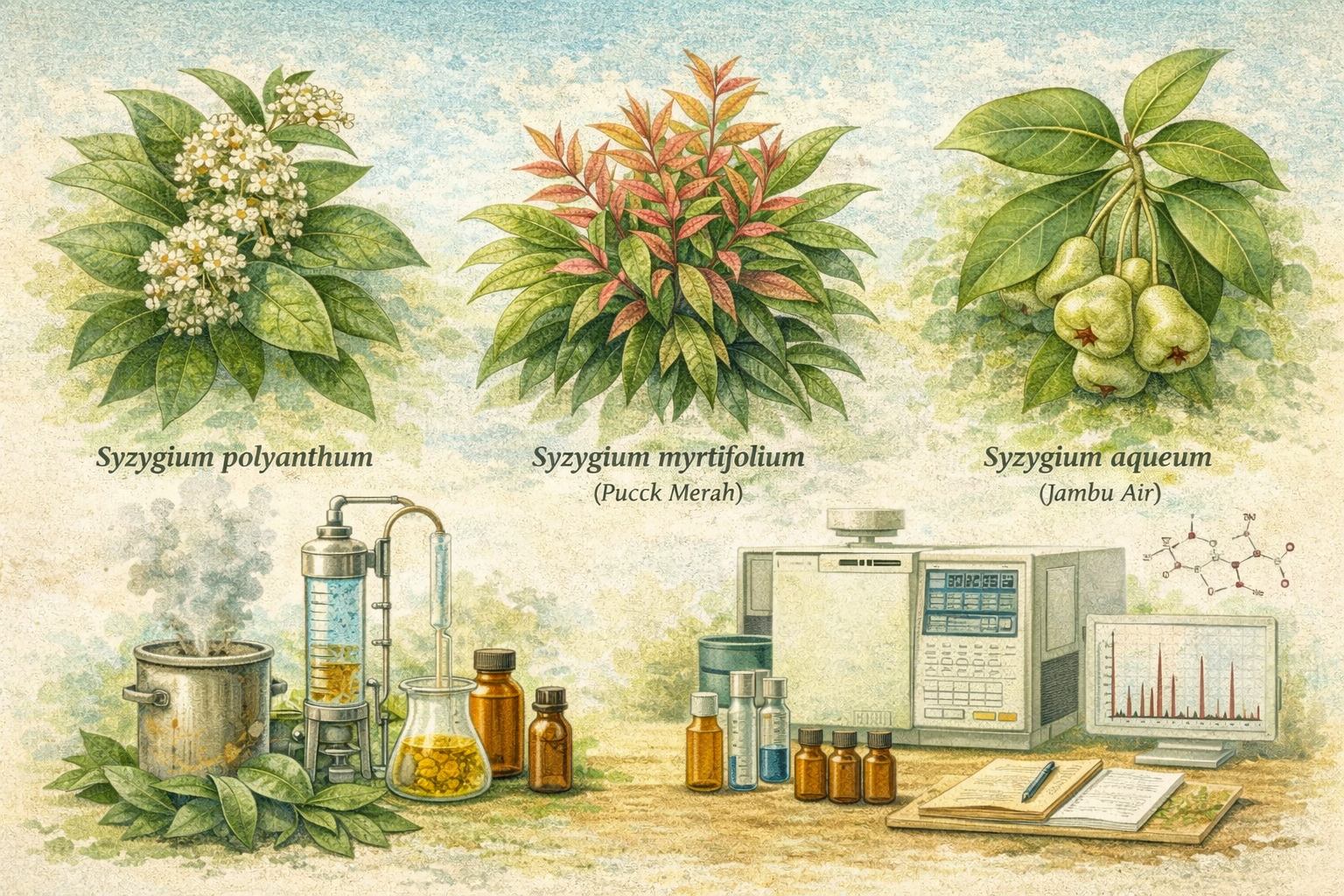
Essential oils are one of the important non-timber forest products (NTFPs), produced by plants as secondary metabolites. Plants of the Myrtaceae family are well known for producing essential oils, and Syzygium is one of its prominent genera. Species from this genus, namely Syzygium polyanthum (Salam), S. myrtifolium (Pucuk Merah), and S. aqueum (Jambu Air) are common plants that are widely cultivated as ornamentals, spices, and fruit-bearing species, and they possess significant potential as sources of essential oils. This study aimed to determine (1) the yield of essential oils from the leaves of three Syzygium species, and (2) to identify the chemical components of the obtained essential oils. The leaves of the three species were distilled using steam and water distillation to extract essential oils. The oil yield was calculated, and its chemical constituents were analyzed with GC-MS. The results showed that the highest essential oil yield was obtained from S. aqueum (0.167%), followed by S. polyanthum (0.080%) and S. myrtifolium (0.061%). The essential oil of S. myrtifolium contained the greatest number of compounds (65), followed by S. aqueum (46 compounds) and S. polyanthum (18 compounds). The main constituents of S. polyanthum essential oil were caryophyllene (40.79% rel.) and humulene (17.61% rel.); S. myrtifolium oil was dominated by 3- carene (20.05% rel.) and caryophyllene (16.45% rel.); while S. aqueum oil was mainly composed of 3- carene (23.58% rel.) and caryophyllene (18.96% rel.). Caryophyllene was identified as one of the principal compounds common to all three Syzygium species.
Article Details

This work is licensed under a Creative Commons Attribution-ShareAlike 4.0 International License.
References
Aidha, N. N., Yunilawati, R., & Rumondang, I. (2019). Method Development for Analysis of Essential Oils Authenticity using Gas Chromatography-Mass Spectrometry (GC-MS). 2nd International Conference of Essential Oils, 41–46. https://doi.org/10.5220/0009956000410046
Aprilia, J. Z., Wisanti, & Putri, E. K. (2021). Kajian Taksonomi Numerik Tiga Jenis Syzygium Berdasarkan Karakter Morfologi. Lentera Bio, 10(1), 40–50. https://journal.unesa.ac.id/index.php/lenterabio/index40
Benddine, H., Zaid, R., Babaali, D., & Daoudi-Hacini, S. (2023). Biological activity of essential oils of Myrtus communis (Myrtaceae, Family) and Foeniculum vulgare (Apiaceae, Family) on open fields conditions against corn aphids Rhopalosiphum maidis (Fitch, 1856) in western Algeria. Journal of the Saudi Society of Agricultural Sciences, 22(2), 78–88. https://doi.org/10.1016/j.jssas.2022.07.001
Bolouri, P., Salami, R., Kouhi, S., Kordi, M., Asgari, B., Hadian, J., & Astatkie, T. (2022). Aplicaciones de aceites esenciales y extractos de plantas en diferentes industrias. Moleculas, 27(24), 1–17.
Choironi, N. A., Sunarto, S., Utami, E. D., & Fareza, M. S. (2023). GC-MS Analysis and Antibacterial Activity of Essential Oils of Five Syzygium Species Leaves. ALCHEMY Jurnal Penelitian Kimia, 19(1), 61. https://doi.org/10.20961/alchemy.19.1.67401.61-67
Dickson, K., Scott, C., White, H., Zhou, J., Kelly, M., & Lehmann, C. (2023). Antibacterial and Analgesic Properties of Beta-Caryophyllene in a Murine Urinary Tract Infection Model. Molecules, 28(10), 1–12. https://doi.org/10.3390/molecules28104144
Fan, S., Chang, J., Zong, Y., Hu, G., & Jia, J. (2018). GC-MS analysis of the composition of the essential oil from Dendranthema indicum Var. Aromaticum using three extraction methods and two columns. Molecules, 23(3), 1. https://doi.org/10.3390/molecules23030576
Francomano, F., Caruso, A., Barbarossa, A., Fazio, A., Torre, C. La, Ceramella, J., Mallamaci, R., Saturnino, C., Iacopetta, D., & Sinicropi, M. S. (2019). β-caryophyllene: A sesquiterpene with countless biological properties. Applied Sciences (Switzerland), 9(24), 1–19. https://doi.org/10.3390/app9245420
Hamad, A., Mahardika, M. G. P., Yuliani, I., & Hartanti, D. (2017). Chemical constituents and antimicrobial activities of essential oils of Syzygium polyanthum and Syzygium aromaticum. Rasayan Journal of Chemistry, 10(2), 564–569. https://doi.org/10.7324/RJC.2017.1021693
Hamidi, Z., Sribudiani, E., & Pramana, A. (2024). Yield and Quality of Red Pucuk Essential Oil Through the Steam Distillation Method. Jurnal Penelitian Hasil Hutan, 42(2), 19–28. https://doi.org/10.55981.jphh.2024.4503
Huong, L. T., Hung, N. H., Linh, N. N., Pham, T. V., Dai, D. N., Hop, N. Q., Setzer, W. N., Son, N. T., Andlauer, W., & Brück, W. M. (2023). Essential Oils of Five Syzygium Species Growing Wild in Vietnam: Chemical Compositions and Antimicrobial and Mosquito Larvicidal Potentials. Molecules, 28(22). https://doi.org/10.3390/molecules28227505
Istiqomah, Harlia, & Jayuska, A. (2020). Karakterisasi Minyak Atsiri Daun Salam (Syzygium polyanthum Wight) Asal Kalimantan Barat Dengan Metode Destilasi Uap. Jurnal Kimia Khatulistiwa, 8(3), 37–44.
Jena, S., Ray, A., Sahoo, A., Das, P. K., Dash, K. T., Kar, S. K., Nayak, S., & Panda, P. C. (2021). Chemical Composition and Biological Activities of Leaf Essential Oil of Syzygium myrtifolium from Eastern India. Journal of Essential Oil-Bearing Plants, 24(3), 582–595. https://doi.org/10.1080/0972060X.2021.1947897
Julizan, N., Ishmayana, S., Zainuddin, A., Van Hung, P., & Kurnia, D. (2023). Potential of Syzygnium polyanthum as Natural Food Preservative: A Review. Foods, 12(12). https://doi.org/10.3390/foods12122275
Kartiko, A. B., Kuspradini, H., & Rosamah, E. (2021). Karakteristik Minyak Atsiri Daun Melaleuca leucadendra L. dari Empat Lokasi yang Berbeda Di Kabupaten Paser Kalimantan Timur. Ulin-J Hut Trop, 5(2), 80–85.
Mohamed, A. A., & Alotaibi, B. M. (2023). Essential oils of some medicinal plants and their biological activities: a mini review. Journal of Umm Al-Qura University for Applied Sciences, 9(1), 40–49. https://doi.org/10.1007/s43994-022-00018-1
Mustapa, M. A., Guswenrivo, I., Zurohtun, A., Khairul Ikram, N. K., & Muchtaridi, M. (2023). Analysis of Essential Oils Components from Aromatic Plants Using Headspace Repellent Method against Aedes aegypti Mosquitoes. Molecules, 28(11). https://doi.org/10.3390/molecules28114269
Pratiwi, R. A., & Nurlaeni, Y. (2021). The potency of myrtaceae family from cibodas botanic gardens (Cianjur, indonesia) as botanical pesticide. Biodiversitas, 22(10), 4648–4664. https://doi.org/10.13057/biodiv/d221058
Setiawansyah, A., & Gemantari, B. M. (2022). Potential Activity of Caryophyllene Derivatives as Xanthine Oxidase Inhibitor: An in silico Quantitative Structure-Activity Relationship Analysis. J.Food Pharm.Sci, 2022(3), 700–708. www.journal.ugm.ac.id/v3/JFPA
Sobeh, M., Braun, M. S., Krstin, S., Youssef, F. S., Ashour, M. L., & Wink, M. (2016). Chemical Profiling of the Essential Oils of Syzygium aqueum, Syzygium samarangense and Eugenia uniflora and Their Discrimination Using Chemometric Analysis. Chemistry and Biodiversity, 13(11), 1537–1550. https://doi.org/10.1002/cbdv.201600089
Suryati, Yenuuar, T. A. A., Fadhia, S. H., Ulia, R. V., Salsabilla, M. M., & Arifin, B. (2023). Komponen Kimia Minyak Atsiri yang Diisolasi dari Daun Tanaman Pucuk Merah (Syzygium myrtifolium Walp.) dan Potensi Antibakteri serta Toksisitasnya. Jurnal Riset Kimia, 14(1), 70–80. https://doi.org/10.25077/jrk.v14i1.583
Udawaty, W., Yusro, F., & Sisillia, L. (2019). Identifikasi Senyawa Kimia Minyak Sereh Wangi Klon G3 (Cymbopogon nardus L.) Dengan Media Tanam Tanah Gambut Dan Potensinya Sebagai Antibakteri Enterococcus faecalis. Jurnal Tengkawang, 9(2), 71–81.
Ueta, I. (2022). Gas Chromatographic Determination of Volatile Compounds. Analytical Sciences, 38(5), 737–738. https://doi.org/10.1007/s44211-022-00108-4
Żukowska, G., & Durczyńska, Z. (2024). Properties and Applications of Essential Oils: A Review. In Journal of Ecological Engineering (Vol. 25, Issue 2, pp. 333–340). Polskie Towarzystwo Inzynierii Ekologicznej (PTIE). https://doi.org/10.12911/22998993/177404


