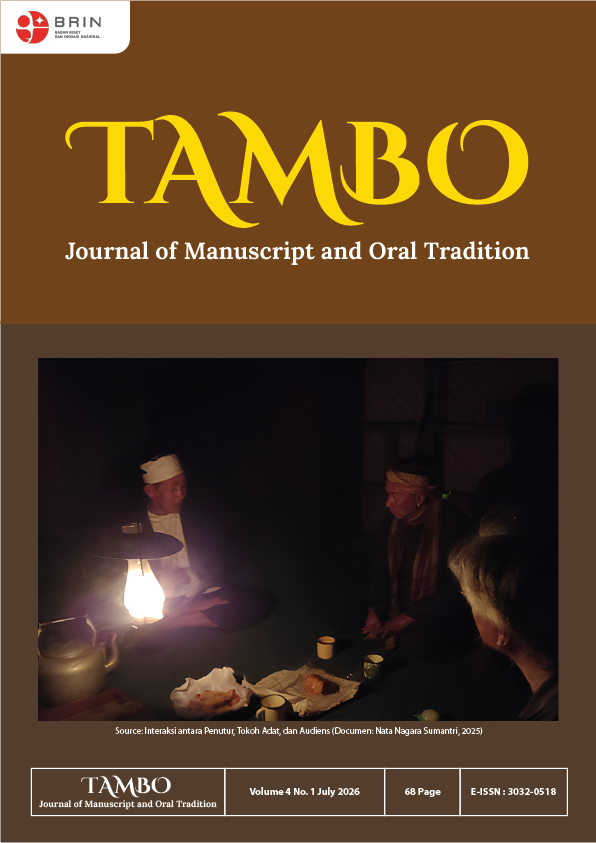
Sunna Hadat: Upacara Perubahan Status Kedewasaan Sosial Masyarakat Muslim Alor Kecil Nusa Tenggara Timur
DOI:
https://doi.org/10.55981/tambo.2026.13624Keywords:
Sunna Hadat, Alor, circumcision ritual, cultural tolerance, social identityAbstract
The practice of male circumcision is celebrated through the Sunna Hadat ritual by a Muslim community living within a predominantly Christian and Catholic society. This article examines Sunna Hadat as an oral tradition and a mechanism of social reproduction, as well as the dynamics of interreligious tolerance surrounding its enactment. As an oral tradition, Sunna Hadat incorporates mantras, prayers, and customary chants transmitted genealogically through customary institutions and performed by elders, religious leaders, and the nuclear family. While its narrative structure remains relatively stable, variations in diction and symbolic emphasis occur across generations. Transformations are evident in linguistic adjustments, ritual duration, and the stronger integration of formal Islamic elements compared to earlier practices. Using a cultural studies approach, particularly the theory of representation developed by Stuart Hall and the concept of rites of passage introduced by Arnold van Gennep, this study demonstrates that Sunna Hadat affirms social transition and reflects ongoing identity negotiation in a multireligious context.
References
Althus, F. A. (1997). Female circumcision: Rite of Passage or Violation of Rights? International Family Planning Perspectives, 23(3), 130–133. Guttmacher Institute.
Alam, L., Setiawan, B., Harimurti, S. M., Miftahulhaq, M., & Alam, M. (2023). The changing piety and spirituality: A new trend of Islamic urbanism in Yogyakarta and Surakarta. Indonesian Journal of Islam and Muslim Societies, 13(1), 227–252.
Bohannan, P. (1954). Circumcision among the Tiv. Man, 54, 2–6.
Beidelman, T. O. (1997). The Cool Knife: Imagery of Gender, Sexuality, and Moral Education in Kaguru Initiation Ritual. Washington, DC: Smithsonian Institution Press.
Barnes, R. H. (1982). The Majapahit Dependency Galiyao. Bijdragen tot de Taal-, Land- en Volkenkunde, 138(1), 1–25.
Bailey, R. C., Muga, R., Poulussen, R., & Abicht, H. (2002). The Acceptability of Male Circumcision to Reduce HIV Infections in Nyanza Province, Kenya. AIDS Care, 14(1), 27–40.
Bognár, B. (2024). Hybrid social spaces and the individualisation of religious experience in the global north. Religions, 15(2), 241.
Basri, R. & Kashim, A. (2024). Female Circumcision in Bugis-Makassar Society of South Sulawesi: Between Cultural Symbolism and Islamic Law. Samārah: Journal of Gender, Culture and Religion. 8(3), 1503—1025.
Christensen, D. R., & Sumiala, J. (2024). Digital death: Transforming rituals, history, and the afterlife. Social Sciences, 13(7), 346. https://doi.org/10.3390/socsci13070346
Dellenborg, L. (2007). Multiple meanings of female initiation: “Circumcision” among Jola women in Lower Casamance, Senegal (Doctoral dissertation, Göteborg University, Department of Social Anthropology, School of Global Studies). Göteborg University.
DeLaet, D. L. (2009). Framing Male Circumcision as a Human Rights Issue? Contributions to the Debate Over the Universality of Human Rights. Journal of Human Rights, 8(4), 405–426. https://doi.org/10.1080/14754830903324795 Gluckman, M. (1949). The Role of The Sexes in Wiko Circumcision Ceremonies. In M. Fortes (Ed.), Social structure: Studies presented to A. R. Radcliffe-Brown (pp. 145–167). Oxford: Clarendon Press.
Ifire, B. W., Omare, S., & Njure, S. (2024). The Moral and Normative Foundation of Idumi Circumcision Ritual among the Tiriki of Hamisi Sub-County. 2(2), 1—9.
Koentjaraningrat. (1993). Masalah Kesukubangsaan dan Integrasi Nasional. Jakarta: Gramedia Pustaka Utama.
Karicha, J. M., Wanjiku, M. N., & Otieno, S. (2023). An examination of the spiritual and moral importance of contemporary male circumcision ritual among the Ameru in Kenya. East African Research and Technology Journal. 9(12), 582 - 592
Kasim, A. dkk. (2024). Tradition or Religion? Unpacking Female Circumcision in Bugis-Makassar Culture and Islamic Law. Al-Risalah Journal. 24(1), 1—15.
Langaji, A., & Umar, R. (2024). The practice of female circumcision in Palopo City between religious and cultural teachings: A study of the living hadith perspective. IDEAS: Journal on English Language Teaching and Learning, Linguistics and Literature, 11(2), 1926-1934
Masinde, M. K. L. (2024). Tachoni male circumcision rituals: Navigating cultural revitalization, heritage and identity through lexico-semantic analysis. Journal of Kenyan Cultural Studies. 4(2), 1—15.
Mehta, Deepak. (1996). Circumcision, body and community. Contributions to Indian Sociology. Volume 30, Issue 2. https://doi.org/10.1177/006996679603000202
Mundzir, A., Rahman, F., & Ilham, M. (2025). Female circumcision: Between sharia legal evidence and government regulations. Istinbath: International Journal of Hadith Interpretation, 24(1), 97—109.
Ndawule, Luvuyo (2025). Balancing Tradition and Modernity: Examining Knowledge Transmission in Male Circumcision Practices. International Journal of Research and Innovation in Social Science (IJRISS). IX(IV), 248—252.
Ong, W. J. (1982). Orality and Literacy. New Haven: Yale University Press.
Ohaja, M., & Anyim, C. (2021). Rituals and embodied cultural practices at the beginning of life: African perspectives. Religions, 12(11), 1024. https://doi.org/10.3390/rel12111024
Qodim, H., & Darwis, R. (2022). Pluralisme dan kerukunan umat beragama di Kabupaten Alor Nusa Tenggara Timur perspektif maqashid al-ummah. Farabi, 19(2), 132–153.
Rambe, S., & Iwan. (2024). Balancing tradition and public health: The Al-Shafi’i perspective on female circumcision in light of PP No. 28/2024 and MUI Fatwa No. 9A/2008. Al-Risalah: Jurnal Ilmu Syariah dan Hukum, 24(2), 209—223.
Reifsnider, M. (2025). Identity, Ritual, and Community: Circumcision Practices among Muslim Diaspora in Northern Europe. International Journal of Ethnographic Cultural Studies. 10(4), 187—198.
Schroeder, R. (2022). Male circumcision and social identity formation in South Africa: Ritual, community, and transition to adulthood. African Studies Quarterly, 21(2), 45–63.
Schroeder, E. (2022). The impact of adolescent initiation rites in East and Southern Africa: Implications for policies and practices. Youth & Society. 27(1), 181—192
Silverman, Eric K. (2004). Anthropology and Circumcision. Annual Review Anthropology. 33:419-445. https://doi.org/10.1146/annurev.anthro.33.070203.143706
Spencer, P. (1965). The Samburu: A Study of Gerontocracy in A Nomadic Tribe. London: Routledge & Kegan Paul.
Sulistyono, Y., Rahmawati, L. E., Biat, I. T., Febrianti, R., Zafar, M., & Aprilyana, N. (2024). The perception of ancestral history, legends, and myths of the Alorese Muslim minority group in East Nusa Tenggara, Indonesia. IBDA: Jurnal Kajian Islam dan Budaya, 22(2), 235–256.
Van Gennep, A. (1960 [1909]). The rites of passage (M. B. Vizedom & G. L. Caffee, Trans.). Chicago: University of Chicago Press.
Vansina, J. (2014). Tradisi Lisan sebagai Sejarah (Terjemahan). Yogyakarta: Ombak.
Wanamngxa, A. N. N. (1971). The Function of Circumcision Among Xhosa-Speaking Tribes in Historical Perspective. In E. J. De Jager (Ed.), Man: Anthropological essays presented to O. F. Raum (pp. 183–204). Cape Town: C. Struik.
Wanyama, Mellitus & Egesah, Umar. (2015). Ethnography and Ethno-music of Babukusu Traditional Male Circumcision; Messaging, Symbolism and Rationale. Sociology and Anthropology, 3(1), 6 - 18. DOI: 10.13189/sa.2015.030102.
Yessekeyeva, E., & Venbrux, E. (2021). Ritual, ritualization, and religion in the work of Kazakhstani artist Anvar Musrepov. Religions, 12(10), 892.
Yang, V. L. Y. (2024). Building communities through rituals: Glimpses into the life of Chinese Christian communities in the 17th century. Religions, 15(4), 444.
Downloads
Published
How to Cite
Issue
Section
License
Copyright (c) 2026 Tambo: Journal of Manuscript and Oral Tradition

This work is licensed under a Creative Commons Attribution-NonCommercial-ShareAlike 4.0 International License.